Blog

  • Long Weekends 2027 from Chandigarh: Every Leave-Day You Should Actually Use

    Long Weekends 2027 from Chandigarh: Every Leave-Day You Should Actually Use

    Most long-weekend calendars are written for a generic Indian reader and then copy-pasted across a hundred travel blogs with the same eleven dates. They also all miss something that matters a lot if you live in Chandigarh, Mohali, or anywhere in Punjab: Lohri, Maghi, and Baisakhi are not footnotes here, they are three of the biggest dates on the calendar, and in 2027 they line up with the national holiday calendar in a way worth planning around months in advance. This is the version of that calendar built for this region specifically, ranked not by month but by something more useful, how many days off each one actually delivers per leave day you spend.

    We build this kind of calendar every year for our own trip planning as much as for clients, because the difference between a good long weekend and a great one usually comes down to noticing the pattern early rather than reacting to it in the last two weeks before the holiday. A festival that lands on a Tuesday is a completely different travel opportunity than the same festival landing on a Sunday, and most calendars people glance at on their phone do not make that distinction obvious. This one does, and it is built specifically around a Chandigarh departure point, so every recommendation below assumes you are flying or driving out of this region rather than starting from Delhi or Mumbai.

    Quick context: 2027’s standout is not Diwali or Christmas, it is a five-day April cluster around Baisakhi that most national calendars will not flag properly because they treat it as a single-day regional holiday. Full breakdown below.

    Why Weekday Placement Decides Everything

    The single biggest variable in any long-weekend calendar is not which festivals fall in a given year, those are fixed regardless, it is which day of the week they land on. A holiday on a Tuesday or Thursday, sitting one day away from the weekend, is worth far more than the same holiday on a Sunday, because it turns a single leave-day application into a multi-day break. A holiday that lands on Saturday or Sunday outright, meanwhile, effectively vanishes into the normal weekend and delivers nothing extra. 2027 happens to be a strong year for Chandigarh specifically because several of its biggest regional festivals, Baisakhi, Lohri, and Maghi among them, land on exactly the right side of the week. That is the entire mechanic behind the ranking below.

    Ranked by Leave-Day ROI

    Instead of listing holidays in calendar order, we are ranking them by return on investment, meaning how many consecutive days off you get for how many actual leave days you spend from your annual quota. A three-day weekend that needs zero leave is a better deal than a four-day weekend that costs you two.

    Rank Occasion Dates Leave Days Needed Total Days Off
    1 Baisakhi + Rama Navami + Mahavir Jayanti cluster Wed Apr 14 to Mon Apr 19, 2027 1 (Friday Apr 16) 6 days
    2 Lohri + Maghi Wed Jan 13 to Sun Jan 17, 2027 1 (Friday Jan 15) 5 days
    3 Republic Day Sat Jan 23 to Tue Jan 26, 2027 1 (Monday Jan 25) 4 days
    4 Holi Sat Mar 20 to Mon Mar 22, 2027 0 3 days
    5 Diwali Fri Oct 29 to Sun Oct 31, 2027 0 3 days

    The gap between rank one and everything else is the real story of 2027. One Friday of leave in April turns into six consecutive days off, which is a genuinely rare alignment and worth blocking on your calendar now, before your team’s leave calendar fills up around it.

    The April Cluster, in Detail

    This is the one every generic calendar site will undersell, because they list Baisakhi, Rama Navami, and Mahavir Jayanti as three separate minor entries instead of noticing they land back to back.

    • Saturday and Sunday, April 10 and 11: Your normal weekend, the calm before the run starts.
    • Wednesday, April 14: Baisakhi, the Punjab harvest festival and the anniversary of the founding of the Khalsa, a full public holiday.
    • Thursday, April 15: Rama Navami, also a public holiday.
    • Friday, April 16: A working day, and the single leave application that unlocks the whole stretch.
    • Saturday and Sunday, April 17 and 18: Weekend, no leave required.
    • Monday, April 19: Mahavir Jayanti, another public holiday, closing out the run.

    That is six consecutive days off, Wednesday to Monday, for the cost of a single Friday’s leave. We are flagging this early, in August 2026, specifically because a stretch this good gets requested by half your office the moment people notice it, and flight and hotel prices for late April 2027 will move accordingly as that happens. Booking early on this one is not just convenient, it is meaningfully cheaper than waiting.
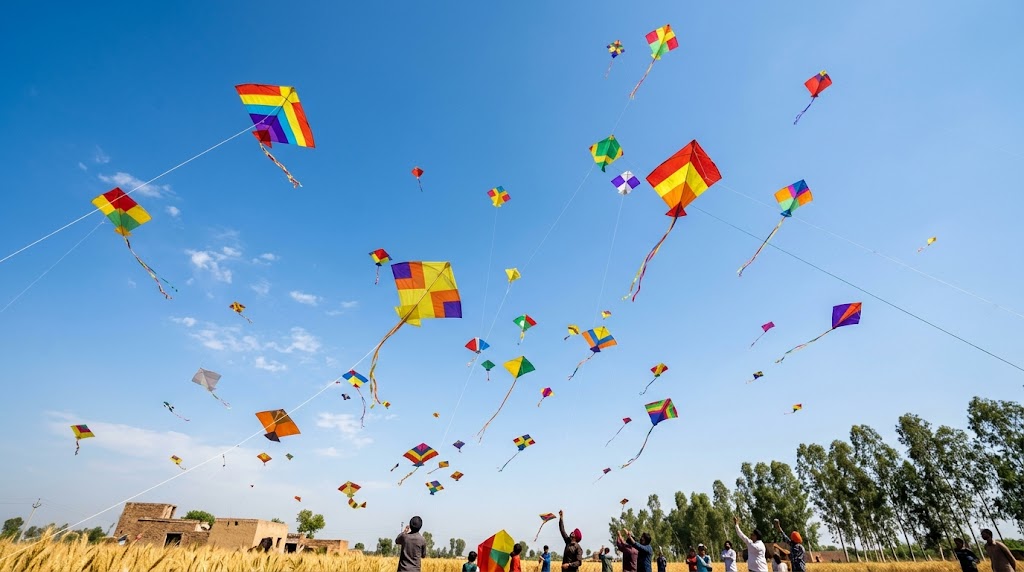
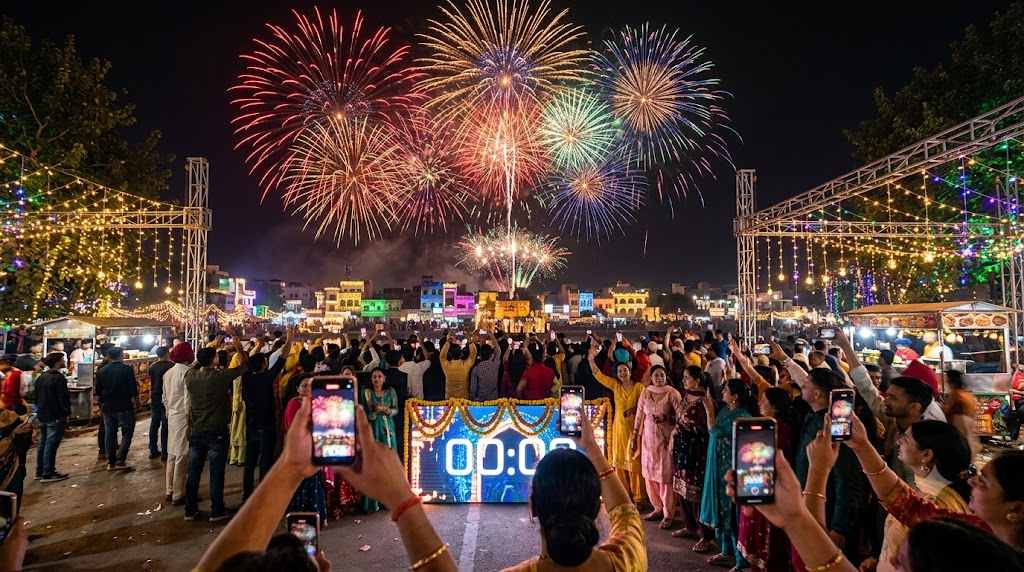
    Kite flying against a clear blue sky during Baisakhi harvest festival in Punjab
    Baisakhi marks the start of the harvest season in Punjab and anchors the biggest long weekend on the 2027 calendar

    January: Two Long Weekends, Thirteen Days Apart

    January 2027 is unusually generous for a month that normally just means post-New-Year routine. Two separate long weekends sit less than two weeks apart.

    Lohri and Maghi (January 13 to 17)

    Lohri falls on Wednesday, January 13, and Maghi follows immediately on Thursday, January 14. Apply a single day of leave on Friday, January 15, and the run extends straight through the weekend to Sunday, January 17, five days off in total. This is a distinctly Punjab-flavoured long weekend that national calendars tend to compress into a single generic entry, when in practice it is two consecutive regional holidays that happen to land midweek.

    Republic Day (January 23 to 26)

    Republic Day itself falls on Tuesday, January 26. Take Monday, January 25, as leave and the weekend before it, Saturday and Sunday the 23rd and 24th, rolls straight into the holiday for a four-day break. Coming so soon after the Lohri-Maghi stretch, this is a good one to combine into a single longer leave block if your workplace allows it, rather than two separate short trips.

    The Reliable Middle: Holi and Diwali

    Two of the year’s biggest festivals fall in genuinely useful spots on the calendar without needing any leave at all.

    • Holi, Monday, March 22: Paired with the preceding Saturday and Sunday for a clean three-day weekend, zero leave required. Domestic hill destinations and Rajasthan see a real spike in bookings around this window, so early booking still pays off even though the dates themselves need no leave application.
    • Diwali, Friday, October 29: A Friday holiday is about as good as Diwali’s calendar placement gets, rolling straight into the weekend for three days off with zero leave needed. See our full Diwali travel planning guide for how far ahead to book flights around this window generally, since the booking-window logic holds regardless of year.

    The Ones That Do Not Help This Year

    Not every major holiday creates a long weekend, and 2027 has a few that land awkwardly. Worth knowing so you are not caught planning around a bonus day that does not exist.

    Occasion 2027 Date Why It Does Not Extend
    Independence Day Sunday, August 15 Falls on a Sunday, effectively absorbed into the normal weekend with no extra day gained
    Gandhi Jayanti Saturday, October 2 Falls on a Saturday, similarly absorbed rather than adding a bonus day
    Guru Nanak Jayanti Sunday, November 14 Falls on a Sunday nationally; many Punjab workplaces do informally shift a compensatory day for Gurpurab, but confirm with your specific employer rather than assuming

    If your workplace does grant a compensatory day for any of these three, treat it as a pleasant surprise rather than something to book flights against months in advance.

    Which Trip Fits Which Weekend

    The length of the break should decide the destination, not the other way round. Here is how we would map 2027’s windows against the kind of trips people actually ask us for.

    Window Days Off Suits
    Lohri-Maghi (Jan 13-17) 5 days A proper hill escape while the plains are cold, our Kashmir winter package or a Spiti Valley snow run for the more adventurous
    Republic Day (Jan 23-26) 4 days An international short-haul, Dubai or a Gulf destination fits comfortably within four days including flight time
    Holi (Mar 20-22) 3 days A closer domestic circuit or a weekend getaway from Chandigarh destination, since three days leaves limited room for a long connecting flight
    Baisakhi cluster (Apr 14-19) 6 days The one window genuinely long enough for Andaman, the Northeast, or a proper Southeast Asia trip like Bali or Singapore without feeling rushed
    Diwali (Oct 29-31) 3 days A festive domestic trip closer to home, or simply staying local since Diwali itself is often a family occasion rather than a travel one

    The Baisakhi cluster is worth repeating here: six days is genuinely enough runway for a destination that needs a connecting flight or a visa, in a way three-day weekends are not. If an Andaman or a Southeast Asia trip has been sitting on your list, this is the 2027 window built for it.

    Is 2027 Better or Worse Than 2026 for Long Weekends

    Worth a quick honest comparison since people planning ahead often ask this. 2026’s long weekend calendar leaned more heavily on Diwali and the Christmas-New Year corridor, both of which fell on strong weekday placements that year. 2027 is different in shape rather than better or worse overall, it trades a slightly quieter festive-season calendar for the standout April cluster, which has no real equivalent in 2026. If your travel habit leans toward the big festive corridor, 2026 was the stronger year. If it leans toward a proper multi-day break at a time of year with genuinely pleasant weather across most of India, 2027’s April stretch is arguably the better one to plan around.

    A Note on How These Dates Were Checked

    Public holiday dates for festivals tied to lunar or solar calendars, Holi, Baisakhi, Rama Navami, Mahavir Jayanti among them, are calculated well in advance and are reliable, but official state government notifications for the exact list of gazetted holidays are typically only published toward the end of the preceding year. The dates above are drawn from established calendar-date calculations and cross-checked against multiple sources current as of August 2026. We would recommend a final cross-check against your specific employer’s official 2027 holiday circular once it is issued, particularly for compensatory or restricted holidays, before finalising non-refundable bookings.

    Planning Around Notice Periods

    The math in this calendar only works if the leave actually gets approved, and the single biggest reason a good long weekend plan falls apart is applying for leave too late. A few practical notes from years of watching this play out for our clients:

    • The April cluster will be the most contested leave request of the year. If your workplace runs on a first-come basis for popular dates, apply the moment your leave calendar opens for 2027, not closer to the date.
    • Coordinate with your travel companions’ leave approval before booking anything non-refundable. A flight booked before a spouse’s or friend’s leave is confirmed is a common and entirely avoidable source of stress.
    • Build a one-day buffer into international itineraries during the April window specifically, since it falls right at the edge of several destinations’ seasonal weather shifts, and a delayed connection eating into a six-day trip hurts more than it would on a longer holiday.

    How to Actually Use This Calendar

    1. Apply for the April 14 to 19 leave now, or as soon as your organisation opens leave requests for that period. This is the stretch competition will be highest for, both at your workplace and for flight seats.
    2. Decide destination by trip length, not the other way round. A 6-day April window suits an Andaman or a Northeast trip; a 3-day Holi or Diwali weekend suits a closer hill station or a Rajasthan circuit.
    3. Book flights 6 to 8 weeks ahead for the 3-day weekends, and 10 to 12 weeks ahead for the April cluster, since that stretch will see the sharpest price climb as more people notice it over the coming months.
    4. Cross-check your specific employer’s holiday list, since Punjab state government offices, private companies, and banks do not always observe identical dates, particularly around Gurpurab and regional observances.

    A Tricity Wrinkle: Three Holiday Lists, One Calendar

    Chandigarh itself is a Union Territory with its own gazetted holiday list, while Mohali sits in Punjab and Panchkula sits in Haryana, and the three do not always match exactly. Most of the dates in this guide, the national holidays and the major Sikh and Punjabi festivals, are observed consistently across all three. Where it gets inconsistent is around smaller restricted or optional holidays, regional observances that some state governments gazette and others leave as a “restricted” choice for employees to pick from a list rather than a fixed day off.

    If you work for a Punjab or Haryana state government office, a bank, or a large organisation with a formal holiday circular, it is worth checking whether Lohri, Maghi, or Guru Gobind Singh Jayanti sit on your specific employer’s fixed list or their restricted-holiday list, since a restricted holiday still needs to be actively chosen and applied for rather than being an automatic day off. This is a small detail, but it is exactly the kind of thing that quietly breaks a long-weekend plan for someone who assumed a date was fixed when it was actually optional.

    Why We Are Publishing This in August 2026

    A calendar for a year that has not started yet might seem premature to publish in August, but that is deliberate. Search interest in “2027 long weekend” style queries typically stays low through most of 2026 and then climbs sharply from around November onward, once people start setting their annual leave plans for the coming year. Publishing now means this guide is already indexed, already answering the question, by the time that search volume actually arrives. It is the same logic behind publishing Diwali and Christmas-New Year planning content months ahead of the season rather than the week before, the content needs lead time to be found, and travellers who plan early get better flight and hotel availability regardless of which destination they choose.

    Frequently Asked Questions

    What is the best long weekend of 2027 for travel?

    The Baisakhi to Mahavir Jayanti cluster, April 14 to 19, is the standout. It delivers six consecutive days off for a single day of leave, the best ratio anywhere on the 2027 calendar.

    Is Republic Day 2027 a long weekend?

    Yes, with one day of leave. Republic Day falls on Tuesday, January 26, so taking Monday the 25th off connects it to the preceding weekend for four consecutive days.

    Do Lohri and Maghi both count as public holidays?

    In Punjab, yes, both are observed as regional public holidays, falling on Wednesday, January 13, and Thursday, January 14, in 2027 respectively.

    Why does this calendar differ from generic national long-weekend lists?

    Most national calendars either skip Punjab-specific festivals like Lohri, Maghi, and Baisakhi entirely or list them as single isolated dates without noticing how they cluster with national holidays like Rama Navami and Mahavir Jayanti in 2027 specifically.

    Should I book flights now for an April 2027 trip?

    Not this early, but you should apply for the leave now. Flight prices for domestic and international routes typically firm up meaningfully 10 to 12 weeks out, so booking in late January or early February 2027 is the practical window, while the leave application itself is worth locking in as soon as possible.

    Are Lohri and Maghi guaranteed holidays for everyone in the Tricity?

    Not automatically for everyone. They are standard gazetted holidays for most Punjab-based organisations, but some employers, particularly in Chandigarh’s Union Territory administration or multinational offices, list them as restricted or optional holidays instead. Check your specific employer’s official circular rather than assuming.

    What if my employer’s holiday list does not match these dates exactly?

    That is expected and common, since Chandigarh, Punjab, and Haryana each issue their own gazetted holiday notifications, and private employers often follow a modified version of one of these lists. Treat this guide as the national and Punjab-regional baseline, then cross-check the specific dates against your own workplace circular once it is released, typically toward the end of the preceding year.

    Quick Reference: Save This Before You Forget

    If you only take one thing from this guide, take this list. Five dates, five leave decisions, worth pinning somewhere you will actually see again in a few months.

    • January 13-17: Lohri and Maghi, apply for Friday Jan 15 off, five days total
    • January 23-26: Republic Day, apply for Monday Jan 25 off, four days total
    • March 20-22: Holi, no leave needed, three days total
    • April 14-19: Baisakhi cluster, apply for Friday Apr 16 off, six days total, the year’s best window
    • October 29-31: Diwali, no leave needed, three days total

    Set a reminder for whenever your organisation opens leave applications for 2027 and apply for the April dates first. Everything else on this list is close to guaranteed once the calendar turns; the April cluster is the one where being early actually changes the outcome.

    Get the Trip Sorted Before the Leave Fills Up

    A long weekend this good only stays a good deal if you plan it before everyone else in your office notices the same dates. We build trip plans around exactly these windows every year, matching destination to the number of days actually available rather than fitting a generic package into whatever dates are left. Browse our India tour packages from Chandigarh or our international packages for ideas suited to a 3-day versus a 6-day window, or call us directly at +91 99143 10333 and we will help you match the right trip to the right leave-day math. Flywings team since 2005.


  • Andaman Islands Package from Chandigarh: How Many Days Do You Actually Need

    Andaman Islands Package from Chandigarh: How Many Days Do You Actually Need

    The question we get asked most about Andaman is not “should we go,” it is “how many days do we actually need.” That is a fair question, because unlike a Dubai or Bangkok trip where four days is comfortable and six is generous, Andaman has a built-in time cost before the holiday even starts. There is no direct flight from Chandigarh, the islands themselves are separated by ferry crossings, and the weather half the year makes the whole trip a bad idea. This guide is built around that one decision, how many days to block on the calendar, because getting it wrong is the single most common reason people come back from Andaman saying it felt rushed.

    Quick context: Indian citizens do not need any special permit to visit Port Blair, Havelock, or Neil Island, just a valid photo ID. The permit confusion you have probably read about online applies to foreign nationals and to restricted tribal areas, not to a standard Indian tourist’s itinerary. More on this below, because it is worth clearing up properly.

    Why Trip Length Is the Real Planning Question

    Every other packaged destination we write about, Dubai, Bali, Singapore, is reachable in one flight leg or close to it, so the “how many days” question is mostly about budget and appetite. Andaman is different for two structural reasons.

    • There is no non-stop flight from Chandigarh to Port Blair. Every itinerary connects through a hub city, and the connection itself eats the better part of a travel day in each direction.
    • The islands are not one place. Port Blair, Havelock (officially Swaraj Dweep), and Neil (officially Shaheed Dweep) are separate islands linked by ferry, and each one earns its own day or two rather than being a stop on a single loop.

    Add those two facts together and a 4-day Andaman trip and a 9-day Andaman trip are genuinely different holidays, not the same holiday compressed or stretched. Picking the wrong one is where the disappointment comes from, not the destination itself.

    Getting There: What “From Chandigarh” Actually Means

    There is no direct Chandigarh to Port Blair flight, and there is unlikely to be one anytime soon given the route economics. Every itinerary out of Chandigarh routes through one of three hub cities, and which one you connect through changes your travel day meaningfully.

    Hub Route Typical Frequency What to Know
    Via Chennai (MAA) Most frequent, roughly 5 to 6 Chennai-Port Blair flights daily The most reliable connection with the most schedule flexibility if your first leg runs late
    Via Kolkata (CCU) Moderate, roughly 2 to 3 daily onward flights Often the shortest total distance flown, useful if your Chandigarh-Kolkata leg has good timing
    Via Delhi (DEL) Frequent Chandigarh-Delhi hop, then a connecting flight to Port Blair from Delhi Easiest first leg since Chandigarh-Delhi flights run constantly, but check the layover window carefully

    Total journey time typically runs five to seven hours of flying plus a one to two hour layover, so realistically the entire first day and the entire last day of any Andaman trip are travel days, not island days. This is the single biggest planning mistake we see: people count arrival day and departure day as beach days when booking, then feel short-changed once the trip is underway. Build your itinerary length around the days you will actually have on the sand, not the total nights booked.

    Permits: What Is True and What Is Outdated Internet Advice

    This is worth its own section because so much of what circulates online about Andaman permits is either outdated or was never true for Indian citizens in the first place.

    Traveller Type What They Actually Need
    Indian citizens visiting Port Blair, Havelock, Neil, Ross Island, North Bay No special permit. A valid government photo ID (Aadhaar or equivalent) is sufficient, the same as any domestic trip.
    Foreign nationals visiting the standard tourist circuit A Restricted Area Permit (RAP), typically issued on arrival or online, valid for around 30 days
    Anyone wanting to visit tribal reserve areas (home to the Jarawa, Sentinelese, Onge, or Great Andamanese communities) Not permitted for casual tourism at all. These areas are protected and regulated by the Andaman & Nicobar Administration, and responsible operators will not offer or encourage this.

    If an itinerary, forum post, or travel group message is telling you that you as an Indian tourist need a special Andaman permit for Port Blair or Havelock, that information is wrong or badly outdated. Carry your ID, book your ferry tickets in advance during peak season, and that is the extent of the paperwork.

    Pick Your Trip Length

    These are the three shapes an Andaman trip realistically takes. None of them is the “correct” one, they suit different travellers and different amounts of leave.

    4 Days: The Long Weekend Dash

    This works if Andaman is a long-weekend add-on rather than a main annual trip. It only covers Port Blair and one island, usually Havelock, and it moves fast.

    • Day 1: Arrive Port Blair, afternoon at Corbyn’s Cove or a relaxed evening, Cellular Jail light and sound show
    • Day 2: Morning ferry to Havelock, check in, Radhanagar Beach for sunset
    • Day 3: Full day on Havelock, snorkelling or a glass-bottom boat trip at Elephant Beach
    • Day 4: Morning ferry back to Port Blair, departure

    The honest trade-off: you will see genuinely beautiful water and come home tired, because two of your four days are travel-adjacent. This length works for a couple squeezing in a trip around a long weekend, not for a first Andaman visit if you want it to feel unhurried.

    6 Days: The Standard Trip

    This is the itinerary most first-time Andaman visitors should book, and it is what most travel agents mean by default when they say “Andaman package.”

    • Day 1: Arrive Port Blair, settle in, Cellular Jail visit
    • Day 2: Ferry to Havelock, afternoon at Radhanagar Beach
    • Day 3: Havelock water activities day, snorkelling, scuba trial dive, or Elephant Beach
    • Day 4: Ferry to Neil Island, Natural Bridge and Laxmanpur Beach at sunset
    • Day 5: Morning on Neil, afternoon ferry back to Port Blair, North Bay or Ross Island (Netaji Subhas Chandra Bose Dweep) if time allows
    • Day 6: Departure

    This length gets you all three main islands without feeling like a checklist, and it leaves enough slack that a delayed ferry or a rained-out afternoon does not collapse the whole trip. If you are asking us for a default recommendation, this is it.

    9 Days: The Deep Dive

    Worth it for honeymooners, divers, or anyone who considers a beach holiday genuinely wasted if it is not unhurried. This length adds real diving time, a slower pace on each island, and room for weather buffer days, which matter more in Andaman than most destinations since ferries do get cancelled in rough seas.

    • Extra nights on Havelock for certified diving courses (multi-day certifications need the extra time)
    • A buffer day built in specifically to absorb a ferry cancellation without losing a paid night elsewhere
    • Time for Baratang Island’s limestone caves and mangrove creek, a full-day excursion most 6-day itineraries skip entirely
    • A slower Neil Island stretch, which rewards unhurried mornings more than any other island in the group

    When to Go, and When Genuinely Not To

    This is one destination where the off-season is not a minor discount trade-off, it materially changes what the trip looks like.

    Window Conditions Verdict
    October to May Calm seas, clear water, reliable ferries, 24 to 32 degrees C The full window works well; peak clarity for snorkelling is typically December to April
    November to February Coolest, calmest, most romantic Best for honeymoons specifically
    December to March Most predictable weather, gentlest seas Best for families with young children or first-time snorkellers
    June to September Southwest monsoon, heavy rain, rough seas Avoid. Ferries between islands get suspended without much notice, and water sports operators shut down for days at a stretch

    We will say this plainly because most listing sites will not: if someone offers you a heavily discounted Andaman package for July or August, understand exactly what you are trading for that price. It is not a quieter version of the same trip, it is a trip where a genuine chance exists that your inter-island ferry gets cancelled and half your itinerary has to be rebuilt on the fly.

    What a Package Should Actually Include

    Because Andaman involves inter-island movement in a way most domestic trips do not, the line items that matter are slightly different from a standard hill-station or beach package elsewhere in India.

    • Confirmed ferry tickets between islands, booked in advance for your specific dates, not “arranged on arrival.” Peak season ferries sell out.
    • Hotel transfers on each island separately, since Port Blair, Havelock, and Neil each need their own local transport, this is not one continuous road trip.
    • Clarity on which activities are included versus optional add-ons, particularly scuba diving and the North Bay/Ross Island boat circuit, which are commonly quoted separately.
    • A realistic buffer day if you are travelling October to May at the shoulder edges, since even calm-season ferries occasionally get rescheduled for tide and weather reasons.

    We do not publish fixed package prices here, because an Andaman itinerary genuinely changes cost depending on trip length, hotel category on each island, and whether diving certification is involved. What we can tell you honestly: a well-built 6-day itinerary with confirmed ferries and mid-range hotels on all three islands tends to run noticeably less than people expect once they compare it against an equivalent international beach trip, largely because there is no international airfare or visa cost involved. Reach out and we will put together a real, itemised quote for your dates within 24 hours, no obligation.

    Passenger ferry crossing calm blue water between Port Blair and Havelock Island Andaman
    The Port Blair to Havelock ferry crossing, one of several inter-island legs an Andaman itinerary needs to plan around

    What Each Island Is Actually Known For

    A common mistake we see in self-planned itineraries is treating Port Blair, Havelock, and Neil as interchangeable beach stops. They are not, and knowing what each one is genuinely good for helps you decide how many nights to give each one.

    Port Blair: History, Not Beaches

    Port Blair is where you land, and most visitors treat it purely as a transit point, which undersells it. The Cellular Jail, built by the British and used to imprison Indian freedom fighters, runs a light and sound show in the evening that is genuinely moving rather than a tourist formality. Corbyn’s Cove offers a passable beach for an afternoon, but the real reason to give Port Blair a proper day rather than rushing through is the history, the Anthropological Museum, and the Samudrika Naval Marine Museum if you have an extra half day.

    Havelock (Swaraj Dweep): The Water Activities Hub

    Havelock is where most of the postcard Andaman photos come from, and it earns that reputation. Radhanagar Beach was rated among Asia’s best beaches by international travel media for good reason, wide white sand, clean turquoise water, and a sunset that does not need filters. This is also the island for anyone wanting scuba diving, whether a one-time trial dive or a full PADI or SSI certification course, since most of the certified dive schools operate here rather than on Neil or in Port Blair. Elephant Beach, reachable by a short boat ride or a jungle trek, is the go-to for snorkelling and glass-bottom boat rides.

    Neil (Shaheed Dweep): The Slow Island

    Neil is smaller, quieter, and deliberately less developed than Havelock, which is exactly its appeal. The Natural Bridge, a limestone rock formation exposed at low tide, and Laxmanpur Beach’s sunset are the two fixed points most itineraries build around, but the real value of Neil is the pace. It is the island to give an unhurried morning to rather than pack with activities, and honeymooners in particular tend to rate it as the highlight of the trip precisely because there is less to do, not more.

    Cost Shape, Without Fixed Numbers

    We are deliberately not publishing fixed price tags here since Andaman cost varies a lot by season, hotel category, and whether diving certification is involved, and a number posted in August 2026 will be stale within months anyway. What we can tell you honestly, in relative terms, is how the budget stacks up.

    Trip Style Where the Money Goes Who It Suits
    Budget-conscious Standard hotels on Havelock and Neil rather than beachfront resorts, shared ferry classes, activities booked selectively rather than bundled Backpackers and groups of friends prioritising experiences over comfort
    Mid-range (most common) 3-star to 4-star hotels close to the main beaches, all ferries pre-booked, one or two paid activities like snorkelling or a trial dive included Families and first-time visitors, the default we build most quotes around
    Premium Beachfront or sea-view resorts, private transfers instead of shared vehicles, full diving certification course, a Baratang or private boat excursion added Honeymooners and anyone treating this as a once-a-year trip rather than a quick getaway

    Booking three to four months ahead of peak season (December through February) typically saves a meaningful percentage on both flights and beachfront hotel categories compared to booking a few weeks out, since Andaman hotel inventory is genuinely limited and does not scale the way a city destination’s does.

    How Andaman Compares to Goa and Bali

    Since we get asked this often by people weighing a beach trip generally rather than Andaman specifically, here is the honest comparison.

    Factor Andaman Goa Bali
    Water clarity Genuinely the best of the three, near-transparent in the right season Decent but not comparable Good, especially around the Gili islands and Nusa Penida
    Nightlife and crowds Minimal, this is not a party destination Strong, especially North Goa Strong in Seminyak and Canggu
    Travel effort from Chandigarh Highest, connecting flight required Lowest, direct or one-stop options common Medium, one international connection typically via a metro hub
    Documentation None beyond ID for Indians None, domestic travel Visa-on-arrival for Indians, straightforward
    Best fit Nature, diving, unplugging completely Easy weekend energy, nightlife, quick access A broader mix of culture, beaches, and nightlife in one trip

    If the goal is genuinely getting away from noise and screens with water clarity nothing else in India matches, Andaman wins clearly. If the goal is a lower-effort weekend with more going on after dark, Goa remains the easier call.

    Practical Packing and Prep Notes

    • Carry a physical printout of your ID and hotel bookings, since mobile connectivity between islands can be patchy and you do not want to be searching for a PDF at a ferry counter.
    • Book inter-island ferries the moment your dates are fixed, especially December through February, since seats on the faster private ferry operators sell out well ahead of the sailing date in peak season.
    • Reef-safe sunscreen is not optional, several dive and snorkel operators now check for it before letting you in the water, since ordinary sunscreen damages the coral.
    • Cash still matters outside Port Blair, since ATMs and card acceptance get noticeably less reliable on Havelock and especially Neil Island.
    • Pack for both sun and sudden rain even in the dry season, since a passing shower on an otherwise clear day is common and will not derail plans if you are prepared for it.

    Frequently Asked Questions

    Do Indian tourists need a permit for Andaman?

    No. Indian citizens need only a valid photo ID to visit Port Blair, Havelock, Neil Island, and the standard tourist circuit. No Inner Line Permit, Restricted Area Permit, or advance paperwork is required for the areas any standard itinerary covers.

    Is there a direct flight from Chandigarh to Port Blair?

    Not currently. Every route connects through Chennai, Kolkata, or Delhi, with Chennai offering the most frequent onward flights to Port Blair.

    How many days should a first-time Andaman trip be?

    Six days is the sweet spot for a first visit, enough time to properly cover Port Blair, Havelock, and Neil Island without feeling rushed, while keeping the trip length manageable against annual leave.

    Is Andaman good for a honeymoon?

    Yes, particularly November through February, when seas are calmest and the weather is at its most reliably pleasant. Havelock’s Radhanagar Beach and Neil Island’s quieter pace are the two stretches honeymooners consistently rate highest.

    Can Andaman be done as a budget trip?

    Yes, though budget flexibility matters most on flights and hotel category rather than on activities, since ferry tickets and entry fees are fixed regardless of hotel tier. Travelling in the January to March window also tends to offer better hotel availability and rates than the December peak.

    What is the biggest mistake people make planning an Andaman trip?

    Counting arrival and departure days as full beach days. Given the connecting-flight travel time from Chandigarh, both ends of the trip are largely travel days, and itineraries that do not account for this end up feeling rushed even when the nights-booked count looks generous.

    Do I need to know how to swim to enjoy the water activities?

    No. Snorkelling trips, glass-bottom boat rides, and trial scuba dives are all conducted with life jackets and an instructor or guide alongside you, so non-swimmers regularly take part safely. A full diving certification course does involve some in-water skills training, but the instructors build up to it gradually.

    Is Baratang Island worth adding to the itinerary?

    If you have the extra day, yes. Baratang’s limestone caves and the mangrove creek boat ride are genuinely different from anything on Havelock or Neil, but it is a full-day excursion on its own and works best as an addition to a 9-day trip rather than squeezed into a 6-day one.

    Plan It Properly, Not Generically

    Andaman rewards planning more than most Indian destinations because of the ferries, the connecting flights, and the genuine weather risk outside the October-to-May window. A generic 5N/6D template pulled off a listing site will not tell you which hub route suits your dates, whether your ferry schedule has enough buffer, or whether the diving add-on you are being quoted is worth it for your trip length. That is the actual value of talking to a human before booking rather than clicking through an OTA package page. Explore more India tour packages from Chandigarh, browse our weekend getaway guide if four days is genuinely all you have, or call us directly at +91 99143 10333 for a real itinerary built around your actual leave and budget. Flywings team since 2005.
  • Bachelor and Bachelorette Trip Destinations from Chandigarh: The Squad’s Decision Guide

    Bachelor and Bachelorette Trip Destinations from Chandigarh: The Squad’s Decision Guide

    Every bachelor or bachelorette trip starts with the same group chat argument: does the squad want a beach, a mountain, a different country entirely, or whatever is cheapest given half the group just spent their savings on the wedding gift. At Flywings Tour & Packages Pvt Ltd, we have booked enough of these trips out of Chandigarh to know the argument usually is not really about the destination, it is about what kind of trip everyone actually wants, which is a slightly different question and a much easier one to actually answer as a group. This guide sorts destinations by vibe and budget first, so your group chat can skip straight to the fun part.

    Quick context: Most bachelor and bachelorette trips from the Tricity fall into one of four vibes: beach and nightlife, mountains and adventure, a short international escape, or budget-friendly and close. Picking the vibe first, then the destination, ends the group chat argument faster than debating individual cities.

    Start With the Vibe, Not the Destination

    The fastest way to end a stalled group chat is to stop debating specific cities and start agreeing on what kind of trip everyone actually wants. Once the vibe is settled, the destination shortlist usually picks itself.

    • Beach and nightlife: daytime pool or beach time, proper nights out, a trip built around energy rather than sightseeing.
    • Mountains and adventure: road trips, trekking, genuine physical activity, and the kind of photos that do not look like everyone else’s bachelor trip.
    • A short international escape: the novelty and photos of a foreign trip without needing two weeks off work.
    • Budget-friendly and close: a real trip without the price tag of the other three, often the right call when half the group is also paying for wedding expenses the same season.

    How Many Days Does Each Vibe Actually Need

    One of the most common planning mistakes is picking a destination that suits the vibe but not the actual number of days the group can realistically get away for. Matching trip length to destination avoids the two most common regrets we hear afterward, a rushed trip that felt like more travel than celebration, or a longer booking that half the group could not actually commit to.

    • A weekend (2-3 days): Amritsar, Kasauli, or a tight Goa trip. Anything requiring a long-haul international flight will feel almost entirely like travel days on this timeline.
    • A long weekend (4 days): Dubai’s direct flight makes it genuinely workable here, as does a relaxed Goa trip or Rishikesh with a bit of buffer.
    • A proper week (5-7 days): Thailand, Bali or Leh Ladakh all come into their own at this length, giving enough time to actually settle into the destination rather than rushing through a checklist.

    The Squad Decision Matrix

    Destination Vibe Trip Length Getting There from Chandigarh
    Goa Beach and nightlife 3-4 days Via Delhi, well-connected
    Leh Ladakh Mountains and adventure 5-7 days Via Delhi, seasonal (May-September)
    Rishikesh Mountains and adventure, budget-friendly 2-3 days Road trip, no flight needed
    Thailand Beach, nightlife, international escape 4-5 days Via Delhi, visa-free entry
    Bali Beach, adventure, international escape 5-6 days Via Delhi/KL, visa on arrival
    Dubai Nightlife, international escape, short trip 3-4 days Direct from Chandigarh (IXC)
    Amritsar or Kasauli Budget-friendly, close 1-2 days Under 4 hours by road

    Beach and Nightlife: Goa vs Thailand

    This is the most common comparison we field, and the honest answer depends on what the group actually values more, familiarity and lower cost, or novelty and a genuinely different scene.

    • Goa wins on simplicity: no visa, no international flight, and a well-worn playbook for exactly this kind of trip. It is also more forgiving on a tight budget and last-minute planning, since domestic bookings have more flexibility than international ones.
    • Thailand wins on novelty and, for many groups, better value than people expect once you compare like for like, since visa-free entry removes the paperwork friction and the nightlife scene in Bangkok or on the islands is built specifically for exactly this kind of trip.

    Our rule of thumb: if the trip is being planned inside six weeks of the wedding, Goa. If there is genuine lead time and everyone’s passport is sorted, Thailand usually wins the group vote once people see real options side by side. It is also worth checking each group member’s passport validity before this decision gets made, since a passport with less than six months’ validity from the travel date rules out the international option entirely regardless of what the group actually wants.

    Mountains and Adventure: Leh Ladakh vs Rishikesh

    Both scratch the same itch differently. Leh Ladakh is the bigger trip in every sense, higher altitude, longer duration, a proper road-trip-through-dramatic-scenery experience that has become something of a bachelor trip cliché precisely because it delivers every time. It needs more planning, a seasonal window (roughly May to September), and a group genuinely up for the physical demands of altitude. Rishikesh is the accessible version of the same energy, closer, shorter, no altitude concerns, with river rafting and a livelier scene than its spiritual reputation might suggest, making it the better choice when the group has less time or a lower risk appetite for a first big group trip.

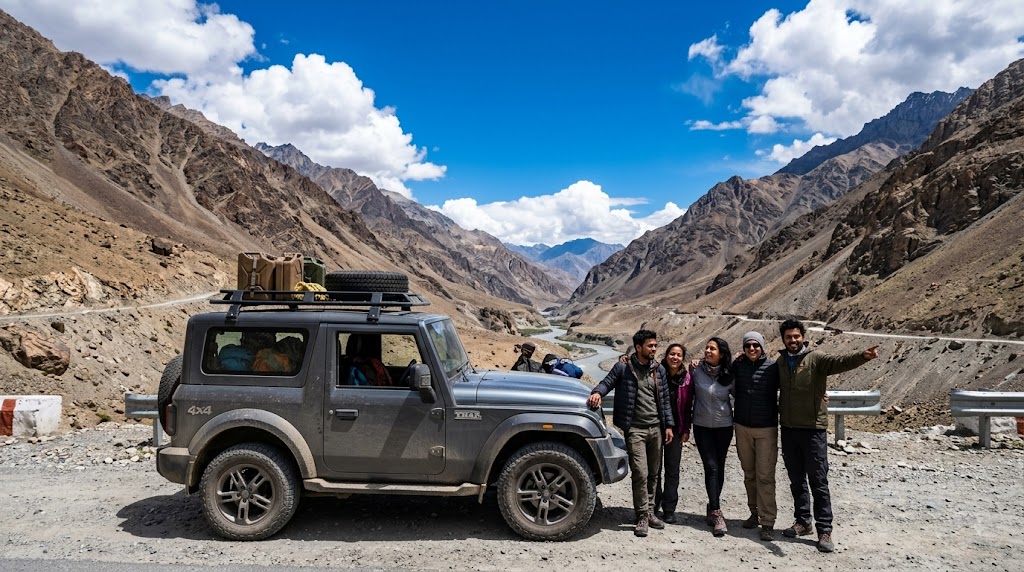
    Group of friends on a road trip with a jeep against dramatic Leh Ladakh mountain scenery - Leh Ladakh bachelor trip guide
    Leh Ladakh has become a bachelor trip staple for a reason: few destinations deliver this much dramatic scenery and genuine adventure in one trip.

    The International Escape: Thailand vs Bali vs Dubai

    Thailand Bali Dubai
    Visa Visa-free, 30 days Visa on arrival Pre-arranged, we handle it
    Flight from Chandigarh Via Delhi Via Delhi or KL, longer Direct, ~3h 40m
    Vibe Islands, nightlife, value Beach clubs, villas, longer trip energy Glamour, shortest travel time
    Best if The group wants value and nightlife You have 5-6 days to spend properly Time is tight but the trip should still feel big

    Dubai deserves more consideration than it usually gets for this specific trip type, purely because the direct flight from Chandigarh means a genuinely short trip still delivers an international bachelor party without eating an entire week of everyone’s leave balance, covered in more detail in our Dubai guide.

    Budget-Friendly and Close: When the Wedding Already Ate the Budget

    Not every bachelor trip needs a flight. Amritsar, Kasauli, and the wider Himachal circuit covered in our weekend getaways guide deliver a genuine group trip, good food, a change of scenery, actual time together, without the cost of flights or the planning overhead of visas and international bookings. This is very often the right call when the group is also collectively funding wedding gifts, outfits, and other wedding-season expenses in the same few months.

    Timing It Around the Wedding Calendar

    Most bachelor and bachelorette trips happen four to eight weeks before the wedding itself, close enough that the trip still feels connected to the upcoming event, far enough that everyone has recovered in time for wedding-week responsibilities. This window tends to clash with the same peak wedding season that drives up domestic flight and hotel demand generally, which is worth knowing before assuming a domestic trip will automatically be the cheaper, easier option. If the wedding falls in the busy November to February window covered in our long weekend calendar, booking the bachelor or bachelorette trip early matters just as much as it does for the wedding guest travel itself.

    Planning the Group Booking

    Bachelor and bachelorette trips have a specific booking challenge: the group usually confirms in stages, a few people commit early, several more “probably” for weeks, and final numbers often only lock a few weeks before departure. This is exactly what group fare blocks and flexible hotel bookings are built for, similar in principle to the wedding guest coordination covered in our destination wedding travel guide, just at a smaller scale and a much less formal tone. Booking as a coordinated group, even a group of six to eight, tends to beat everyone booking individually once flights and rooms are compared side by side.

    Bachelorette-Specific Considerations

    Much of the destination logic above applies equally to bachelor and bachelorette trips, but a few things are worth planning differently for a bachelorette group specifically:

    • Spa and wellness time tends to matter more, which makes Bali, with its strong spa and villa culture, a consistently popular bachelorette pick even among groups that considered Thailand first.
    • Photography-friendly settings get requested often, and destinations with a strong visual identity, Bali’s rice terraces, Dubai’s skyline, Leh Ladakh’s landscapes, tend to score well specifically for this reason.
    • Villa stays with a shared pool and common space are frequently preferred over standard hotel rooms, since much of a bachelorette trip’s best moments happen in shared downtime rather than out at venues.
    • Safety and comfort for an all-women group is a legitimate factor in destination choice, and we are always upfront about which destinations and specific areas we would and would not recommend for exactly this reason.

    Budgeting Honestly Across the Group

    Bachelor and bachelorette trip budgets vary enormously depending on destination and length, and the most common planning mistake is not disagreeing about the number, but never actually agreeing on one before booking starts. A few practical habits that keep the trip fun rather than financially stressful for anyone:

    • Set a per-person range early, before anyone starts sending destination ideas, so the shortlist is realistic from the start rather than needing to be cut down later.
    • Decide who is covering the guest of honour’s share, a common bachelor and bachelorette trip tradition that needs agreeing on early, not assumed.
    • Book flights and the main accommodation as a group even if daily spending stays individual, since the biggest costs benefit most from group rates and coordinated timing.
    • Build in one genuinely free, no-spend day for destinations like Goa or Thailand, since a trip that is non-stop paid activities from morning to night burns out both budgets and energy faster than expected.

    Real Group Trips We Have Actually Planned

    • “Eight of us, four different budgets.” A Mohali group planning a Thailand bachelor trip had a genuine spread from tight-budget to happy-to-splurge within the same friend group. We priced a shared flight and hotel base with optional add-on experiences, so the core trip stayed affordable for everyone while a few could add extras without the whole group needing to match spending.
    • “We want Leh Ladakh but nobody has done a high-altitude trip before.” A Chandigarh group building genuine anxiety about altitude sickness got a slower, more gradual itinerary with extra acclimatisation time built in, the same logic covered in our Spiti Valley altitude guidance, which turned a nervous group into a confident one by departure day.
    • “The bachelorette needs to work around three different flight cities.” A bride’s college friends were flying in from three different Indian cities to join the Chandigarh-based core group for a Bali trip. We coordinated arrival windows so nobody landed more than a few hours apart, avoiding the common problem of half the group waiting around at the destination for the rest to arrive.

    What to Book in Advance vs Decide on Arrival

    Not everything needs locking down before departure, and over-planning a bachelor or bachelorette trip can drain some of its spontaneous energy just as much as under-planning creates chaos. A practical split:

    • Lock in advance: flights, main accommodation, and any single big-ticket experience the whole group wants guaranteed, a specific beach club table, a desert safari slot, entry to a particular event or venue that could sell out.
    • Decide on arrival: daily activities, restaurant choices, and how each day actually unfolds. Group energy on a bachelor or bachelorette trip is unpredictable in a good way, and leaving room for a spontaneous late night or a lazy recovery morning usually produces better memories than a rigid hour-by-hour itinerary.

    The goal of booking the big pieces early is removing stress, not removing spontaneity. A group that has to worry about whether tonight’s flight or tomorrow’s hotel is actually confirmed enjoys the trip less than one that already has that settled and can focus entirely on the celebration itself.

    Frequently Asked Questions

    What is the best bachelor party destination from Chandigarh?

    It depends on the group’s vibe and timeline more than any single “best” answer. Goa suits a beach and nightlife trip with minimal planning, Leh Ladakh suits an adventure-focused group with a longer window, and Dubai suits a group wanting an international trip without eating a full week of leave, thanks to the direct flight.

    Goa or Thailand for a bachelor trip?

    Goa wins on simplicity, cost and last-minute planning. Thailand wins on novelty and, with visa-free entry, is often more straightforward internationally than people expect. Groups planning further ahead tend to lean Thailand once they compare real options; groups planning inside six weeks tend to land on Goa.

    How far ahead should a bachelor or bachelorette trip be booked?

    Six to eight weeks ahead gives the best combination of fare savings and group coordination time, similar to the booking-window principle in our cheap flights guide, though domestic budget-friendly options like Amritsar or Kasauli can work on shorter notice.

    What is a good budget-friendly bachelor trip option near Chandigarh?

    Amritsar, Kasauli and the wider Himachal circuit deliver a genuine group trip without flights or visas, ideal when the group is also funding wedding-season expenses. Rishikesh adds river rafting and adventure to the budget-friendly, close-to-home category.

    Can Flywings handle group bookings for a bachelor or bachelorette trip?

    Yes, group flight and hotel coordination for exactly this kind of trip, including staged confirmations as the group finalises numbers, is something we handle regularly. Tell us the destination shortlist and rough group size to get a comparison quote.

    Is Leh Ladakh actually manageable for a group unfamiliar with high altitude?

    Yes, with sensible planning, gradual acclimatisation and a driver experienced with the region, similar to the altitude guidance in our Spiti Valley guide. It is not a trip to rush, but it is very achievable for a reasonably fit group with the right pacing.

    When should a bachelor or bachelorette trip happen relative to the wedding?

    Four to eight weeks before the wedding is the most common window, giving the group enough separation to recover and refocus on wedding preparations. This timing often overlaps with peak wedding season demand, so booking the trip early matters as much as it does for any other festive-season travel.

    How do you handle a group flying in from multiple cities?

    We coordinate arrival and departure windows across everyone’s starting city so the group lands within a reasonable window of each other, rather than some members waiting hours at the destination for others. This is a common scenario for college friend groups scattered across India and abroad.

    Let the Group Chat Move On to Planning the Fun Part

    Tell us the vibe your group has landed on and roughly how many people, and we will turn the shortlist above into real flight and hotel options rather than another round of unresolved group chat debate. Explore our Dubai, weekend getaway and Spiti Valley guides for more on specific options, or reach us directly:

    Written by Sukhjinder Kaur, Senior Travel Content Writer at Flywings Tour & Packages Pvt Ltd – planning group trips from Mohali, Punjab since 2005. Seasonal and visa guidance reflects current requirements as of August 2026 and can change, so confirm current details when you enquire.

  • Workation Destinations from Chandigarh: Work From the Hills Without Losing Your WiFi

    Workation Destinations from Chandigarh: Work From the Hills Without Losing Your WiFi

    Somewhere in the last few years, the question changed from “where should we go on holiday” to “where can I actually get work done while feeling like I am on holiday.” Over sixty percent of Indian travellers now actively look for exactly this, and the honest answer for anyone reading this from Chandigarh is that some of India’s best workation hubs are closer than most people realise. At Flywings Tour & Packages Pvt Ltd, we get asked about this constantly, usually by someone who has just realised their team is fully remote for a week and wondering whether that week has to happen at a kitchen table, or whether it could happen somewhere with a view instead. This guide compares the hill stations that actually work for it, not just the ones that look good in a listicle, ranked by the questions that actually determine whether the trip succeeds rather than the ones that make for a prettier photo.

    Quick context: A workation only works if the WiFi does. This guide ranks Chandigarh-reachable hill destinations by connectivity reliability and distance first, scenery second, which is the opposite order most travel content uses and the order that actually matters once you are three hours into a client call.

    What Actually Matters for a Workation, in Order

    1. Reliable internet, not just available internet. A property advertising WiFi and a property with fibre-backed WiFi that survives a video call are two very different things.
    2. Distance from Chandigarh, since a workation with a six-hour drive each way eats into the working days you actually have available.
    3. A proper desk and chair, not a bed and a view. This sounds obvious and is the single most common disappointment first-time workation bookers report.
    4. Backup power, since hill towns see more frequent outages than plains cities, and a property without a generator or inverter can lose you an afternoon without warning.
    5. Everything else, the view, the cafes, the hiking trails, matters enormously for the experience, but only after the first four are actually sorted.

    The Hub Comparison

    Destination Distance from Chandigarh Connectivity Best For
    Kasauli ~60 km, under 2 hours Generally reliable, close enough for a same-day backup plan if needed A short workation, or testing the concept before committing to a longer one
    Dharamshala / McLeod Ganj ~250 km, 5-6 hours Strong in the main town, more variable outside it, café WiFi is a reliable fallback Longer stays, solo workers who like a built-in café culture for changes of scene
    Bir Billing ~270 km, 6 hours Improving fast but genuinely check with your specific property first Travellers who want serious outdoor time (paragliding, hiking) alongside work
    Tirthan Valley ~260 km, 6-7 hours Patchier, best treated as a genuine digital-detox-with-some-work option rather than a full remote-work base Short async-friendly work stretches, not client-call-heavy weeks
    Manali ~310 km, 7-8 hours Reliable in the main town, co-living spaces increasingly common Longer, multi-week workations with an established remote-work community

    Kasauli: The Test Run

    If you have never done a workation before, Kasauli is the honest place to start. It is close enough that a failed experiment costs you a weekend, not a week, and close enough that if something urgent comes up at the office, Chandigarh is under two hours away rather than a full day’s travel. The trade-off is that Kasauli feels less like a destination workation and more like a change of scenery, which for a first attempt is exactly the point.

    McLeod Ganj: The Established Choice

    Dharamshala and McLeod Ganj have the most developed remote-work culture of any option on this list, which shows up in practical ways: cafes that expect laptop workers rather than tolerate them, more reliable connectivity because more of the local economy depends on it, and enough of a working community that meeting other remote workers happens naturally rather than requiring effort. It is also far enough from Chandigarh that this genuinely needs to be a proper trip, not a long weekend squeezed around a normal work week.

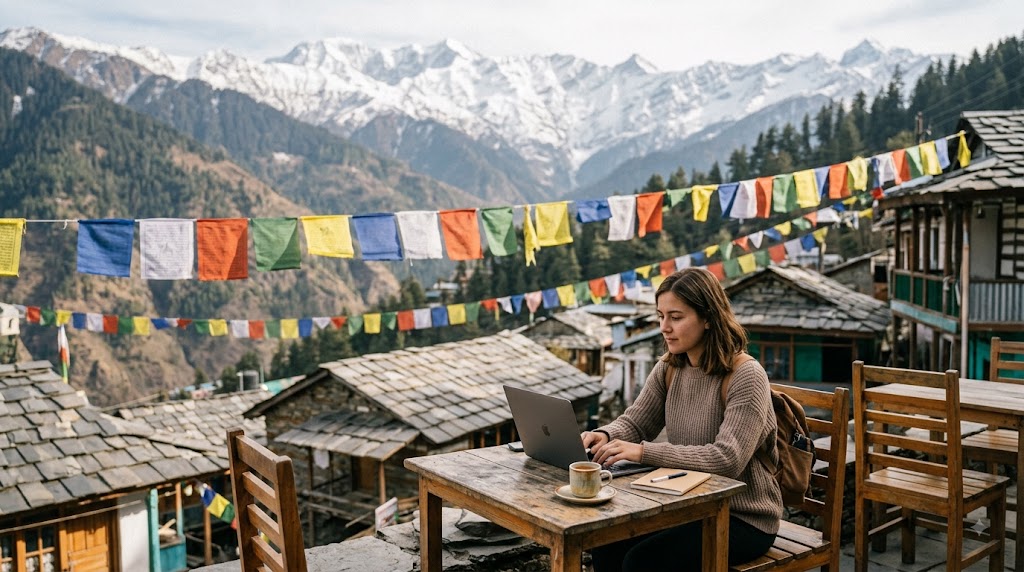
    Person working on a laptop at a hillside cafe in McLeod Ganj with mountain views - McLeod Ganj workation guide
    McLeod Ganj’s cafe culture is built around exactly this: a laptop, a mountain view, and WiFi that does not embarrass itself during a call.

    Bir Billing: Work Hard, Fly Harder

    Bir Billing has built its reputation on paragliding, and that reputation is well earned, but it is increasingly showing up in workation searches for a specific reason: the same qualities that make it a great paragliding base, a real town with real infrastructure rather than a scenic viewpoint with a few hotels, also make it workable for remote work. The honest caveat is that connectivity here is genuinely improving rather than already excellent, so this is the destination on this list where checking a specific property’s actual internet setup before booking matters most.

    Tirthan Valley: Beautiful, But Be Honest About Why You Are Going

    Tirthan Valley is stunning, and it is also the entry on this list where we are most likely to talk a client out of treating it as a primary workation base. Connectivity here is patchier than the other options, which makes it wonderful for a genuine digital detox with light, asynchronous work, and frustrating for anyone whose week involves scheduled video calls. Know which trip you are actually planning before you book.

    Manali: The Long-Stay Option

    For workations measured in weeks rather than days, Manali has the most developed infrastructure of anywhere on this list, including a genuine co-living scene that did not exist a few years ago. It is also the furthest from Chandigarh, which means the travel time only makes sense once amortised across a longer stay. A three-day Manali workation rarely feels worth the journey. A three-week one often does.

    Beyond the Big Five: Underrated Options Worth Watching

    The hubs above are the reliable, well-tested choices, but a few less obvious names are worth knowing about, particularly if you want somewhere quieter with fewer other remote workers competing for the same cafe tables:

    • Bundi in Rajasthan is further afield but increasingly mentioned in workation circles for its heritage architecture and a slower pace, better suited to a longer trip that starts or ends in Chandigarh via Delhi.
    • Coorg and Kodaikanal, further south, come up often in national workation content but are a genuine flight rather than a drive from Chandigarh, worth considering only if the trip itself, not just the working days, is the point.
    • Chikhaldara in Maharashtra is flagged as an emerging option nationally, though realistically too far for a Chandigarh-based short workation and better suited to travellers already in that region.

    For most Chandigarh-based remote workers, the Himachal hub comparison above covers the genuinely practical options. These further-flung picks are worth knowing about mainly for a longer, dedicated trip rather than a regular workation rotation.

    Workation vs Bleisure: Two Different Trips

    It is worth distinguishing a workation from the bleisure trend covered in our corporate travel guide, since they solve different problems. Bleisure typically means extending an existing business trip by a few personal days at the same destination. A workation is a dedicated trip built entirely around working remotely from somewhere other than home or office, for its own sake, with no business trip attached to it. Both are growing quickly among Indian professionals, but they need slightly different planning, and conflating them tends to produce a trip that does neither job particularly well.

    What to Actually Pack for a Workation

    • A portable WiFi hotspot or a second SIM on a different network, as backup for exactly the property WiFi outage you did not plan for.
    • A laptop stand and an external keyboard, since working from a bed for a week is a fast route to a sore neck and slower typing.
    • A power bank rated for laptop charging, not just phone charging, for the hill towns where outages are more common than in the plains.
    • Layered clothing, since most of these destinations run noticeably cooler than Chandigarh, especially in the evenings.
    • Noise-cancelling headphones, for the call you need to take from a cafe or a shared co-living space.

    Booking the Right Kind of Stay

    Not every hotel or homestay in these towns is workation-ready, even when the listing says it has WiFi. What separates a genuinely workable stay from a disappointing one:

    • A dedicated desk in the room, confirmed before booking rather than assumed from photos.
    • Recent reviews mentioning WiFi speed specifically, not just its presence, since a property can technically have WiFi that cannot handle a video call.
    • Co-living or co-working focused properties in Manali and McLeod Ganj specifically, which are increasingly purpose-built for exactly this traveller rather than repurposed tourist accommodation.
    • A cafe or two within walking distance as a genuine backup plan, not a nice-to-have.

    Best Time of Year for a Himachal Workation

    Season Conditions Verdict
    March – June Pleasant, warming toward summer, roads fully open Reliable and comfortable, popular enough that booking a couple of weeks ahead helps
    July – September Monsoon, landslide risk on some routes, lower crowds and rates Workable if you can be flexible about travel dates around weather, quieter cafes as a bonus
    October – November Clear skies, crisp air, arguably the best month for both work and weekend hikes Our top recommendation for a first workation attempt
    December – February Cold, occasional snow at higher points, some properties reduce services Beautiful but confirm heating and power reliability before booking, cold snaps can affect connectivity infrastructure too

    October and November consistently come up as the sweet spot in conversations with clients who have done this more than once, since the monsoon’s connectivity risk has passed and winter’s cold and reduced services have not yet arrived.

    Weekday vs Weekend: Planning Around the Actual Work

    The travellers who get the most out of a workation treat the travel days deliberately, arriving a day before the work week starts rather than trying to work through arrival-day travel fatigue, and building in at least one genuine day off mid-stay rather than treating every single day as a normal office day in a nicer location. Our weekend getaways guide covers the pure-leisure version of many of these same routes, worth reading if you are trying to decide whether this trip should be a workation at all or simply a proper break.

    Solo Workation vs Team Workation

    The planning conversation changes noticeably depending on whether you are going alone or bringing a small team, and it is worth being clear about which one you are actually organising before booking anything.

    • Solo workations prioritise café culture and a light sense of community over dedicated meeting space, since most solo remote workers are on calls rather than hosting them, and value being somewhere with other people around rather than fully isolated.
    • Small team workations, increasingly requested by startups and small departments wanting a change of scenery together, need a property with an actual meeting room or a large common area with reliable WiFi that can handle several simultaneous video calls, not just one.
    • Team workations also need group logistics, shared transport from Chandigarh, rooms clustered together rather than scattered, and a single point of coordination, similar in spirit to the group travel principles covered in our group travel desk, just for a work trip rather than a wedding or pilgrimage.

    A property that works beautifully for one person quietly working through a laptop on a café balcony can fall apart the moment five colleagues try to run a client call from the same WiFi connection at the same time. This is worth checking with the property directly rather than assuming capacity that was never actually tested.

    Talking to Your Manager About a Workation

    For employees rather than founders or freelancers, the workation conversation often needs to happen with a manager first, and it goes better with specifics rather than a vague request. Naming the exact destination, the connectivity plan including a backup option, and confirming which days involve meetings versus focused work tends to land better than a general ask to “work remotely for a bit.” Several of our corporate clients, covered in more depth in our corporate travel guide, have started formalising exactly this kind of request into their travel policy, which is worth checking if your company already has a managed travel programme in place.

    Common Workation Mistakes We See

    Mistake Why It Backfires
    Booking based on the view in the photos alone The desk setup and WiFi speed matter more day to day than the view does after the first afternoon
    Choosing the furthest, most scenic option for a 3-day trip Travel time eats the working days you actually need, and the trip ends just as you settle in
    Not confirming backup power with the property Hill town outages are common enough that this should be a direct question, not an assumption
    Scheduling the same call-heavy week you would have in the office Defeats much of the purpose, and stretches the property’s WiFi at exactly the wrong moments

    Frequently Asked Questions

    Which is the best workation destination near Chandigarh?

    It depends on trip length. Kasauli suits a short trip or a first attempt, McLeod Ganj suits a week-long stay with an established remote-work culture, and Manali suits multi-week stays where the longer travel time is worth amortising across more working days.

    How reliable is WiFi in Himachal hill towns?

    It varies significantly by town and even by specific property. McLeod Ganj and Manali have the most developed, reliable connectivity on this list. Bir Billing is improving. Tirthan Valley is genuinely patchier and better suited to lighter, asynchronous work.

    How far in advance should I book a workation stay?

    Two to four weeks ahead is usually enough for these destinations outside peak season, though properties with dedicated co-working setups in Manali and McLeod Ganj can book up faster since demand for exactly that setup keeps growing.

    Can Flywings help plan a workation trip, not just a holiday?

    Yes, we increasingly get exactly this request, and the planning conversation is slightly different from a normal leisure trip. Tell us how many days are genuinely work days versus leisure days, and we will match the destination and property accordingly.

    Is a workation worth it for a trip shorter than a week?

    For destinations under two hours away like Kasauli, yes. For anything requiring a five-plus hour drive, the travel time starts to outweigh the benefit on a trip shorter than about five days.

    What is the difference between a workation and a bleisure trip?

    A bleisure trip extends an existing business trip with a few personal days at the same destination. A workation is a standalone trip built entirely around remote work somewhere other than home, with no business trip attached. They solve different problems and are usually planned differently.

    Can a small team do a workation together, not just one person?

    Yes, and this is a growing request from startups and small departments. It needs a different kind of property, one with genuine meeting space and WiFi capacity for several simultaneous calls, plus group transport and room coordination similar to any group trip.

    Bring the Laptop, Skip the Kitchen Table

    A good workation is really just good logistics wearing a nicer view. Tell us your work pattern, how many days you actually need reliable connectivity for, and we will point you at the right hub and the right property rather than the prettiest listing. Explore our weekend getaways guide for the leisure version of these same routes, or reach us directly:

    Written by Sukhjinder Kaur, Senior Travel Content Writer at Flywings Tour & Packages Pvt Ltd – planning trips from Mohali, Punjab since 2005. Connectivity and infrastructure details reflect conditions as of August 2026 and can change property by property, so confirm specifics before booking.

  • Christmas and New Year 2026-27 Travel from Chandigarh: Where to Go and When to Book

    Christmas and New Year 2026-27 Travel from Chandigarh: Where to Go and When to Book

    Somewhere around the second week of December, every year, the same thing happens. Fares that looked perfectly reasonable in October suddenly do not, hotel rooms in the obvious destinations disappear, and half the Tricity is trying to book the same handful of routes at the same time. The window that matters most, roughly 20 December 2026 through 4 January 2027, is the single busiest international travel corridor of the Indian calendar, and it arrives every year with the same predictable pattern of early planners getting the trip they wanted and late planners settling for whatever is left. At Flywings Tour & Packages Pvt Ltd, this guide exists to help you make two decisions early: where you actually want to go, and when to book it so the fare still makes sense.

    Quick context: The core Christmas-New Year travel window runs from around 20 December 2026 to 4 January 2027. Trending international picks for this window include Dubai, Thailand, Bali, Singapore, the Maldives, Vietnam and Turkey. Domestic favourites include Kerala, Goa, Jaipur and Delhi. Booking 8-12 weeks ahead, meaning starting now, is what separates a normal fare from a peak-week fare.

    Why This Window Behaves Differently From a Normal Holiday

    Most travel planning follows a simple rule: book a few weeks ahead and you will generally be fine. Christmas and New Year break that rule for the same reason Diwali does, covered in detail in our Diwali travel guide. Demand does not spread evenly across December, it concentrates hard into the ten days surrounding Christmas and New Year’s Eve specifically. Two festivals, one extended school and work break, and an entire country deciding to travel in the same narrow window, all at once. Fare buckets on the popular routes empty out far earlier than travellers expect, which is exactly why this guide starts in August rather than November. By the time festive decorations go up in shopping malls, the best fares for this window are usually already gone, booked by travellers who started planning while it still felt too early to bother.

    Destination Comparison: Where to Spend the Season

    Destination Why It’s Trending Best For
    Dubai Direct flight from Chandigarh, spectacular New Year’s Eve fireworks displays, winter weather is genuinely pleasant Couples and families wanting glamour without a long flight
    Thailand Visa-free entry, island New Year parties, December sits in the dry season Friend groups and value-conscious travellers
    Bali December falls in the dry season, beach club New Year’s Eve events, our full Bali guide covers the zones Longer trips, honeymooners, wellness-focused travellers
    Singapore Marina Bay’s New Year fireworks are a genuine spectacle, efficient and family-friendly Families and first-time international travellers
    Maldives December-March is the dry season peak, resort New Year’s Eve packages are a signature experience Honeymooners and milestone celebrations
    Kerala Houseboat New Year’s Eve on the backwaters, Kochi’s carnival atmosphere Travellers wanting a peaceful, festive domestic option
    Goa India’s default New Year party destination, beach clubs and countdown events Friend groups and younger travellers wanting energy over relaxation
    Jaipur and Delhi Heritage properties, winter weather, New Year events blending tradition and nightlife Shorter domestic breaks without international booking pressure

    International vs Domestic: The Honest Trade-Off

    International trips for this window need to be booked earliest, since visa processing, longer flights and higher demand all stack together. Domestic options offer more flexibility on booking timeline and no visa consideration at all, but the popular ones, particularly Goa and Kerala’s backwater resorts, sell out their best properties just as early as international flights do. Neither category is automatically the safer late-booking choice. Both reward early planning, just for slightly different reasons.

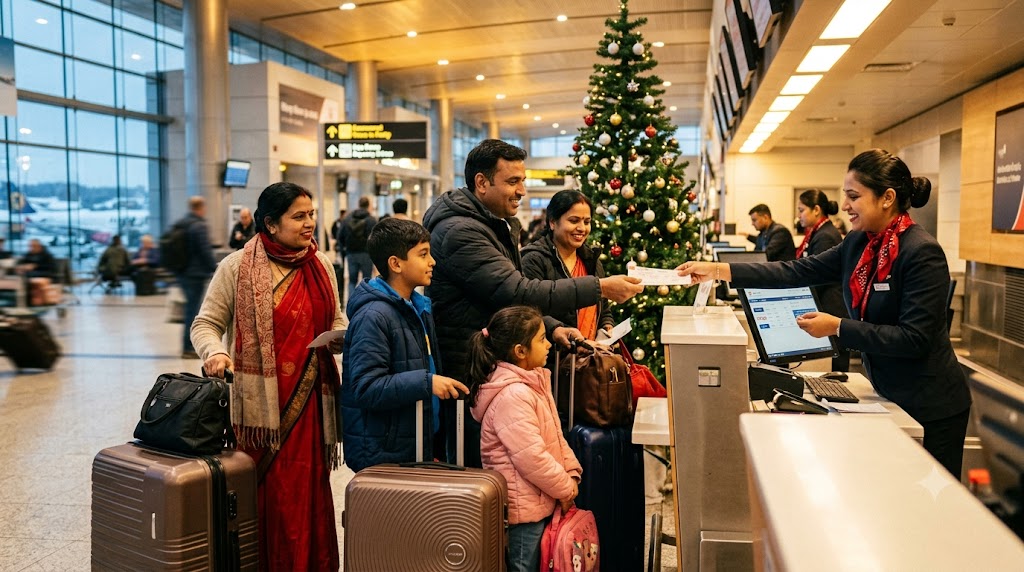
    Family with luggage checking in at an airport counter during the winter holiday travel season - Christmas December travel booking tips
    The second week of December is when most families realise how far fares have moved since October. Booking early avoids this entirely.

    When to Book: A Simple Timeline

    • Now through September: the best window for international bookings, especially Dubai, Thailand, Bali, Singapore and the Maldives. Visa processing, where needed, also has comfortable breathing room at this stage.
    • October: still workable for most destinations, though the easiest fare buckets on the most popular routes are starting to close. This is the last comfortable window for Goa and Kerala’s best properties too.
    • November: options narrow noticeably. Flexibility on exact dates becomes more valuable than flexibility on destination at this point.
    • December, before the 15th: late but not lost, particularly for less obvious routings or slightly less mainstream destinations. Our desk tracks live inventory rather than relying on what a portal search shows as unavailable.
    • After 15 December: genuinely difficult for the most popular destinations. This is when a live ticketing desk’s daily fare tracking matters most, finding what is actually still bookable rather than what a static search result gives up on.

    December Weather Across the Shortlist

    Destination December Weather What It Means for Your Trip
    Dubai Pleasant, 15-25°C, minimal rain Comfortable for outdoor events and desert evenings alike
    Thailand Dry season, warm and sunny Among the best months of the year to visit
    Bali Dry season, warm with occasional short showers Reliable beach and outdoor conditions for New Year’s Eve events
    Singapore Warm and humid, wetter month Short showers are common, indoor and covered attractions balance this well
    Maldives Dry season, one of the best windows of the year Peak season for a reason, book resorts and villas early
    Kerala Cool and pleasant, minimal rain Ideal backwater and hill weather
    Goa Warm, dry, peak beach season Perfect conditions, which is exactly why it is also peak crowd season
    Jaipur and Delhi Cold, particularly at night, occasional winter fog Pack proper layers, mornings can be genuinely chilly

    New Year’s Eve Specifically: What to Book Separately

    Beyond the flight and hotel, New Year’s Eve itself often needs its own booking, particularly at destinations with signature countdown events. Dubai’s fireworks viewing spots, Maldives resort gala dinners, Bali and Goa’s beach club New Year parties and Singapore’s Marina Bay celebrations all sell tickets or require reservations well ahead of the night itself. Travellers who assume this can be sorted on arrival are consistently the ones who end up watching the fireworks from a hotel room instead of the vantage point they actually wanted. We build this into the itinerary at booking stage specifically to avoid this.

    What Tricity Families Are Actually Booking This Window

    Patterns from our own desk over the past few festive seasons are fairly consistent. Dubai remains the single most-booked international option for Chandigarh and Punjab travellers specifically, largely because the direct flight removes the biggest source of holiday-travel stress for a family that already has enough to coordinate. Thailand and Bali follow close behind, typically booked by slightly younger groups and honeymoon couples willing to accept a longer routing for a different kind of trip. On the domestic side, Kerala has grown noticeably as a New Year choice over Goa for families specifically, largely because backwater properties offer a calmer countdown experience with young children or elderly parents in the group, while Goa remains the default for friend groups without that consideration. None of this should dictate your own choice, but it is a useful reality check against whatever a generic online listicle suggests is universally trending, since national travel trends and Tricity travel patterns do not always line up exactly.

    Getting There From Chandigarh and Amritsar

    Dubai remains the standout option for direct connectivity, with the daily non-stop IndiGo flight from Chandigarh covered in our Dubai guide. Most other international options on this list route through Delhi, and our ticketing desk prices the full combined itinerary together, applying the same booking-window logic from our cheap flights guide. For Amritsar travellers, the international connections covered in our Chandigarh and Amritsar flights guide are worth checking against the Delhi routing for this specific window, since ATQ’s international schedule occasionally offers a real advantage during peak season.

    Packing for the December Window

    • Layers, even for warm destinations. Dubai and Bangkok evenings cool down more than daytime heat suggests, and outdoor New Year’s Eve events often run late into a cooler night.
    • Proper winter clothing for Jaipur, Delhi or any North Indian option. December mornings and nights are genuinely cold, more than many travellers expect from a domestic trip.
    • Festive or smart-casual outfits. Many New Year’s Eve events, from resort galas to beach club parties, have dress expectations worth checking in advance.
    • A power bank and offline maps. Peak-season crowds strain mobile networks at popular countdown venues more than an ordinary day would.
    • Travel insurance, particularly for international trips during the year’s busiest travel period, when disruptions are statistically more likely simply due to volume.

    Why Booking Together Beats Booking Piecemeal

    It is tempting to book a flight the moment a good fare appears, then figure out the hotel later, then look at the New Year’s Eve event closer to the date. For most of the year this staggered approach works fine. For this specific window, it tends to backfire, since the flight, hotel and marquee event all compete for the same shrinking inventory on the same handful of dates. Booking them together, even roughly, means a coordinated plan rather than three separate gambles that may not actually fit together by the time all three are confirmed. This is exactly the coordination a single travel desk handles better than three separate bookings across three different platforms, since one call catches a scheduling conflict that three unrelated confirmations never would.

    Booking Mistakes We See Every December

    • Assuming “there’s still time” through late November. By the time this feeling sets in, the best fare buckets on popular routes have usually already closed.
    • Booking the flight but not the New Year’s Eve event. Signature countdown experiences at popular resorts and venues need their own advance booking, not an assumption of walk-up availability.
    • Ignoring visa timelines for international options. Processing volume rises industry-wide during peak booking months, so applications filed in November for a December trip carry more risk than the same application filed in September.
    • Comparing only the flight price, not the total trip cost. A slightly pricier flight paired with much better hotel availability often beats a cheap flight into a destination where nothing decent is left to book.
    • Splitting a group’s bookings across different dates or routings to chase marginally lower individual fares, which usually costs more in coordination stress than it saves in money.

    What a Comfortable Booking Timeline Actually Looks Like

    Rather than treat this as one big decision made all at once, it helps to break it into three smaller ones spread across the coming weeks. First, agree on a shortlist of two or three destinations with whoever you are travelling with, rather than a single fixed choice, since flexibility between two good options often finds a meaningfully better fare than commitment to one. Second, get a live quote from our desk across that shortlist, so the fare comparison is based on actual current pricing rather than a number remembered from a previous year’s trip. Third, confirm within the same week the quote comes back, since peak-season fare buckets do not wait for a decision to be made at leisure. Families who follow roughly this sequence consistently end up with both a better price and a calmer December than those who start the same conversation in November.

    Choosing by Traveller Type

    • Couples and honeymooners: the Maldives or Bali for a slower, more romantic countdown, or Dubai for glamour with the shortest flight. See our full comparison in the Bali vs Maldives vs Dubai guide.
    • Families with kids: Singapore’s efficiency and family-friendly infrastructure, or Kerala’s calmer backwater houseboats, both work well without the late-night party focus of some other options.
    • Friend groups: Thailand or Goa for energy, nightlife and value, or Bali’s Canggu and Seminyak zones for a slightly more polished version of the same idea.
    • Multi-generational family trips: Jaipur or Delhi for a domestic option with heritage character and no visa complexity for elderly travellers, or Dubai if the group wants an international trip with a short, direct flight.
    • Solo travellers and small groups: Vietnam or Turkey for something further off the usual circuit, both trending picks for this window among more adventurous travellers.

    Christmas Day and New Year’s Eve: Two Different Trips in One Window

    It is worth separating these mentally, since they are not quite the same trip even though they often get booked together. Christmas Day itself tends to matter more in destinations with a genuine Christian heritage or strong festive culture, such as Kerala’s Christmas markets and church celebrations, or European-style Christmas experiences in some international destinations. New Year’s Eve is the more universally celebrated date across almost every destination on this list, with countdown events, fireworks and parties forming the centrepiece regardless of local religious tradition. Some travellers want both moments to matter equally across a longer trip, while others treat Christmas as a quiet travel day and build the whole trip around New Year’s Eve itself. Knowing which version you want shapes both the destination choice and the itinerary pacing.

    The 12-Day Window: Fitting Both Festivals Into One Trip

    Because Christmas and New Year sit less than a week apart, many travellers use this stretch for one longer trip rather than two separate short ones. A twelve-day window from around 23 December to 4 January comfortably covers a full international holiday, including a destination that might otherwise feel rushed on a standard five or six day trip. This is particularly worth considering for destinations like Bali or Vietnam, which reward a longer stay, or for combining two destinations, such as a Dubai stopover paired with a longer Maldives or Thailand leg. If your workplace shuts down for the season regardless, this is often the single best-value travel window of the entire year in terms of leave days spent versus trip length gained.

    Frequently Asked Questions

    When is the peak Christmas-New Year travel window in 2026-27?

    Roughly 20 December 2026 through 4 January 2027 sees the heaviest demand, driven by school and work breaks stacking on top of both festivals. Fares and hotel rates across this window rise well ahead of the actual dates as inventory sells through.

    How far ahead should I book for New Year 2027?

    Eight to twelve weeks ahead is the safest window for international destinations, which means starting the process now through September gives the most options and the best fares. Domestic bookings have slightly more flexibility but still reward early planning for the most popular properties.

    Which international destination is trending most for New Year 2027?

    Dubai, Thailand, Bali, Singapore and the Maldives are the consistently trending picks for Indian travellers this window, alongside newer entries like Vietnam and Turkey for those wanting something less familiar.

    Is Goa or Kerala better for New Year celebrations?

    Goa suits travellers wanting beach clubs, nightlife and countdown parties, while Kerala offers a calmer, more scenic New Year’s Eve, particularly on a backwater houseboat. Neither is objectively better, the choice comes down to whether you want energy or relaxation.

    Do I need to book New Year’s Eve events separately from my hotel?

    Often, yes, particularly at destinations with signature countdown experiences like Dubai’s fireworks viewpoints or Maldives resort gala dinners. These sell out or require reservations independently of the room booking itself, and we build this into every itinerary at the planning stage.

    Can Flywings arrange a Christmas-New Year trip for a family or friend group?

    Yes, this is one of our busiest periods every year. Group flight coordination, matched hotel rooms and New Year event bookings are all handled as one itemised package. Tell us your destination preference, group size and dates to get started.

    Should I book flights and hotels separately or through one desk?

    Through one desk, ideally, especially for this specific window. Because flights, hotel rooms and marquee New Year’s Eve events all compete for the same limited inventory on the same dates, coordinating them together avoids the situation where one piece is confirmed and the others no longer fit the plan.

    Is it worth combining Christmas and New Year into one longer trip?

    Often, yes, particularly if your workplace or school schedule already provides a break across this window. A ten to twelve day trip makes better use of the same leave days than two separate short trips would, and suits destinations like Bali or Vietnam that reward a longer stay.

    Decide the Destination, We Will Handle the Timing

    The hardest part of this trip is usually picking where to go. Once that decision is made, the booking calendar takes care of itself if you start now rather than in November. Explore our international tour packages from Chandigarh, browse India tour packages for the domestic options, or reach us directly:

    Written by Sukhjinder Kaur, Senior Travel Content Writer at Flywings Tour & Packages Pvt Ltd – booking flights and holidays from Mohali, Punjab since 2005. Destination trends and booking guidance reflect data available as of August 2026, and fares and availability change, so confirm current details when you enquire.

  • Destination Wedding Guest Travel from Chandigarh: The Family Coordinator’s Guide (2026)

    Destination Wedding Guest Travel from Chandigarh: The Family Coordinator’s Guide (2026)

    Every big fat Punjabi wedding now has an unofficial job title that never appears on the invitation card: the one relative who ends up coordinating everyone’s travel. If a destination wedding is in the plans, whether it lands in Bali, Thailand, Goa or Kerala, that person is usually managing flights, hotel rooms and sometimes visas for anywhere between fifty and three hundred guests, on top of everything else a wedding already demands. At Flywings Tour & Packages Pvt Ltd, we have quietly become that coordinator’s second phone call, right after the venue is booked. This guide is written for that person, whoever it turns out to be in your family.

    Quick context: Destination wedding guest travel is fundamentally a group logistics problem, not a venue problem. Wedding planners handle the ceremony, decor and catering. Almost none of them handle fifty families’ flights, passports and hotel rooms, and that gap is exactly where a coordinated travel desk earns its place. Start guest travel planning the same week the venue is confirmed, not after the invitations go out.

    Why This Job Always Falls on One Person

    A destination wedding has two separate logistics problems that get treated as one. The couple and the wedding planner handle the venue, the ceremony and the celebration itself. Nobody officially owns getting fifty or a hundred and fifty guests there, with working passports, sensible flight connections and rooms that do not put three generations of one family on opposite ends of a resort. That job lands on whichever relative is most organised, most available, or simply could not say no fast enough. It is a real, demanding role, and it deserves real support rather than a spreadsheet and good intentions. Most coordinators discover the scale of the job only after agreeing to it, somewhere around the moment the guest list crosses fifty names and the first three flight fare quotes come back at three different prices for the same route.

    Stage One: Understand Your Guest List Before You Book Anything

    Before a single flight gets booked, the coordinator needs a working guest map, because a wedding guest list is never one uniform group. It typically splits into distinct travel needs:

    • Elderly guests who need direct or minimal-connection routes, aisle seating and wheelchair assistance arranged in advance rather than requested at the airport.
    • Young families with children who need adjoining or nearby rooms, and flight timings that do not fight nap schedules.
    • NRI guests flying in from abroad who need their international leg coordinated with the domestic or onward connection, often with a very different booking timeline than local guests.
    • Local Chandigarh and Punjab guests who may want to travel together as a group rather than book individually.
    • The couple’s close bridal party who often arrive earlier and leave later than the main guest block, for pre-wedding events and photography.

    Mapping this early, even roughly, is what lets a group booking actually work, rather than fifty separate PNRs booked in fifty separate moments of panic.

    Stage Two: Group Flights, and Why They Are Not Just Fifty Individual Tickets

    Once the guest map exists, group flight booking becomes possible, and it works completely differently from individual booking. Airlines release group fare blocks that hold a set number of seats at a negotiated rate, with names submitted later than a normal booking deadline allows. This single feature solves the most stressful part of wedding travel coordination: guests confirming attendance on their own timeline, without the coordinator racing a fare that changes every time someone finally replies to the invitation. It also means the whole travelling block sits together on the aircraft, rather than scattered across a flight in whatever seats were left by the time everyone individually booked.

    Stage Three: Hotel Room Blocks That Actually Reflect Family Groups

    A wedding guest list is not a random collection of individuals, it is a set of family units that need to stay together, and a good hotel block reflects that rather than assigning rooms in whatever order bookings arrived. This means:

    • Adjoining or same-floor rooms for immediate family groups, particularly with young children or elderly members.
    • A flexible rooming list that can absorb late changes, since wedding guest numbers shift right up to the final weeks.
    • A shared group rate that beats what any individual guest would find booking the same resort independently.
    • Coordination with the wedding planner’s own room blocks for the couple, bridal party and close family, so the two blocks do not accidentally compete for the same inventory.
    Family member reviewing a wedding guest travel spreadsheet with flight and hotel details on a laptop - wedding travel coordination
    The unofficial job of most destination weddings: one relative, one spreadsheet, fifty families’ worth of flights and rooms to track.

    Stage Four: Visas, the Part Almost Everyone Underestimates

    If the wedding is international, visa requirements rarely match across the guest list the way people assume. NRI guests holding different passports may face different requirements than Indian-passport guests flying from Chandigarh. Elderly guests’ documents may need renewal timelines checked well ahead. And whichever destination is chosen, from our own coverage of Bali’s visa on arrival to Thailand’s recently updated entry rules, the requirement itself can be simple while still needing someone to actually verify it against fifty different passports rather than assume it is the same for everyone. This is precisely the kind of detail a coordinator juggling a hundred other wedding tasks should not be personally chasing down passport by passport.

    Stage Five: The Week-Of Logistics Nobody Plans For Until It Is Urgent

    • Airport pickup coordination for staggered guest arrivals across several days, rather than assuming everyone will simply find their own way.
    • A single point of contact guests can call if a flight is delayed or a connection is missed, so the coordinator is not personally fielding calls during the wedding itself.
    • Return flight reminders for guests who booked early and may have genuinely forgotten their own return date by the time the celebrations wind down.
    • A contingency plan for at least one flight disruption, since with a large enough guest list, statistically something will be delayed or rescheduled.

    Choosing the Destination With Guest Travel in Mind

    Couples usually choose a destination for how it looks in photographs, which is entirely fair, but the coordinator should have a voice in the conversation too, because some destinations are dramatically easier to move a hundred guests through than others:

    Destination Guest Travel Reality
    Goa or Kerala No visa needed for any Indian guest, the simplest option for a large, mixed-age guest list
    Thailand Visa-free entry for Indian passport holders, a direct or easy-connection flight, strong hotel group-block availability
    Bali Visa on arrival, longer connecting flight, worth it for the visuals but needs more advance planning for elderly guests
    Dubai Pre-arranged visa needed for every guest, but the direct Chandigarh-Dubai flight is a genuine advantage for a Tricity-heavy guest list

    None of this should override what the couple actually wants. It simply means the coordinator walks in prepared, rather than discovering the guest logistics challenge only after the venue contract is already signed. Raising these questions early, even briefly, tends to save far more stress in month three of planning than it costs in a single early conversation.

    Real Coordination Scenarios We Have Actually Solved

    • “Half our guest list has never left India before.” A Mohali family’s Thailand wedding had a guest list split almost evenly between well-travelled NRI relatives and first-time-international-flyer local guests. We ran a simple document checklist for the first-timers, since a passport that had never been used before needed a different level of hand-holding than a frequent traveller’s.
    • “The groom’s side and bride’s side booked separately and now nobody is on the same flight.” By the time we were brought in, two competing WhatsApp groups had already booked guests across four different flights on the same day. We consolidated what could still be moved onto a shared group block and left the rest, a lesson in why guest travel coordination should start before individual bookings happen, not after.
    • “One grandmother’s passport expires six weeks before the wedding.” A routine passport renewal check during our standard document review caught this early enough to fix calmly, rather than becoming a wedding-week crisis discovered at check-in.
    • “We have 40 confirmed guests and 60 maybes.” This is normal, not a planning failure. Group fare blocks exist specifically to hold capacity for exactly this kind of uncertain confirmation curve, letting the coordinator avoid booking (and paying for) seats that might not be needed.

    Budgeting for Guest Travel Without Fixed Numbers

    Every family asks the same early question: what will this actually cost. The honest answer is that guest travel cost depends on too many moving parts, destination, season, guest count, and how far ahead booking happens, to quote a single figure responsibly. What we can say is that a coordinated group booking consistently beats the total of fifty individual bookings for the same dates and destination, sometimes substantially, simply because negotiated group rates and early booking both work in the family’s favour rather than against it. We prepare an itemised group quote once the guest map and destination are confirmed, broken down clearly enough that the coordinator can share relevant portions with guests who are covering their own travel.

    What a Coordinated Travel Desk Actually Takes Off Your Plate

    Coordinator Handling It Alone Working With a Group Travel Desk
    Flight booking Fifty individual bookings, fifty individual fare risks One group fare block, held seats, flexible name submission
    Hotel rooms Manually requesting adjoining rooms and hoping the property honours it A managed rooming list matched to family groups
    Visa checks Guessing which guests actually need what, and when Verified per guest, with documentation support
    Disruption on the day The coordinator’s personal phone, ringing constantly One desk fielding guest calls, freeing the coordinator to actually attend the wedding
    Guest communication WhatsApp groups and spreadsheets managed solo One shared source of truth guests can be pointed to

    Working Alongside Your Wedding Planner, Not Replacing Them

    It is worth being clear about where this service starts and stops, since the two roles are genuinely different jobs. Your wedding planner owns the venue, decor, catering, ceremony logistics and the overall creative vision of the event itself. A travel desk owns getting guests there and back safely, comfortably and on budget. The best destination weddings we have supported are the ones where these two functions communicate directly rather than the coordinator relaying messages between them. We are always happy to join a call with your planner early, so room block numbers, arrival schedules and any venue-specific transport needs are aligned from the start rather than discovered as a conflict two weeks before the wedding.

    Managing the WhatsApp Group Without Losing Your Mind

    Every destination wedding eventually grows a guest travel WhatsApp group, and every coordinator eventually dreads it a little. The volume of repeated questions, most of them some version of “what time is my flight” or “can I bring an extra bag”, is genuinely exhausting on top of everything else a wedding demands. A structured travel plan reduces this considerably, since guests with a single shared document listing their own flight, hotel and transfer details ask far fewer scattered questions than guests relying entirely on memory and group chat scrollback. We build exactly this kind of shared reference as part of every group booking, which on its own tends to be the detail coordinators thank us for most once the wedding is over.

    A Realistic Planning Timeline

    1. As soon as the venue is confirmed: start the guest travel map, even roughly. Waiting for a final headcount before starting delays everything downstream.
    2. 8-12 weeks before the wedding: lock the group flight block and hotel room block, the same booking-window logic that applies to any large travel group.
    3. 6-8 weeks before: begin visa documentation for any guest who needs it, since processing times vary and some guests will be slower to send documents than others.
    4. 2-4 weeks before: finalise the rooming list and confirm any late guest additions or drop-offs against the held block.
    5. Wedding week: hand the day-to-day guest queries to the travel desk, and actually enjoy the wedding you spent months coordinating everyone else’s way to.

    Why Punjab Families Face a Slightly Different Version of This Problem

    Punjabi weddings tend to run larger and more multi-generational than many other regional wedding traditions, and destination weddings from the Tricity inherit that scale. It is common for a single guest list to include grandparents who have never flown internationally, NRI relatives flying in from Canada, the UK or Australia on entirely different timelines, and a large contingent of local friends and extended family travelling together for the first time as a group. This is precisely the mix that makes generic destination wedding advice, most of it written for smaller, more uniform guest lists, less useful for a genuinely large Punjabi wedding. The travel content available online is largely written for a hundred-guest wedding in a single country with a single passport type among the group, which simply is not the reality most Chandigarh and Punjab families are actually planning around. A coordinator working with a desk that understands this specific guest composition, rather than a one-size-fits-all wedding travel template, tends to have a noticeably calmer few months leading up to the event.

    Frequently Asked Questions

    Who should actually coordinate wedding guest travel?

    In most families, one relative ends up doing it informally, alongside their own wedding responsibilities. The role works far better when that person has a travel desk backing them up for the actual bookings, documentation and disruption handling, rather than managing all of it personally on top of everything else a wedding demands.

    How far in advance should we book group flights for wedding guests?

    Eight to twelve weeks ahead is the sweet spot for most destinations, similar to the booking-window principle covered in our cheap flights guide. Group blocks specifically benefit from early booking since name submission can happen later, giving guests more time to confirm attendance without losing the fare.

    Do all wedding guests need the same visa for an international destination?

    Not necessarily. Requirements can differ by passport, particularly for NRI guests holding foreign passports attending alongside Indian-passport family members. Every guest’s documentation should be checked individually rather than assumed to match the majority.

    Can hotel rooms really be blocked for family groups rather than assigned randomly?

    Yes, this is one of the core benefits of a managed group booking. Rooming lists can be built around actual family units and adjusted as guest numbers shift, rather than leaving room assignment to whatever order individual bookings happened to arrive in.

    What happens if a guest’s flight is delayed during the wedding week?

    With a coordinated travel desk, guests have one number to call, and disruptions get managed centrally rather than becoming the coordinator’s personal emergency in the middle of wedding events. This is one of the most appreciated parts of the service by families who have coordinated a wedding without it.

    Can Flywings handle guest travel for a wedding the venue and planner are managing separately?

    Yes, this is exactly how most of our destination wedding work happens. The venue and ceremony stay with your wedding planner, while we handle flights, hotel blocks and visa coordination for the guest list, working alongside the planner’s own timeline rather than competing with it.

    How many guests are needed before group booking makes sense?

    Group fare blocks typically become available from around ten travellers, though the coordination benefit, one point of contact, one rooming list, one source of truth for guests, is valuable well before that threshold too, especially for multi-generational family groups.

    What if some guests want to book their own flights independently?

    That is completely normal and easy to accommodate. We simply need those guests’ arrival details to fold them into the hotel rooming list and the on-ground coordination plan, so they are not left out of transfers and communication just because they booked their own ticket.

    Can you help with pre-wedding events that need separate travel, like a mehendi or sangeet at a different location?

    Yes, multi-location wedding functions are increasingly common, and we coordinate the full sequence rather than just the main event, including bridal party members who often need to arrive earlier and stay later than the main guest block.

    Let Someone Else Carry the Spreadsheet

    If you have been handed the job of getting everyone to the wedding, you did not sign up to become a part-time travel agent for fifty families. Tell us the destination, the rough guest count and the wedding date, and we will build the flight blocks, hotel rooming and visa checklist around it. Explore our group travel desk, browse destination guides for Bali, Dubai and Thailand, or reach us directly:

    Written by Sukhjinder Kaur, Senior Travel Content Writer at Flywings Tour & Packages Pvt Ltd – coordinating group and wedding travel from Mohali, Punjab since 2005. Visa and booking guidance reflects current requirements as of August 2026, and can change, so confirm current details when you enquire.

  • Diwali 2026 Travel from Chandigarh: The Countdown Guide to Booking Before Prices Spike

    Diwali 2026 Travel from Chandigarh: The Countdown Guide to Booking Before Prices Spike

    Diwali 2026 falls on Sunday, 8 November, and if that date feels far away right now, it is not. It sits exactly inside the booking window that decides whether your festival trip costs a fair fare or a panic fare. At Flywings Tour & Packages Pvt Ltd, the weeks before Diwali are the busiest of our year, and the single biggest factor separating a smooth trip from a stressful one is not the destination. It is when the booking actually happened. This guide is built as a countdown, so wherever you are reading it, you know exactly what to do next.

    Quick facts before you plan: Diwali 2026 is Sunday, 8 November. The five-day festival window runs from Dhanteras on 6 November to Bhai Dooj on 10 November. The best outbound days are 5, 8 or 9 November, with 6 and 7 November typically the most expensive. Fares booked 60-90 days ahead run meaningfully cheaper than last-week bookings.

    12 Weeks Out: Lock Your Dates and Start Watching Fares

    At twelve weeks before Diwali, most people have not started thinking about travel yet, which is exactly why this is the best time to start. Decide roughly where you want to go and how many days you can take off. You do not need a firm booking yet, but you do need a firm date range, because every week you wait from here narrows your options and raises your likely fare. This is also the point to start a fare watch on your preferred route with our desk, the same approach we cover in detail in our cheap flights guide. Twelve weeks feels early to most people, and that instinct is exactly why so many festival trips end up costing more than they needed to. The travellers who move first are not being anxious. They are simply the ones who understand how festival demand actually behaves.

    8-10 Weeks Out: Book Flights Now, Not Later

    This is the single most important window on this entire calendar. Fares booked 60-90 days ahead of Diwali are consistently the cheapest available, and every week you wait after this point trades away savings. If your dates are fixed by family plans or leave approval, this is when you commit. Two tactical details worth knowing:

    • Flying on Diwali day itself (8 November) is often 20-40% cheaper than flying the Friday or Saturday before it, since most travellers want to be home for the actual festival evening rather than in transit.
    • Return flights on 12 or 13 November tend to be the best-value return dates, just after the festival crowd has already gone home.

    If you are travelling as a family group or planning a joint trip with relatives, this is also the point to ask about group fare blocks, which we cover in our group travel desk.

    6-8 Weeks Out: Confirm Hotels and Visas

    With flights locked, hotel rooms in popular Diwali destinations begin filling fast, particularly anywhere with its own festival draw. If your trip is international, this is also the last comfortable window to file a visa application without rushing processing. For destinations we have covered in detail, cross-check the current entry rules before booking non-refundable stays, especially given how quickly rules can shift, as our Thailand visa update showed earlier this year.

    4 Weeks Out: The Last Comfortable Booking Window

    By four weeks out, the easiest fares and room categories are already gone, but a good trip is still very achievable. This is the point where we start actively working around constraints rather than simply booking the obvious choice. If your first-choice flight has gone up sharply, we look at nearby dates, alternate routings through Delhi, or a different departure time that still gets you home for the festival.

    2 Weeks Out: Damage Control, Not Panic

    If you are reading this with two weeks left, the message is simple: it is late, not hopeless. Fares will be higher and the best hotels will be gone, but options still exist, particularly if you have some flexibility on exact dates or are open to a less obvious destination. This is exactly where a ticketing desk that tracks live inventory daily earns its keep over a portal search that only shows what is left rather than what could still work with a small adjustment.

    Airport departure board and travellers with luggage during festival travel season - Diwali flight booking tips
    Festival-week airports fill fast. The travellers who booked eight to ten weeks out are the ones moving through security calmly.

    Why Festival Fares Behave Differently From Normal Fares

    On a normal route, fares mostly follow the booking-window pattern we cover in our cheap flights guide: book four to six weeks out and you generally do fine. Diwali breaks that pattern because demand is not spread across the month, it is compressed into a handful of specific days. Airlines know exactly which dates the whole country wants to fly on, and fare buckets on those dates empty out far faster than on an ordinary week. This is why the 60-90 day window matters more for Diwali than for almost any other trip you will book all year. It is not a general rule of thumb here, it is the difference between a normal fare and a genuinely inflated one.

    What Actually Happens to a Route You Wait On

    It helps to see this as a real pattern rather than an abstract warning. A route that shows a comfortable, ordinary fare in early August will typically show a noticeably higher fare by mid-September, purely because the cheapest seat buckets have sold. By late October, the same route often has only the highest fare classes left, and by the first week of November, some flights on the peak days are simply full. None of this happens as one dramatic jump. It happens in small increments every week, which is exactly why it is easy to underestimate until the week you actually try to book.

    Diwali 2026: The Full Festival Calendar

    Date Occasion
    Friday, 6 November Dhanteras
    Saturday, 7 November Choti Diwali / Naraka Chaturdashi
    Sunday, 8 November Diwali / Lakshmi Puja
    Monday, 9 November Govardhan Puja
    Tuesday, 10 November Bhai Dooj

    Knowing this full calendar matters for travel planning specifically because it shapes demand. The Friday and Saturday before Diwali are when everyone wants to already be home, which is exactly why those two days carry the highest fares of the entire window.

    Best and Worst Days to Fly: A Simple Rule

    Day Fare Pattern Why
    Thursday, 5 November Good value Ahead of the main rush, before demand peaks
    Friday, 6 November Most expensive Everyone wants to be home for Dhanteras and the run-up to Diwali
    Saturday, 7 November Most expensive Last full travel day before Diwali itself
    Sunday, 8 November Often 20-40% cheaper Diwali day itself, when most travellers prefer to already be settled at home
    Monday, 9 November Good value Festival mood continues, but travel demand has eased
    Thursday-Friday, 12-13 November Best return value The return rush has already passed

    Where to Go for Diwali: Three Directions

    Stay in Punjab, See the Festival Itself

    You do not need to leave the region to have a memorable Diwali trip. Amritsar’s Golden Temple during Diwali is lit with thousands of lamps in one of the most photographed sights of the entire festival calendar, covered in full in our Golden Temple visitor guide. If a short domestic trip fits your leave better than an international one, this is very often the best single option on this list.

    A Long Weekend Escape

    With Diwali falling on a Sunday, a few strategically placed leave days either side create a genuine long weekend without using much annual leave. Our weekend getaways guide covers the full shortlist of hill and heritage options within a few hours of Chandigarh, several of which are at their most pleasant in early November.

    An International Trip Timed Around It

    For travellers using Diwali as the anchor for a longer international holiday, November sits inside the good-weather window for several of our most-booked destinations, including Dubai, Malaysia and Singapore. Since Diwali leave often stacks with a following weekend, this is one of the few windows all year where a proper international trip fits inside a realistic leave balance.

    How This Is Different From a Normal Long Weekend

    Our weekend getaways guide covers the general 2026 long-weekend calendar, and much of that logic still applies here, but Diwali deserves its own treatment for one reason: it is the single highest-demand travel week of the entire Indian calendar, well above Republic Day, Independence Day or even most wedding-season weekends. That scale changes the maths. A booking strategy that comfortably works for an ordinary long weekend, such as booking three to four weeks out, simply does not hold for Diwali, where the same timeline often means choosing from whatever fares happen to be left rather than the fare you actually wanted.

    Diwali Booking Mistakes We See Every Year

    • Waiting for a sale that never quite arrives. Diwali is peak season everywhere in India. Airlines rarely need to discount a route that will sell out anyway.
    • Booking the outbound flight without checking the return date’s price. A cheap outbound on a bad return date can cost more overall than a slightly pricier outbound paired with a smart return.
    • Ignoring tier-2 routing options. Sometimes flying via a slightly less obvious connection, rather than the first result a search shows, saves meaningfully during peak weeks.
    • Assuming hotel rooms will still be there. Popular Diwali destinations, especially Amritsar and hill towns, genuinely sell out their best properties weeks ahead.
    • Forgetting visa timelines for international trips. A visa that normally takes a few days can slow down during any high-demand travel season, so file early rather than assuming standard processing speed will hold.

    Packing and Practical Diwali Travel Notes

    • Carry sweets and gifts in checked luggage, not hand baggage, since many airlines restrict certain packaged food items and loose sweets in the cabin, and checked bags avoid the question entirely.
    • Firecrackers cannot be carried on any flight, checked or hand baggage, under standard aviation safety rules. Buy them locally at your destination if that is part of your celebration plan.
    • Book airport transfers in advance for late Diwali-night arrivals, since taxi availability in many cities drops sharply on the festival evening itself as drivers head home to celebrate.
    • Keep a printed copy of hotel bookings and ID for every traveller, particularly for group trips, since front desks during peak season move faster with paperwork ready rather than searched for on the spot.
    • If travelling with elderly family members, confirm wheelchair or priority boarding assistance at the time of booking rather than at the airport, since festival-week staff are stretched thinner than usual.

    Group and Family Diwali Travel

    Diwali is one of the few times of year when extended families genuinely try to travel together, and this is exactly where a coordinated booking beats everyone booking separately. Group fare blocks hold seats and allow later name confirmation, room blocks keep everyone in the same wing of a hotel rather than scattered floors apart, and one point of contact means a schedule change affects one phone call instead of ten confused family group chats. If your Diwali plan involves more than a handful of travellers, tell us the headcount early. This is a peak-season constraint that only gets tighter the closer you get to the date, and group flexibility on dates tends to shrink faster than individual flexibility does, simply because more people need to agree on the same days.

    Diwali Travel by Traveller Type

    • Students coming home: book the moment your college calendar confirms the break, since student routes to smaller cities often have fewer flight options to begin with, and those thin out fastest of all.
    • Couples planning a Diwali honeymoon or anniversary trip: pair the festival with an international window like our Bali vs Maldives vs Dubai guide covers, since November sits inside good weather for most of those routes.
    • Families with school-going kids: school Diwali breaks are usually announced well ahead, so this is often the easiest group to plan early for, provided the booking actually happens as soon as dates are known rather than closer to the break itself.
    • Working professionals with limited leave: since Diwali falls on a Sunday in 2026, a well-placed single leave day either side can create a genuine long weekend without a heavy leave-balance cost.
    • Senior citizens visiting family: book earlier rather than later specifically to secure aisle seating, wheelchair assistance slots and convenient flight timings, all of which get harder to arrange as a route fills up.

    What This Costs to Get Wrong

    The honest version of this guide is simple: nothing about Diwali travel is complicated, but the cost of delay compounds quietly. A route that is comfortably affordable at ten weeks out can be significantly pricier at four weeks out, not because of any single dramatic price jump, but because each week a few more of the cheapest seats and rooms disappear. Nobody notices the individual week that mattered. Everyone notices the total by the time they are booking in a hurry. The fix is not complicated. It is simply acting on this countdown at whichever stage you are reading it, rather than filing it away for later and rediscovering it in October with fewer options left.

    Diwali Travel Within India vs an International Trip

    Both are genuinely good options for Diwali, and the right choice depends less on budget than on what kind of break you actually want. A domestic trip, particularly to somewhere with its own festival atmosphere like Amritsar or a nearby hill town, lets you stay connected to the Diwali mood itself, the lights, the food, the sense of the whole country celebrating around you. An international trip trades that atmosphere for a genuine change of scene, which some travellers specifically want after a demanding year, and November’s weather works well for several of our most-booked routes. Neither is the better answer in general. We usually ask one simple question to help clients decide: do you want Diwali to be the destination, or do you want Diwali to be the excuse to finally take the trip you have been planning anyway. The answer usually settles it quickly.

    A Simple Test to Know Which Week You Are In

    If you are unsure where you fall on this countdown, a quick way to check is to look at what a normal search shows you right now. If your preferred route and dates still show a range of reasonable fare options across several airlines, you are still in a comfortable booking window. If you notice most flights on your exact dates only show one or two remaining fare classes, or prices have visibly jumped compared to nearby dates, you have moved into the later, more constrained part of the calendar. Either way, calling our desk at this point gets you an honest read on whether to book immediately, wait a short window for a specific fare release, or adjust dates slightly for meaningfully better value.

    Frequently Asked Questions

    When is Diwali in 2026?

    Diwali falls on Sunday, 8 November 2026. The full five-day festival window runs from Dhanteras on 6 November to Bhai Dooj on 10 November.

    Is it actually cheaper to fly on Diwali day itself?

    Often, yes. Since most travellers prioritise being home before the festival evening, flights on 8 November itself can run 20-40% cheaper than the Friday or Saturday immediately before it, when demand peaks hardest.

    How far in advance should I book Diwali flights?

    Sixty to ninety days ahead is the sweet spot for most routes. At the time of publishing this guide, that window is open now. Every week that passes narrows the gap between a fair fare and a peak-week fare.

    Where should I go for a short Diwali trip from Chandigarh?

    Amritsar is one of the most rewarding short options, since the Golden Temple during Diwali is genuinely spectacular and it is only a few hours from the Tricity. For something further, our weekend getaways guide covers hill and heritage options that suit a long weekend built around the festival dates.

    Can Flywings arrange a Diwali trip for an extended family group?

    Yes, and this is one of our busiest services every festival season. Group flight blocks, coordinated hotel rooms and one point of contact for the whole family are exactly what we build for Diwali group trips. Share your headcount and rough dates as early as possible.

    What if I am only booking a few weeks before Diwali?

    It is late, not hopeless. Fares and room categories will be more limited, but a live desk that checks actual current inventory can usually still find a workable option, particularly with a little flexibility on exact dates.

    Should I book Diwali flights and hotels separately or together?

    Together, ideally, and through one desk. Booking a flight without confirming hotel availability for the same dates risks landing a great fare with nowhere good left to stay, particularly in smaller Diwali-popular towns where room inventory is limited. We check both before confirming either.

    Do visa rules change or slow down during Diwali season?

    Processing speed does not officially change, but volume does, since many travellers file applications in the same weeks. Filing your visa application as early as possible in the countdown, rather than assuming standard turnaround will hold under higher demand, is the safer approach for any international Diwali trip.

    Start the Countdown Today

    Diwali 2026 is close enough to plan properly and far enough away to still get it right. Tell us your dates, your destination ideas and your group size, and we will build the itinerary around the calendar above rather than around a rush. Explore our tour packages, browse India tour packages from Chandigarh, or reach us directly:

    Written by Sukhjinder Kaur, Senior Travel Content Writer at Flywings Tour & Packages Pvt Ltd – booking flights and holidays from Mohali, Punjab since 2005. Dates and fare patterns reflect published festival calendars and industry booking data as of August 2026. Confirm current fares and availability when you enquire.

  • Almaty, Kazakhstan Tour Package from India: Why This Is the Destination to Book Before Everyone Else Discovers It (2026)

    Almaty, Kazakhstan Tour Package from India: Why This Is the Destination to Book Before Everyone Else Discovers It (2026)

    Every few years, a destination sits exactly where Bali or Georgia sat before everyone else found them — genuinely stunning, still affordable, and nowhere near as crowded as it will be in five years. Right now, for Indian travellers, that destination is Almaty, Kazakhstan. A green, mountain-ringed city at the foot of the Tian Shan range, with a direct flight from Delhi under five hours, visa-free entry, and landscapes that genuinely surprise first-time visitors who expected something closer to a Soviet-era stereotype than an alpine lake district. At Flywings Tour & Packages Pvt Ltd, Almaty has become one of our fastest-growing enquiries — this guide makes the case for going now, and covers everything you need to plan the trip.

    Quick facts before you plan: Kazakhstan is visa-free for Indian passport holders, up to 14 days per visit (maximum 42 days within any rolling 180-day period). Direct flights from Delhi with Air Astana take under 5 hours. Best months are April–June and September–October for sightseeing, December–March for skiing. Most trips run 4–6 days.

    Why Almaty, Why Now

    Three things line up for Almaty right now in a way they won’t stay lined up forever:

    • Visa-free entry that most travellers don’t know about. Unlike the e-Visa processes many Central Asian destinations require, Kazakhstan offers genuine visa-free entry for Indians — no advance paperwork, no waiting on approval.
    • A direct flight that makes it genuinely convenient. Under 5 hours from Delhi puts Almaty closer, time-wise, than several Southeast Asian destinations Indian travellers already treat as routine.
    • Still-affordable, still-uncrowded. Almaty’s tourism infrastructure is developing quickly, but it hasn’t yet seen the price inflation or crowding that follows once a destination becomes mainstream — the window where “we went before it got popular” is genuinely open today.

    What Almaty Actually Feels Like

    Set aside any assumption built on Kazakhstan’s Soviet-era reputation — Almaty today is a green, leafy city with wide boulevards, a backdrop of snow-capped peaks visible from most central streets, and a noticeably relaxed pace. It reads more like a Central European alpine city than anything the word “Kazakhstan” might suggest to a first-time visitor, which is precisely the reaction we hear most often from clients returning from their trip. Almaty served as Kazakhstan’s capital until 1997, and the decades as a national capital left it with a scale and infrastructure — museums, theatres, a genuine café culture — that many newer “emerging destination” cities simply haven’t had time to develop yet.

    Things to Do in Almaty: The First-Timer’s Shortlist

    • Kok-Tobe Hill: a cable car ride to a hilltop park with panoramic city and mountain views — Almaty’s easiest, most reliable “wow” moment, especially near sunset.
    • Medeu: the world’s highest-altitude speed skating rink, set at nearly 1,700 metres in a dramatic mountain valley just outside the city — worth visiting even if you don’t skate, purely for the setting.
    • Shymbulak: Kazakhstan’s premier ski resort, reachable by cable car from Medeu — a ski destination in winter, and a scenic high-altitude walk in summer.
    • Big Almaty Lake: a turquoise alpine lake roughly an hour from the city, ringed by snow-dusted peaks — one of the most photographed spots in the region and a genuinely easy half-day trip.
    • Green Bazaar: a lively covered market for local produce, dried fruits, nuts and Kazakh specialities — an easy, atmospheric way to spend an hour between bigger excursions.
    • Zenkov Cathedral: one of the world’s tallest wooden buildings, built without a single nail, sitting inside the leafy Panfilov Park.

    The Signature Day Trip: Charyn Canyon

    Often called the “Grand Canyon of Kazakhstan,” Charyn Canyon is roughly a 3-hour drive from Almaty and, for most visitors, the single most dramatic day trip in the region — layered red-rock formations stretching for kilometres, dramatically different from anything else on a typical Almaty itinerary. It’s a full-day excursion, usually arranged with a private driver, and one we build into almost every Almaty package regardless of trip length, since it delivers a genuinely different landscape from the city’s alpine scenery.

    Dramatic red rock formations of Charyn Canyon under a wide blue sky — Charyn Canyon day trip from Almaty
    Charyn Canyon’s striated red-rock formations — a full-day trip from Almaty and the landscape most first-time visitors don’t expect Kazakhstan to have.

    What to Eat in Almaty

    Kazakh cuisine reflects the country’s nomadic history — hearty, meat-forward, and built for cold climates, with plenty of variety for adventurous eaters:

    • Beshbarmak: Kazakhstan’s national dish — boiled meat (usually horse or lamb) served over wide pasta sheets with onion sauce, traditionally eaten by hand.
    • Plov: a rice pilaf with meat, carrots and spices, shared across much of Central Asia with regional variations.
    • Kazy: horse-meat sausage, a delicacy at celebrations and a genuine local speciality worth trying at least once.
    • Baursak: small fried dough pieces, often served with tea or honey — a common breakfast or snack item.
    • Shubat and kumis: fermented camel and mare’s milk respectively — an acquired taste, but a genuinely unique local experience for curious travellers.

    Almaty’s restaurant scene also includes plenty of international and Russian-influenced options for travellers who want a break from local specialities, and the Green Bazaar remains the easiest place to sample several items in one visit.

    Almaty vs Other Emerging Destinations

    Since Almaty is often mentioned alongside other under-the-radar picks, here’s an honest comparison for travellers weighing options:

    Almaty Georgia (Tbilisi) Uzbekistan (Tashkent/Samarkand)
    Visa for Indians Visa-free, 14 days Visa-free, 1 year e-Visa required
    Direct flight from India Yes, Delhi, under 5 hours Limited direct options Limited direct options
    Signature landscape Alpine mountains, canyons, lakes Wine country, mountains, coastline Silk Road architecture, desert cities
    Best for Nature and mountain scenery, quick trips Longer, varied trips mixing nature and city History and architecture-focused travellers

    Almaty’s edge is specifically the combination of a direct flight and visa-free entry with genuinely dramatic scenery — several other emerging Central Asian and Caucasus destinations ask for more effort (longer routing, e-Visa applications) to reach a comparable “wow” factor. For a first offbeat international trip, that lower-friction entry point often matters as much as the scenery itself in deciding whether the trip actually gets booked rather than staying on a someday list.

    Almaty Culture and Etiquette Notes

    • A secular, multicultural country: Kazakhstan is majority Muslim but constitutionally secular, with a notably relaxed, cosmopolitan atmosphere in Almaty compared to what “Central Asia” might suggest.
    • Russian is widely spoken alongside Kazakh, and English is increasingly common in hotels and tourist-facing businesses, though a translation app is still genuinely useful for markets and local eateries.
    • Hospitality runs deep: Kazakh culture places a strong emphasis on hospitality, especially around food and tea — accepting an offered meal or tea graciously is culturally significant.
    • Dress code is relaxed in the city itself, though modest dress remains sensible at religious sites and in more rural areas visited on excursions.
    • Tipping is appreciated in restaurants and for guides/drivers but not rigidly expected — 10% is a reasonable norm where service charge isn’t already included.

    Sample 5-Day Itinerary

    1. Day 1 — Arrival: Land in Almaty, transfer to hotel, evening at leisure — Panfilov Park and Zenkov Cathedral work well for a gentle first walk.
    2. Day 2 — City Highlights: Kok-Tobe Hill cable car, Green Bazaar, and central Almaty’s boulevards and cafés.
    3. Day 3 — Mountains: Medeu ice rink and the Shymbulak cable car — a full day at altitude with some of the trip’s best views.
    4. Day 4 — Charyn Canyon: A full-day excursion to the canyon, returning to Almaty in the evening.
    5. Day 5 — Big Almaty Lake and Departure: A morning trip to the lake before an afternoon departure, or extend a day if your schedule allows.

    Travellers with an extra day or two often add Kaindy and Kolsay Lakes — a further pair of alpine lakes slightly beyond Charyn Canyon’s route — for a deeper nature-focused extension.

    Visa-Free Entry: The Detail Most Travellers Get Wrong

    Kazakhstan offers Indian passport holders genuine visa-free entry — up to 14 consecutive days per visit, with multiple visits permitted within a rolling 180-day period up to a combined 42 days. This is a meaningfully simpler process than many travellers assume, and simpler than several other emerging destinations that require e-Visa applications. For stays longer than the visa-free window, an e-Visa is available — relevant mainly for extended trips rather than a standard holiday. As always, carry the standard documents: passport valid 6+ months from your travel date, a return or onward ticket, and proof of accommodation.

    Best Time to Visit Almaty from India

    Months Conditions Verdict
    April – June Mild spring weather, mountains turning green, lower crowds Excellent for city + nature sightseeing
    July – August Warm summer, best access to high-altitude lakes and canyons Good for full outdoor itineraries, including Charyn Canyon
    September – October Clear autumn skies, comfortable temperatures Arguably the best window — photography-friendly light and thinning crowds
    December – March Cold, snowy, ski season at Shymbulak The pick for skiers; city sightseeing needs serious winter layers

    Getting to Almaty from Chandigarh, Amritsar and Delhi

    Air Astana operates a direct Delhi–Almaty route, with flight time under 5 hours — genuinely convenient by international standards. Chandigarh and Amritsar travellers connect through Delhi, and our ticketing desk prices the combined routing as one itinerary, applying the same booking-window logic from our cheap flights guide to secure the best combined fare.

    What to Pack for Almaty

    • Layered clothing year-round — Almaty’s continental climate swings meaningfully between day and night even in summer.
    • Proper winter layers for December–March — genuinely cold, especially at altitude around Shymbulak.
    • Comfortable walking shoes — the city is walkable, and excursions to the lake and canyon involve some uneven terrain.
    • Sunscreen and sunglasses — UV exposure at altitude around Medeu and Shymbulak is stronger than it feels.
    • A universal power adapter — Kazakhstan uses European-style two-pin sockets.
    • Cash in Kazakhstani Tenge for markets and smaller vendors, alongside cards for hotels and restaurants.

    Money-Saving Tips from Our Desk

    1. Book the direct Delhi–Almaty flight early. As the route grows in popularity, fares on this still-emerging corridor are likely to firm up — early booking protects today’s more accessible pricing.
    2. Visit in shoulder season (April–June or September–October) for lower rates than peak summer or ski season.
    3. Combine Charyn Canyon with Kaindy/Kolsay Lakes in one longer excursion day rather than two separate trips, saving on transport costs.
    4. Eat where locals eat. Kazakh cuisine at neighbourhood spots costs a fraction of hotel restaurant prices and is often better.
    5. Travel as a small group if possible — private driver costs for day trips like Charyn Canyon split favourably across 3–4 travellers.

    Beyond Almaty: Worth the Extension

    • Kaindy and Kolsay Lakes: a further pair of alpine lakes beyond Charyn Canyon’s route — Kaindy is famous for its sunken forest, tree trunks rising from the lake’s surface, submerged after a landslide-triggered flood over a century ago.
    • Astana (Nur-Sultan): Kazakhstan’s futuristic capital, a domestic flight away, offering a striking architectural contrast to Almaty’s green, mountain-backed setting — worth considering for trips of a week or more.
    • Turkistan: a historic Silk Road city further afield, home to the Mausoleum of Khoja Ahmed Yasawi, for travellers wanting to extend into Kazakhstan’s deeper history.

    None of these are necessary for a first, focused Almaty trip — but they’re worth knowing about for travellers who fall for the region and want to return, or who have the extra days to extend a first visit. We treat these as a second-trip conversation with most clients, since a first Almaty visit is already full without stretching into a second city.

    What’s Genuinely Worth the Splurge

    • A private driver for the full Charyn Canyon day, rather than a shared group tour — the extra flexibility on timing and stops is worth it for the canyon’s remote setting.
    • A mountain-view hotel room in Almaty — many properties offer genuine Tian Shan views, a small upgrade that meaningfully changes the stay.
    • A proper Kazakh meal at a traditional restaurant, rather than sticking only to international options — one of the most-remembered parts of the trip according to client feedback.

    Common Almaty Myths We Correct Every Week

    What People Assume The Reality
    “Kazakhstan needs a complicated visa process.” Indian passport holders get genuine visa-free entry for up to 14 days per visit — one of the simpler entry processes in the region.
    “It’s all flat steppe, nothing scenic.” Almaty sits directly at the foot of the Tian Shan mountains, with alpine lakes, canyons and ski resorts all within day-trip distance.
    “There’s no direct flight, it’s a hassle to reach.” Air Astana flies direct from Delhi in under 5 hours — genuinely convenient compared to many longer-haul “offbeat” destinations.
    “It’s not really set up for tourists yet.” Almaty’s tourism infrastructure — hotels, English-speaking guides, organised day trips — is well-developed for a city its size, without yet feeling overrun.

    The Two Faces of a Single Trip: City and Mountains

    What makes Almaty’s itinerary work so cleanly is that the city and its surrounding mountains genuinely feel like two different trips compressed into one short flight — no multi-city routing or extra visas required, unlike similar contrasts elsewhere in the world. A morning at the Green Bazaar or Panfilov Park feels like a European city break; an afternoon at Big Almaty Lake or Shymbulak feels like a Himalayan mountain trip. Few destinations this accessible from India offer that specific combination without asking travellers to add a second flight or a second visa application to get it.

    Planning Around Almaty’s Growing Popularity

    Part of the case for going now is straightforward: destinations that combine a direct flight, visa-free entry and genuinely photogenic landscapes rarely stay quiet for long. Almaty’s tourism numbers from India are climbing, hotel inventory is still catching up in peak months, and the direct Delhi route is a relatively recent, still-maturing addition to the network. None of this is urgent in a way that should rush a booking decision — but travellers weighing “this year or next” should know the early-mover pricing and availability advantage is a real, if narrowing, one, much like Bali or Georgia’s own early years before wider popularity reshaped what a trip there cost.

    Who Almaty Is Perfect For

    • Repeat international travellers who’ve done the standard Southeast Asia and Gulf circuit and want somewhere genuinely different.
    • Nature and mountain lovers who want alpine scenery without the altitude-sickness planning a Himalayan trip like Spiti Valley requires.
    • Photography-focused travellers drawn to Charyn Canyon’s dramatic light and Big Almaty Lake’s turquoise water.
    • Families wanting an easy first Central Asia trip — the direct flight and visa-free entry remove most of the friction that usually comes with “offbeat” destinations.
    • Winter sports travellers — Shymbulak offers a genuine ski destination well outside India’s usual winter-holiday circuit.

    Booking a Package vs Planning Almaty Yourself

    DIY Flywings Almaty Package
    Destination research Limited English-language content compared to established destinations Built from our own growing experience booking this route
    Day trip logistics Arranging Charyn Canyon transport independently Pre-arranged private driver as part of the itinerary
    Seasonal planning Easy to underestimate how cold winter gets Packing and itinerary advice matched to your travel month
    Flight routing Direct flight availability and fares tracked independently Priced as part of one combined Chandigarh/Delhi–Almaty itinerary
    When something goes wrong Limited local support network for a newer destination A human in Mohali, a phone call away

    Frequently Asked Questions

    Do Indians need a visa for Kazakhstan?

    No — Kazakhstan offers Indian passport holders visa-free entry for up to 14 consecutive days per visit, with a combined maximum of 42 days within any rolling 180-day period. An e-Visa is available for longer stays beyond this window.

    Is there a direct flight from India to Almaty?

    Yes — Air Astana operates a direct Delhi–Almaty route, with flight time under 5 hours. Chandigarh and Amritsar travellers connect through Delhi as part of one combined itinerary.

    How many days are needed for an Almaty trip?

    4–6 days comfortably covers the city highlights, Medeu/Shymbulak, and a full-day Charyn Canyon excursion. Travellers with more time often extend to include Kaindy and Kolsay Lakes.

    Is Almaty good for families?

    Yes — the direct flight, visa-free entry, and manageable city size make it an easier “offbeat” first trip for families than many alternatives, though winter travel needs serious cold-weather preparation for young children.

    What is the best time to visit Almaty?

    April–June and September–October offer the best sightseeing conditions — mild weather and good access to mountain excursions. December–March suits skiers heading to Shymbulak, with proper winter gear essential.

    Is Charyn Canyon worth the day trip?

    Almost universally, yes — it’s the single most dramatic landscape near Almaty and looks nothing like the city’s alpine surroundings, giving the trip genuine visual variety. We include it in nearly every Almaty itinerary we book.

    Can Flywings arrange the full Almaty itinerary as one package?

    Yes — flights, hotels, the Charyn Canyon excursion, and city/mountain sightseeing are all bundled into one itemised quote. Tell us your travel dates and group size to get started.

    Is Almaty safe for Indian travellers?

    Yes — Almaty is generally considered a safe, well-organised city for tourists, with a visible, cosmopolitan atmosphere and well-developed hotel and guide infrastructure for its size. Standard travel precautions apply, as with any international trip.

    What language do people speak in Almaty — will English work?

    Kazakh and Russian are the primary languages, with English increasingly common in hotels, airports and tourist-facing businesses. A translation app is genuinely useful for markets and smaller local restaurants, similar to travelling in much of Central and Eastern Europe.

    Can I extend an Almaty trip to see more of Kazakhstan?

    Yes — Astana (the capital) is a domestic flight away and offers a striking architectural contrast, while Kaindy and Kolsay Lakes extend the nature-focused side of a trip. Neither is essential for a first visit, but both suit travellers with a week or more.

    Go Before Everyone Else Discovers It

    Almaty has the rare combination of genuine scenic drama, real convenience (direct flight, visa-free entry) and a still-early window before wider popularity changes the pricing and crowds. Explore more of our international tour packages from Chandigarh, or reach us directly to start planning:

    Written by Sukhjinder Kaur, Senior Travel Content Writer at Flywings Tour & Packages Pvt Ltd — booking flights and holidays from Mohali, Punjab since 2005. Visa requirements and seasonal guidance verified as of July 2026; entry rules and flight schedules can change, so confirm current details when you enquire.

  • Maldives Tour Package from India: How to Choose Your Resort (The Only Decision That Actually Matters) — 2026

    Maldives Tour Package from India: How to Choose Your Resort (The Only Decision That Actually Matters) — 2026

    Most international trips are a series of decisions — which city, which day for which sight, how to get between them. A Maldives trip is different: there is really only one decision that shapes the entire holiday, and it’s the one most first-time visitors get least help with — which resort. Pick the right one for your group and budget, and every day of the trip runs itself; pick the wrong one, and no itinerary planning can fix a villa category or meal plan that doesn’t suit you. At Flywings Tour & Packages Pvt Ltd, resort selection is where we spend most of our time with every Maldives client, and this guide walks through exactly how we do it.

    Quick facts before you plan: Indian passport holders get a free 30-day visa on arrival — no advance paperwork. Flight time from India runs roughly 4–5 hours, mostly via Delhi or Chennai, followed by a seaplane or speedboat transfer to your resort. Most trips run 4–6 days. May and September are the current sweet-spot months — dry-season weather at meaningfully better rates than the December–March peak.

    Why the Resort Choice Matters More Here Than Anywhere Else

    Unlike Bali or Thailand, where you can zone-hop if your first choice doesn’t suit you, the Maldives is built around single-resort, single-island stays — most resorts occupy their own private island, and moving between them mid-trip means another boat or seaplane transfer, which most travellers don’t do. That makes the initial choice unusually final: you’re not picking a hotel for a few nights, you’re picking your entire holiday’s environment, food, activities and mood for the whole stay. This is exactly why our conversations with Maldives clients spend far more time on “which resort” than on “what to do” — the second question mostly answers itself once the first is right, and a client who’s spent time getting the resort choice right rarely calls us mid-trip with a complaint.

    Decision 1: Villa Type

    Villa Type What You Get Best For
    Beach Villa Directly on the sand, private beach access, typically the most affordable category First-timers, families, travellers who want beach time over the overwater “moment”
    Overwater (Water) Villa Built on stilts over the lagoon, direct water access via steps or a ladder, often glass floor panels Honeymooners, couples, the classic “Maldives photo” experience
    Overwater Pool Villa Everything above, plus a private plunge pool on the deck Milestone trips, travellers wanting the fullest luxury version
    Family/Two-Bedroom Villa Larger beach or overwater units connecting two rooms Families and multi-generational trips wanting togetherness with privacy

    Our honest advice: if budget forces a choice between a beach villa at a better resort or an overwater villa at a lesser one, we usually steer clients toward the better resort — service quality and island setting affect the whole trip more than the villa category alone. Photos of an overwater villa look similar across very different quality tiers of resort, and it’s the surrounding service, food and house reef that a photo can’t show you — exactly the details we walk clients through before they commit.

    Decision 2: Which Atoll

    The Maldives is a chain of atolls, and where your resort sits changes your transfer time, price, and even the diving/snorkelling quality:

    • North and South Malé Atolls: closest to the airport, typically a 20–40 minute speedboat transfer — ideal for shorter trips or anyone who dislikes long transfers, usually at a range of price points.
    • Ari Atoll: a short seaplane flight away, known for excellent snorkelling and whale shark/manta ray sightings, popular for slightly longer stays.
    • Outer/further atolls (Baa, Lhaviyani, and beyond): longer seaplane transfers (30–45+ minutes), often quieter, more exclusive resorts with a stronger sense of remoteness — best for travellers who see the transfer itself as part of the adventure rather than a chore.

    For a first Maldives trip, especially 4–5 days, we usually recommend North/South Malé or a short seaplane hop — it protects more of your limited days for actually being at the resort rather than in transit. Speedboat transfers also tend to be more schedule-flexible than seaplanes, which fly only in daylight hours and can bunch arrivals into a single afternoon window — worth knowing if your international flight lands late in the day.

    Decision 3: Meal Plan

    This decision affects your daily budget and freedom more than any other line item on a Maldives quote:

    Plan What’s Included Best For
    Bed & Breakfast Breakfast only Travellers wanting to try different restaurants on the resort à la carte
    Half Board Breakfast + one more meal (usually dinner) A balance of value and flexibility — our most commonly booked plan
    Full Board All three meals Families and groups wanting cost predictability
    All-Inclusive Meals plus a range of drinks and sometimes activities Travellers who want zero additional spending decisions once they land

    Since resort islands have no outside restaurants, the meal plan isn’t optional the way it might be on a city trip — it’s worth deciding deliberately rather than defaulting to whatever a quote first shows.

    Seaplane on the water beside a Maldives resort jetty with overwater villas in the background — Maldives resort transfer guide
    The seaplane transfer is part of the Maldives experience itself — and a genuine factor in choosing which atoll and resort suit your trip length.

    Decision 4: Budget Tier

    Maldives resorts span an unusually wide range, and knowing roughly where you sit helps narrow the search fast:

    • Value tier: beach villas, North/South Malé location, bed & breakfast or half board — the most accessible way into a genuine Maldives experience.
    • Mid-luxury tier: overwater villas at well-regarded resorts, often with half or full board — where most first-time honeymooners land.
    • Ultra-luxury tier: overwater pool villas at outer-atoll resorts with all-inclusive plans — the “bucket list” version, usually for milestone anniversaries or once-in-a-lifetime trips.

    We ask every client for a rough budget range early specifically so we’re not showing beach-villa clients ultra-luxury resorts (or vice versa) — it wastes everyone’s time and usually means starting the search over. It’s worth being candid about budget on the first call rather than starting broad and narrowing down later; Maldives resort pricing varies widely enough that a vague brief tends to waste the first round of options entirely.

    A Day at a Maldives Resort: What to Actually Expect

    For travellers who’ve never done a single-resort holiday before, it helps to know what the days actually look like — because “just relaxing” undersells it:

    • Morning: breakfast (often with a lagoon or ocean view), then a choice of snorkelling straight off your villa’s steps, a house-reef swim, or a resort-arranged excursion.
    • Midday: most resorts offer optional activities — dolphin cruises, sandbank picnics, non-motorised water sports included in many packages, with diving and motorised sports usually at extra cost.
    • Afternoon: genuinely unstructured time — a spa treatment, pool time, or simply the villa deck — this is where the “just relaxing” reputation comes from, and it’s earned.
    • Evening: sunset from the jetty or an overwater bar, followed by dinner — either at your meal-plan restaurant or, for special occasions, a private beach or overwater dining setup many resorts offer.

    The lack of a packed itinerary is the point — Maldives trips work precisely because there’s nowhere else to rush off to, which is either the best or most restless feeling of the whole holiday depending on the traveller. If you suspect your group will get restless without a packed schedule, say so when we’re choosing a resort — some properties run a much fuller activity calendar than others, and matching that to your group’s temperament matters as much as the villa category.

    Honeymoon and Anniversary Touches Worth Arranging

    • Floating breakfast: a tray set up in your villa’s private pool or lagoon steps — one of the most-photographed Maldives moments and simple to arrange in advance.
    • Private beach or sandbank dinner: many resorts set up a candlelit table on an empty stretch of beach or a nearby sandbank for a genuinely private evening.
    • Spa treatments for two: couples’ massage suites, often overwater, are a near-universal offering worth booking ahead during peak season.
    • Room decoration and cake: like any honeymoon destination, telling the resort in advance (which we always do on your behalf) usually gets a decorated room and small surprises included at no extra cost.

    Maldives Culture and Etiquette Notes

    • Resort islands vs local islands: the Maldives is a Muslim country, and this shows up mainly on local (inhabited) islands — modest dress is expected there, while resort islands operate under separate rules allowing swimwear and alcohol.
    • Alcohol is resort-only: it’s served freely on resort islands but not available (and importing it is prohibited) on local islands — relevant mainly if your itinerary includes a local-island excursion.
    • Respect house reefs: reef-safe sunscreen and not touching coral are increasingly expected, with some resorts actively enforcing it as part of conservation efforts.
    • Tipping: not obligatory but appreciated for exceptional service, especially for boat crews, butlers and spa staff — small notes in local currency or USD both work.

    Putting It Together: A Decision Checklist

    1. Set your budget tier first — it narrows the resort list before anything else does.
    2. Choose villa type based on whether the overwater experience or beach access matters more to your group.
    3. Decide your atoll based on trip length — shorter trips favour closer atolls, longer trips can absorb a further transfer.
    4. Pick a meal plan that matches how much you want to think about food once you arrive.
    5. Confirm trip length — most one-resort stays work best at 4–5 nights; beyond that, some travellers split between two resorts instead.

    Free Visa on Arrival: What Indian Travellers Need to Know

    The Maldives offers Indian passport holders a free 30-day visa on arrival — no advance application, no fee, and no embassy visit required. Standard documents still apply: a passport valid for at least 6 months from your travel date, a confirmed return or onward ticket, and proof of your resort booking. Compared to visa processes for other honeymoon-tier destinations (see our Dubai visa guide), this is about as simple as international entry gets — one less thing to plan around on a trip where the resort decision already demands most of your attention.

    Best Time to Visit the Maldives from India

    Months Conditions Verdict
    December – March Peak dry season, the most reliable weather Best conditions, but rates run 10–30% higher — book 8–12 weeks ahead
    May & September Shoulder season with largely dry-season-quality weather The 2026 sweet spot — similar conditions to peak season at meaningfully better rates
    June – August Southwest monsoon possible, generally milder in the Maldives than elsewhere in South Asia Good value; short showers are common but rarely disruptive for a full day
    April & October Transitional months Workable, with reasonable rates and decent weather odds

    May and September deserve more attention than they get — both sit close enough to the dry season that weather risk stays low, while resort rates soften noticeably compared to the December–March rush.

    Getting to the Maldives from Chandigarh and Amritsar

    Flight time from India runs roughly 4–5 hours to Malé, mainly via Delhi, followed by a seaplane or speedboat transfer to your specific resort — the transfer itself is arranged by the resort and included in most packages. Our ticketing desk prices the full Chandigarh–Delhi–Malé routing as one itinerary, applying the same booking-window principle from our cheap flights guide — 6–8 weeks ahead is typically the sweet spot for this longer international routing, especially around the December–March peak.

    What to Pack for the Maldives

    • Reef-safe sunscreen — increasingly required by resorts to protect house reefs, and simply the responsible choice.
    • Light, breathable resort wear — evenings rarely need more than a light layer.
    • A universal adapter — Maldives resorts commonly use UK-style three-pin sockets.
    • Snorkelling gear if you have your own preferred set, though most resorts provide it.
    • A dry bag or waterproof phone case for the seaplane and water activities.
    • Cash in small denominations for tipping, though most on-resort spending runs through your room account.

    Money-Saving Tips from Our Desk

    1. Target May or September for dry-season-quality weather without the December–March price premium.
    2. Choose North/South Malé atoll resorts to cut seaplane transfer costs, which can be a meaningful line item at further atolls.
    3. Book half board over all-inclusive if you don’t drink much alcohol — the price gap often isn’t worth it for light drinkers.
    4. Book 8–12 weeks ahead for December–March travel — overwater villas in peak season sell out well before the dates arrive.
    5. Consider a beach villa at a top-tier resort over an overwater villa at a mid-tier one — service and setting often matter more than the villa type alone.

    Maldives vs Bali vs Dubai: The Honest Comparison

    Since these three routinely compete for the same honeymoon or luxury-trip slot, here’s how the Maldives actually differs:

    Maldives Bali Dubai
    Trip structure One resort, total relaxation Multiple zones, varied experiences City-based, activity-packed
    Visa for Indians Free visa on arrival, 30 days Visa on arrival, 30 days Pre-arranged visa (we handle it)
    Ideal trip length 4–5 days 6–7 days 4–6 days
    Best for Pure honeymoon luxury, zero-itinerary relaxation Longer, varied romantic or wellness trips Glamour, shortest flight, energetic couples

    Our rule of thumb: if “relaxation” is the honeymoon’s actual goal, the Maldives wins outright. If the couple wants variety and a longer trip, Bali edges ahead — see the full breakdown in our Bali vs Maldives vs Dubai comparison.

    Common Maldives Myths We Correct Every Week

    What People Assume The Reality
    “You need a visa arranged before you fly.” Indian passport holders get a free 30-day visa on arrival — no advance paperwork needed.
    “Every resort is basically the same, just pick the cheapest.” Atoll location, villa type and meal plan change the entire trip character — the resort choice matters more here than almost anywhere else.
    “You can easily visit multiple islands during your stay.” Most Maldives resorts occupy a single private island; island-hopping mid-trip is uncommon and usually not worth the transfer time on a short trip.
    “Monsoon season means the trip is ruined.” The Maldives’ wet season brings short showers rather than sustained rain, and shoulder months like May and September often deliver dry-season-quality weather at better rates.

    Who the Maldives Is Perfect For

    • Honeymooners: the overwater villa experience remains the most requested honeymoon booking we handle — see how it compares in our Bali vs Maldives vs Dubai guide.
    • Anniversary and milestone trips: the ultra-luxury tier’s outer-atoll resorts suit couples wanting a genuine once-in-a-lifetime splurge.
    • Families wanting total relaxation: family/two-bedroom villas at value or mid-luxury resorts suit multi-generational trips wanting togetherness without a packed itinerary.
    • Travellers who want zero planning once they land: the single-resort structure means once your resort is chosen well, the rest of the trip largely runs itself.

    Booking a Package vs Planning the Maldives Yourself

    DIY Flywings Maldives Package
    Resort selection Photos vs reality gamble across hundreds of similar-looking listings Matched to your budget, group and priorities from two decades of bookings
    Atoll/transfer logistics Easy to underestimate seaplane costs and timing Priced and scheduled as part of one itemised quote
    Meal plan decision Often defaulted to whatever a portal shows first Chosen deliberately based on how you actually want to holiday
    Peak-season availability Popular overwater villas sell out before you finish comparing We track availability and book early on your behalf
    When something goes wrong A distant resort’s front desk and a long call queue A human in Mohali, a phone call away

    Frequently Asked Questions

    How many days are needed for a Maldives trip?

    4–5 nights at one resort is the standard, comfortable length for most travellers — enough time to properly enjoy the villa, activities and relaxation without needing a second location. Milestone trips sometimes extend to a week or split between two resorts.

    Do Indians need a visa for the Maldives?

    No advance visa is needed — Indian passport holders receive a free 30-day visa on arrival, one of the simplest entry processes among honeymoon-tier destinations.

    Beach villa or overwater villa — which should I choose?

    Overwater villas deliver the classic “Maldives photo” experience and direct lagoon access, ideal for honeymoons; beach villas are typically more affordable and suit families or travellers who prioritise beach time. If budget is tight, a beach villa at a excellent resort often beats an overwater villa at a lesser one.

    What is the cheapest time to visit the Maldives?

    May and September currently offer the best combination of dry-season-quality weather and softer rates — genuinely worth considering over the pricier December–March peak if your dates are flexible.

    Is half board or all-inclusive better value?

    It depends on how much you’ll eat and drink on-resort — half board suits travellers happy with breakfast and one more meal who don’t drink much, while all-inclusive suits those wanting zero additional spending decisions once they arrive. We calculate this against your actual habits rather than assuming one is always better.

    Which atoll should a first-time visitor choose?

    North or South Malé Atoll, generally — the shortest transfer from the airport, which protects more of a shorter trip’s days for actually being at the resort. Longer trips (7+ days) can better absorb a further atoll’s longer seaplane transfer.

    Can Flywings help choose the right resort for our budget?

    Yes — this is the core of what we do for every Maldives client. Tell us your budget, group, and priorities (honeymoon romance, family space, ultra-luxury), and we’ll shortlist resorts that actually match rather than sending a generic list.

    Is alcohol available in the Maldives?

    Yes, but only on resort islands — the Maldives is a Muslim country, and alcohol is neither served nor permitted on local, inhabited islands. If your stay is entirely on a resort island, as most tourist trips are, this rarely comes up in practice.

    Can we split our stay between two Maldives resorts?

    Yes, particularly on trips of a week or longer — some couples pair a lively, activity-focused resort with a quieter, more remote one for contrast. It adds a transfer day, so we typically only recommend it for stays of 7+ nights.

    Let Us Help You Choose the Right Resort

    The Maldives rewards getting one decision right — and that’s exactly where we focus every client conversation. Tell us your budget, group, and what you want from the trip, and we’ll match you to the resort, atoll, villa type and meal plan that fits. Explore our Maldives Luxury 4N/5D package, browse more international tour packages from Chandigarh, or reach us directly:

    Written by Sukhjinder Kaur, Senior Travel Content Writer at Flywings Tour & Packages Pvt Ltd — booking flights and holidays from Mohali, Punjab since 2005. Visa requirements and seasonal guidance verified as of July 2026; entry rules and resort offerings can change, so confirm current details when you enquire.

  • Corporate Travel Management for Chandigarh Companies: The Complete 2026 Guide

    Corporate Travel Management for Chandigarh Companies: The Complete 2026 Guide

    Somewhere between “book it on the company card and expense it later” and a full enterprise travel programme, most growing companies in Chandigarh and Mohali are stuck in an expensive middle ground — travel bookings scattered across apps and inboxes, no visibility into what the company actually spends, and a finance team reconciling GST invoices manually every month-end. Corporate travel management exists to fix exactly this, and it doesn’t require the scale of a national enterprise to make sense. At Flywings Tour & Packages Pvt Ltd, we’ve run the travel desk for Tricity businesses since 2005 — this guide covers what a real corporate travel programme includes, what it actually saves, and how to know if your company needs one.

    Quick context: Indian companies are notably bullish on 2026 travel — the large majority expect stable-to-growing travel budgets this year. Well-run corporate travel programmes typically deliver 15–30% savings through negotiated rates and policy enforcement, and over half of Indian companies report ongoing challenges with GST input tax credit compliance on travel spend — one of the easiest problems a managed programme solves.

    The Real Cost of “Just Booking It Yourself”

    Unmanaged corporate travel doesn’t look expensive line by line — a flight here, a hotel there — but it compounds in ways most finance teams only notice at audit time:

    • No negotiated rates: every employee pays retail fare, every time, with no volume discount ever building up.
    • Policy drift: without enforcement, “book economy, standard hotel category” quietly becomes optional, and costs creep upward employee by employee.
    • GST leakage: input tax credit on air travel and hotel stays requires correctly formatted invoices with the company’s GSTIN — something individual employee bookings frequently get wrong, costing the company recoverable tax.
    • Disruption costs: a cancelled flight or a rescheduled meeting means an employee alone on the phone with an airline call centre, often paying full change fees that a managed booking would have avoided.
    • Zero visibility: finance can’t answer “how much did we spend on travel last quarter, by department” without manually collecting expense reports — a data gap that makes budgeting close to guesswork.

    Signs Your Company Needs a Managed Travel Programme

    • Employees are booking flights and hotels on personal cards and expensing them, with no consolidated view of total spend.
    • Your finance team struggles to claim GST input tax credit on travel because invoices arrive inconsistently formatted or addressed to individuals.
    • There’s no written travel policy, or one exists but nobody enforces it.
    • A cancelled flight or hotel issue becomes the travelling employee’s personal problem to solve, mid-trip.
    • Leadership has asked “what are we spending on travel?” and nobody had a fast, confident answer.
    • Your company is planning its first offsite, conference or incentive trip and has no one internally who’s run one before.

    If two or more of these sound familiar, a managed corporate account — even a lightweight one — will very likely pay for itself within the first few bookings. None of these signs require a company of any particular size to show up; they’re symptoms of informal booking habits, and they appear just as reliably in a 15-person startup as in a 500-person enterprise.

    What a Real Corporate Travel Programme Includes

    1. A Dedicated Booking Desk

    Instead of each employee booking independently, one desk (a named contact, not a rotating call centre) handles every booking against your company’s profile — travel preferences, approved airlines and hotel tiers, and billing details captured once, used every time.

    2. Negotiated Corporate Rates

    Airlines and hotels offer meaningfully better pricing to agencies booking consistent volume than to individual travellers booking one-off — this is where a chunk of that 15–30% savings figure typically comes from, without asking employees to fly less comfortably or stay somewhere worse.

    3. A Travel Policy That’s Actually Enforced

    A written policy is a start; enforcement at the point of booking is what makes it work. This means the desk simply doesn’t book outside policy tiers without an approval step — removing the awkward conversation of finance rejecting an expense claim after the trip is already done.

    4. GST-Compliant Invoicing

    Every booking carries your company’s GSTIN correctly from the start, with consolidated monthly invoices your finance team can reconcile without chasing down individual receipts — directly addressing the input-tax-credit compliance gap that affects the majority of Indian companies managing travel informally.

    5. Reporting and Visibility

    A monthly statement showing spend by department, by traveller, and by category turns “what did we spend on travel” from a research project into a two-minute question with an immediate answer.

    6. 24/7 Disruption Support

    When a flight cancels at 9 PM the night before a client meeting, your travelling employee calls one number and someone reworks the itinerary — rather than navigating an airline’s call centre alone, on their own time, mid-trip.

    7. International Business Travel and Visa Support

    For companies sending employees abroad — client visits, trade fairs, overseas offices — business visa documentation is its own specialised process, distinct from tourist visas. Invitation letters, company documentation, and express processing options for time-sensitive trips are exactly where a desk with two decades of visa experience (see our visa assistance service) earns its keep, especially when a deal-closing trip can’t wait on a standard processing timeline.

    8. Duty of Care

    Knowing where your travelling employees are, and being able to reach or reroute them quickly if something goes wrong at their destination, is a basic responsibility that informal booking simply can’t deliver. A managed programme keeps a live record of who’s travelling where, which matters most exactly when it’s needed least — during a disruption, a health issue, or a regional safety concern.

    Corporate team at an offsite conference venue meeting room — MICE travel planning Chandigarh Mohali
    MICE (Meetings, Incentives, Conferences, Exhibitions) travel brings its own logistics — venue, room blocks, and group transport — that a leisure-travel mindset doesn’t cover.

    MICE Travel: When Business Travel Becomes an Event

    MICE — Meetings, Incentives, Conferences and Exhibitions — is corporate travel’s more complex cousin, and it’s where many companies discover they need outside help fastest:

    • Meetings and offsites: a leadership offsite in the Himachal hills or a sales kickoff in Goa needs venue sourcing, room blocks, AV setup coordination, and group transport — quite different from booking individual business trips.
    • Incentive trips: reward travel for top performers, often international, needs a different planning lens than routine business travel — the experience itself is the point.
    • Conferences and exhibitions: group flight blocks, hotel room blocks with flexible rooming lists, and on-ground coordination for a delegation attending (or hosting) an industry event.

    We plan MICE trips the same way we plan large family or pilgrimage groups (see our group travel desk) — group fare blocks, room blocks with flexible name lists, and one point of coordination instead of each attendee booking independently. The planning horizon matters here more than in routine business travel: venue availability for a 50-person offsite in peak season can require locking dates two to three months ahead, while a group flight block for a conference delegation needs early commitment to secure the seat allocation at all, let alone at a good rate.

    2026 Corporate Travel Trends Shaping What “Good” Looks Like

    Trend What It Means for Your Company
    Budget confidence is high The large majority of Indian companies expect stable-to-growing travel spend in 2026 — this is a year to set up a programme properly, not defer it.
    Policy tightening Many companies are revisiting travel policies and renegotiating supplier contracts — a sign that “informal” travel management is increasingly seen as a cost leak worth fixing.
    Rising “bleisure” travel A majority of organisations report employees extending business trips into personal leisure time — worth a clear policy on what the company covers versus what the employee pays for the extension.
    GST/ITC compliance pressure Over half of Indian companies cite ongoing challenges claiming input tax credit on travel — one of the most concrete, quantifiable reasons to formalise booking through one compliant channel.
    Technology expectations Companies increasingly expect approval workflows and reporting to just work, not be assembled from spreadsheets — even a lightweight managed programme should deliver this.

    Building a Simple Travel Policy: What to Include

    Companies without any written policy don’t need to start with a fifty-page document — a working first version covers just a few decisions clearly:

    1. Booking class by trip length or seniority. E.g., economy for domestic trips under a set duration, a defined upgrade threshold for long-haul international travel.
    2. Hotel category and location guidelines. A star-rating band and a “within reasonable distance of the meeting/office” rule prevents both overspending and inconvenient bookings.
    3. Advance booking expectations. Requiring bookings a set number of days ahead (except genuine emergencies) captures most of the 15–30% savings available through early booking.
    4. Approval workflow. Who signs off on international travel, MICE spend, or bookings above a certain value — kept simple enough that it doesn’t become a bottleneck.
    5. Bleisure policy. A clear line on what the company covers if an employee extends a business trip personally — flights typically stay company-booked, with the employee covering extra nights and personal activities.
    6. Expense and reconciliation process. How travel spend flows into monthly accounting, ideally through consolidated invoicing rather than individual reimbursement claims.

    We help first-time clients draft exactly this kind of lightweight policy as part of onboarding — enough structure to control cost and compliance, without the bureaucracy that makes employees quietly ignore it.

    Choosing a Corporate Travel Partner: Questions Worth Asking

    • “Do you offer GST-compliant invoicing with our GSTIN as standard?” If the answer is vague, your input tax credit will likely stay a recurring headache.
    • “What happens if a flight cancels at 11 PM?” A real answer names a person or a live desk, not a support ticket system.
    • “Can you handle both routine bookings and a 40-person offsite?” Many providers are good at one and weak at the other — worth confirming both are genuinely covered.
    • “How is pricing structured — is there a minimum volume commitment?” Understand what you’re committing to before your first booking, not after.
    • “Do you handle business visa documentation for international travel?” This is where generalist booking apps consistently fall short of a proper travel desk.

    Real Scenarios We’ve Solved for Tricity Companies

    • “Our sales team books flights on five different apps.” A Mohali IT company consolidated all flight and hotel bookings for a 40-person sales team through one desk — the immediate win wasn’t even the fare savings, it was finance finally seeing total travel spend in one monthly statement instead of forty expense reports.
    • “We’re planning our first company offsite and have no idea where to start.” A growing Chandigarh startup needed a 25-person leadership offsite in the hills within six weeks. We handled venue sourcing, room blocks, transport from Chandigarh, and on-site coordination — the founders’ only job was showing up.
    • “Our GST credits on travel keep getting rejected.” A manufacturing client’s accounts team was losing input tax credit because employee-booked hotel invoices didn’t carry the company GSTIN correctly. Routing bookings through one compliant channel fixed this within the first billing cycle.

    Setting Up Your First Corporate Account: What to Expect

    1. A short discovery call. We map your typical routes, travel volume, and current pain points — usually 20–30 minutes.
    2. A proposal tailored to your scale. Fare/rate structure, policy tiers, SLAs and billing terms scaled to how much your company actually travels — no enterprise-sized programme forced onto a small team.
    3. Onboarding your travellers. Employees get one contact for bookings; no new software to learn, no app to install.
    4. First bookings and reporting. Within the first billing cycle, your finance team receives its first consolidated, GST-compliant statement.

    There’s no meaningful minimum size for this to make sense — companies booking even a handful of trips a month already save time and gain visibility from day one; the savings and reporting benefits simply scale up from there. Most clients tell us the biggest surprise isn’t the fare savings, which take a booking cycle or two to become obvious — it’s how quickly the mental overhead of “who’s handling travel this week” disappears once one desk owns it. For an office manager or finance lead who’s been juggling this alongside their actual job, that alone is often reason enough to make the switch.

    Corporate Travel Needs by Company Stage

    • Early-stage startups: travel is infrequent but high-stakes — a founder flying to close a deal or meet an investor can’t afford booking friction or a missed connection. Even without volume, a single point of contact who picks up the phone matters disproportionately at this stage.
    • Growing SMEs (20–200 employees): this is where informal booking habits start costing real money — enough travel volume to unlock negotiated rates, but usually still without a formal policy or consolidated invoicing. Most of our new corporate accounts start here.
    • Established companies with regular travel: the priority shifts to reporting, compliance and MICE capability — leadership wants department-wise spend visibility, and offsites/conferences become a recurring, not occasional, need.
    • Companies with international operations: business visa turnaround time becomes a genuine bottleneck for deal timelines, making visa-desk integration (not just flight booking) a core requirement rather than a nice-to-have.

    We structure every corporate proposal around which of these stages a company is actually in, rather than offering one fixed package regardless of size.

    Corporate Travel vs Ad-Hoc Booking: The Honest Comparison

    Ad-Hoc (Employees Book Themselves) Managed Corporate Account
    Pricing Retail fares every time Negotiated corporate rates
    Policy compliance Discovered after the fact, if at all Enforced at the point of booking
    GST invoicing Inconsistent, often unclaimable Correctly formatted every time
    Reporting Manually assembled from expense reports Monthly statement, ready to reconcile
    Disruption handling Employee’s problem, mid-trip One call to a desk that already knows the itinerary
    MICE/group events Ad-hoc, usually a stressed internal team member’s extra job Planned by a desk experienced in group logistics

    Why a Local Chandigarh/Mohali Desk Beats a National Call Centre

    Large national travel management companies exist, and they work fine for large national companies. For most Tricity businesses, though, a local desk has practical advantages that scale doesn’t replace:

    • Someone who actually knows your team. A named contact who recognises your frequent travellers by name books faster and catches preference mismatches a rotating call-centre agent won’t.
    • Face-to-face onboarding. Walking into an office in Phase 7, Mohali to set up a corporate account is simply easier than a chat-support thread with a national provider.
    • Regional route expertise. Knowing when IXC beats a Delhi departure, or which Amritsar international connections work best for your team’s routes, is exactly the kind of detail a Chandigarh-based desk gets right by default.
    • Faster escalation. When something needs fixing urgently, a local relationship with decades of history moves faster than a ticket number in a national queue.

    Frequently Asked Questions

    Is there a minimum company size for corporate travel management?

    No rigid minimum — companies booking even a few trips a month already benefit from consolidated billing and basic policy structure. Pricing and service level scale with your volume, and many of our longest-standing accounts started small.

    How much can a company actually save with managed corporate travel?

    Industry data points to 15–30% savings through negotiated rates, policy enforcement and supplier consolidation — the exact figure depends on your current booking habits and travel volume, which we assess honestly in the first discovery call rather than promising a fixed number upfront.

    Do you provide GST-compliant invoices for corporate travel?

    Yes — every booking carries your company’s GSTIN correctly, with monthly consolidated statements designed for straightforward input tax credit reconciliation, directly addressing the compliance gap that affects most companies managing travel informally.

    What is MICE travel, and does my company need it?

    MICE stands for Meetings, Incentives, Conferences and Exhibitions — essentially, travel that becomes an event rather than a simple point-to-point trip. If your company runs offsites, sales kickoffs, incentive trips or attends/hosts industry conferences, this is a distinct planning need from routine business travel, and one we handle end to end.

    Can you handle bleisure (business + leisure) travel requests?

    Yes — with rising numbers of employees extending business trips into personal time, we help companies set a clear policy on what’s covered versus what the employee arranges and pays for separately, then book accordingly without complicating the company’s travel policy.

    How quickly can we set up a corporate account?

    Most companies are booking their first trip within days of the discovery call — there’s no lengthy procurement process or software rollout, since the “system” is a dedicated desk your team calls or emails directly.

    Can you plan a company offsite or conference from scratch?

    Yes — venue sourcing, room blocks, group flight bookings, on-ground transport and coordination are all part of our MICE planning service. Tell us your group size, dates and rough goals, and we’ll build a proposal from there.

    Does a startup with infrequent travel really need a managed programme?

    Even without volume, having one reliable contact for high-stakes trips (an investor meeting, a deal-closing client visit) reduces the risk of booking friction at exactly the wrong moment. Many of our startup clients began with occasional bookings and formalised the relationship as travel frequency grew.

    How do you handle business visas for international company travel?

    Through the same visa desk that has processed tourist and business visas since 2005 — invitation letter guidance, company documentation, and express processing options for time-sensitive trips, integrated directly with your corporate travel bookings rather than handled as a separate process.

    What happens to our current travel policy when we onboard with you?

    If you have one, we work within it and enforce it at the point of booking. If you don’t, we help draft a simple first version — booking classes, hotel tiers, approval thresholds and a bleisure policy — during onboarding, scaled to your company’s actual travel patterns rather than a generic template.

    Put a Real System Behind Your Company’s Travel

    Whether it’s twenty flights a month or one big annual offsite, the gap between “employees book it themselves” and a properly run corporate travel programme is usually smaller — and faster to close — than most companies expect. Explore our corporate travel management services, our group and MICE travel desk, or start the conversation directly:

    Written by Sukhjinder Kaur, Senior Travel Content Writer at Flywings Tour & Packages Pvt Ltd — managing business travel for Tricity companies from Mohali, Punjab since 2005. Industry figures reflect 2026 travel-industry research as of July 2026; every company’s savings and setup will vary, so treat these as planning benchmarks, not guarantees.