
Tag: Group Travel

  • Travel Agent vs Online Booking in Chandigarh: When You Actually Need a Human

    Travel Agent vs Online Booking in Chandigarh: When You Actually Need a Human

    Every few months someone in Chandigarh asks us a version of the same question, slightly embarrassed, as though it is a strange thing to ask a travel agency: “Honestly, why should I book through you instead of just doing it myself online?” It is a fair question, and the honest answer is that sometimes you should not. Online booking genuinely wins for a simple, one-way domestic flight with flexible dates. Where it stops winning, and where an actual conversation with someone who does this daily starts paying for itself, is worth being specific about rather than vague about. Most articles comparing travel agents and OTAs are written by one side or the other with an obvious thumb on the scale. We are a travel agency writing this, so read the self-interest into it if you like, but we have tried to write the section below the way we would actually answer the question if you called our Mohali office and asked it directly.

    Quick context: Industry data shows travel agencies are projected to gain market share against OTAs through 2026, driven largely by international and complex bookings, where agents with consolidator fare access typically beat the best publicly listed price by 5 to 7 percent, and by the value of having a human accountable when something goes wrong.

    The Honest Answer: It Depends What You Are Booking

    We are not going to pretend an OTA is always worse. That would be self-serving and untrue. The real answer splits cleanly by booking type, and knowing which category your trip falls into is the actual decision that matters.

    Simple Domestic Flight, Fixed Dates: OTA Usually Wins

    A one-way or round-trip domestic flight with dates you are not going to change, no group, no visa involved, is exactly what OTAs and airline apps are built for. Compare prices across two or three platforms, use a card offer if you have one, and book it yourself. Paying an agent for this adds a step without adding real value.

    International Flights: A Genuine Agent Advantage

    This is where the honest data actually favours a travel agent, not marketing spin. Agents with consolidator access to international fares typically beat the best publicly available OTA price by a real, measurable margin, commonly cited around 5 to 7 percent, particularly on complex multi-city or peak-season international routing. On a Dubai, Thailand, or Europe fare, that is not a trivial saving, and it is on top of the advice on routing and layover choices an OTA’s algorithm will not give you.

    Group Trips: Where OTAs Genuinely Struggle

    Booking eight, fifteen, or forty seats together, on the same flight, with the same hotel block, coordinated arrival times, is not a scenario most OTA platforms are built to handle gracefully. This is the single most common reason Chandigarh families, wedding parties, and corporate teams end up calling us instead of booking individually online, someone needs to hold the whole group together as one coordinated booking, not twenty separate transactions that may or may not end up on the same flight.

    Visa-Heavy Trips: The Documentation Difference

    An OTA will sell you a flight and a hotel. It will not review your visa documentation, tell you your bank statement does not meet a specific embassy’s requirement, or follow up when an application needs a correction. For destinations with a genuine documentation process, Schengen Europe, the UK, the US, even some UAE and Southeast Asian visa categories, this gap is where a proper travel desk earns its value most clearly.

    When Something Goes Wrong: The Real Test

    This is the scenario that actually reveals the difference, and it rarely comes up until it matters. A flight gets cancelled, a connection is missed, a hotel booking does not match what was confirmed. With an OTA, you are generally on your own with a customer support queue. With a travel agent, a specific person who already knows your itinerary picks up the phone and deals with the airline or hotel directly on your behalf. This is genuinely the difference most travellers only appreciate once, usually at the worst possible moment for it to matter.
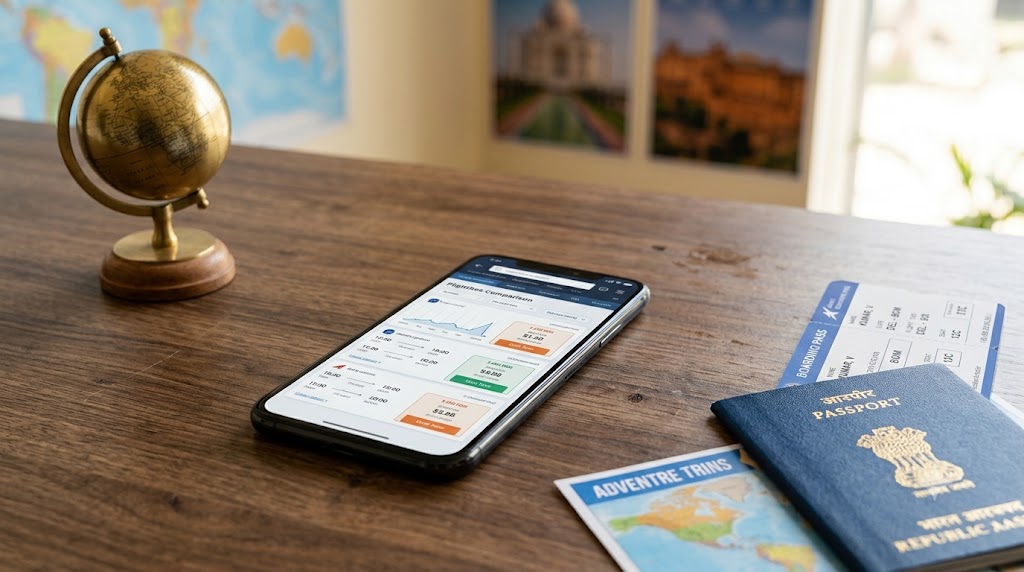
    Close up of a person comparing flight prices on a phone screen next to a passport and boarding pass
    Comparing OTA prices is genuinely the right move for a simple domestic flight, not every booking

    A Quick Decision Table

    Booking Type Better Fit Why
    Simple domestic flight, no group OTA or airline app Straightforward, price-transparent, no coordination needed
    International flight, complex routing Travel agent Consolidator fare access typically beats OTA pricing by 5-7%
    Group of 5 or more travelling together Travel agent Coordinated seating, hotel blocks, and one point of contact
    Trip requiring visa documentation Travel agent Human review of paperwork before submission, not after rejection
    Corporate travel with recurring bookings Travel agent A dedicated desk that knows your company’s travel policy and preferences
    Last-minute flexible solo trip OTA Speed and self-service comparison matter more than personalised advice here

    Five Signs You Are About to Make an Expensive OTA Mistake

    Not every OTA booking goes wrong, most do not, but a specific set of warning signs tends to precede the bookings people regret. Worth checking against before you hit confirm.

    • You are booking more than three or four travellers on the same itinerary. Beyond this size, coordination risk climbs fast, and a split booking across two flights is a common, expensive surprise.
    • Your trip involves a visa you have never applied for before. A first-time Schengen or UK application has genuine failure points a general OTA support line will not catch before you submit.
    • You are combining multiple cities or countries in one trip. Multi-city international routing is exactly where algorithmic pricing tends to miss cheaper combinations a human with fare-construction knowledge would catch.
    • The trip is non-refundable and more than a few months away. Airline schedules and visa rules do occasionally change, and having someone actively monitoring your specific booking is worth more the further out you have booked.
    • You are booking for a company and need consistent policy compliance. A one-off OTA booking will not track your organisation’s travel policy, preferred airlines, or reporting needs the way a dedicated corporate desk will.

    None of these mean an OTA booking will definitely go wrong. They mean the odds of something needing a human to fix it go up meaningfully, and that is exactly the point where the cost of a travel agent’s time starts looking like insurance rather than an unnecessary fee.

    What a Good Travel Agent Conversation Actually Looks Like

    If you have never used one, it is worth knowing what to expect, since a genuinely useful conversation looks different from a sales call.

    1. They ask about your actual constraints first, dates, budget range, group composition, before pitching any specific package, since a good recommendation depends entirely on these details.
    2. They tell you honestly when an OTA would serve you better, the way this guide has for a simple domestic flight, rather than pushing a booking that does not need their involvement.
    3. They explain the routing and pricing logic, not just the final number, so you understand why a particular flight combination or hotel category was chosen.
    4. They give you a direct number or contact, not a generic support inbox, for anything that comes up before or during the trip.
    5. They follow up on visa or documentation deadlines proactively, rather than waiting for you to ask whether something has been submitted.

    If a conversation with a travel agent does not look roughly like this, that is a fair signal to keep comparing options rather than assuming every agency delivers the same value.

    Corporate Travel: A Category of Its Own

    Everything above applies doubly for company travel. A business booking flights individually through whatever OTA each employee happens to prefer ends up with inconsistent pricing, no policy compliance, and no single point of accountability when travel plans change at short notice, which they often do for business trips specifically. A dedicated corporate travel desk tracks your organisation’s preferred airlines, negotiated rates where they exist, and reporting needs, turning a scattered set of individual bookings into one coordinated, policy-compliant process. This is a large enough topic that we have covered it in more depth separately, worth reading if your company currently books travel ad hoc.

    What “Since 2005” Actually Means for This Decision

    We mention our history not as a slogan but because it is directly relevant to the specific advantages above. Consolidator fare relationships, embassy documentation familiarity, airline contacts who pick up the phone when a group booking needs fixing, none of that is built overnight. Flywings Tour & Packages Pvt Ltd has operated out of Phase 7, Mohali since 2005, and the value we are describing above is the accumulated result of two decades of exactly these situations, not a claim we are making without a track record behind it.

    How to Tell If a Quote Is Actually Fair

    Since we are asking you to trust a human recommendation over an algorithm’s price, it is only fair to explain how to check whether that recommendation is actually a good one, rather than asking for blind trust.

    • Ask for the quote broken down by component, flight, hotel, transfers, visa fees, rather than a single bundled figure. A travel agent unwilling to break this down is a fair reason to be cautious.
    • Compare the flight portion specifically against what you see on an OTA for the same route and dates. This isolates whether the consolidator advantage is real for your specific booking, rather than taking it on faith.
    • Ask what happens if you need to cancel or change dates, and get the answer in writing before booking, not after.
    • Check how long the agency has actually operated, since consolidator relationships and airline contacts genuinely take years to build, a newer agency claiming the same advantages as an established one is worth a second look.

    A good travel agent will not be defensive about any of these questions. If one is, that tells you something worth knowing before you commit.

    Group Travel, in More Detail

    This deserves more than the single row it got in the decision table above, since it is one of the clearest cases where the gap between OTA and agent booking shows up in real, avoidable problems. A family of twelve booking a Kashmir trip individually through an OTA risks ending up on different flights if seats run low, in different hotel room categories if availability shifts between individual bookings, and with no single person tracking whether everyone’s documentation, IDs for domestic travel, passports and visas for international, is actually in order before departure day. A coordinated group booking through one desk solves all three at once: one flight manifest, one confirmed room block, and one person whose job is making sure nothing falls through the cracks between twelve different individual confirmations. This applies whether the group is an extended family, a friend circle, a wedding party, or a corporate offsite, the coordination problem is structurally the same regardless of who is travelling.

    Who Should Genuinely Stick With OTAs

    To be fair and specific rather than just directionally honest: solo or couple travellers booking a simple domestic weekend trip, anyone comfortable doing their own visa research for a visa-free or straightforward e-visa destination, and last-minute flexible travellers who value speed over savings are all genuinely well served by an OTA or airline app directly. We would rather you book those trips in five minutes on your phone than call us for something that does not need a conversation. Our value shows up on the bookings this guide has actually named, groups, international routing, visa documentation, and corporate travel, not on every single transaction regardless of complexity.

    What Happens After You Book With Us

    Beyond the initial quote and booking, the ongoing relationship is where the value compounds over a trip’s lifetime. A dedicated contact tracks your visa application status and follows up before a deadline rather than after a missed one, monitors for schedule changes on your specific flights and notifies you rather than leaving you to discover a change at the airport, and remains reachable by phone through the trip itself, not just during the booking process. This is the part of the service that rarely gets mentioned in a “why choose us” pitch but is genuinely where most of the stress reduction actually happens for travellers who have used both OTAs and a proper agency and can compare the experience directly.

    What We Are Not Claiming

    We are not going to tell you a travel agent always beats an OTA, because that is not true, and we would rather you trust an honest answer than a sales pitch. If your trip is a simple domestic flight with flexible dates and no group involved, book it yourself and save the time. We would rather earn your business on the trips where we genuinely add value than pretend to be necessary for every single booking.

    Frequently Asked Questions

    Is a travel agent more expensive than booking online?

    Not necessarily, and often the opposite for international and group bookings specifically, where consolidator fare access and coordinated group pricing frequently beat the best publicly listed OTA price. For a simple domestic flight, the price difference is usually negligible either way.

    What happens if my flight gets cancelled and I booked through an agent?

    A person who already knows your itinerary contacts the airline directly on your behalf to rebook or resolve the issue, rather than you navigating a general customer support queue alone.

    Is it worth using a travel agent for a simple one-way domestic flight?

    Generally no. This is exactly the scenario where an OTA or airline app works well on its own, and we would tell you that honestly rather than take a booking that does not need our involvement.

    Why do group bookings specifically benefit from a travel agent?

    Because coordinating seats, hotel room blocks, and arrival timing across many travellers is not what most OTA platforms are built for. A group booking handled by one accountable desk avoids the common problem of a group ending up split across different flights or with mismatched hotel confirmations.

    Do travel agents help with visa applications?

    Yes, a proper travel desk reviews your documentation before submission rather than after a rejection, which matters most for destinations with genuine paperwork requirements like Schengen Europe, the UK, or the US.

    How do I know if a travel agent’s quote is actually competitive?

    Ask for the quote broken down by component and compare the flight portion specifically against an OTA for the same route and dates. A travel agent confident in their pricing will not hesitate to show this breakdown.

    Is it worth switching from OTA bookings for a company’s corporate travel?

    Generally yes, once a company is booking travel regularly enough that policy compliance, consistent pricing, and a single accountable contact start to matter more than the convenience of individual employees booking through whichever app they prefer.

    What if I only need help with one part of the trip, like the visa, and want to book flights myself?

    That is a genuinely reasonable split, and a good travel desk should be comfortable handling just the visa documentation piece for you rather than insisting on a full package if that is not what you need.

    Book the Way That Actually Fits Your Trip

    If your trip is a group, an international routing, a visa-heavy destination, or corporate travel your company needs handled reliably, that is exactly where a real conversation with a human beats an algorithm. Explore our full range of services, read how to choose the right travel agency if you have not settled on one yet, or call us directly at +91 99143 10333 for a free, no-obligation comparison against what you are seeing online, we will tell you honestly if an OTA is the better call for your specific trip. Flywings team since 2005.


  • Destination Wedding Guest Travel from Chandigarh: The Family Coordinator’s Guide (2026)

    Destination Wedding Guest Travel from Chandigarh: The Family Coordinator’s Guide (2026)

    Every big fat Punjabi wedding now has an unofficial job title that never appears on the invitation card: the one relative who ends up coordinating everyone’s travel. If a destination wedding is in the plans, whether it lands in Bali, Thailand, Goa or Kerala, that person is usually managing flights, hotel rooms and sometimes visas for anywhere between fifty and three hundred guests, on top of everything else a wedding already demands. At Flywings Tour & Packages Pvt Ltd, we have quietly become that coordinator’s second phone call, right after the venue is booked. This guide is written for that person, whoever it turns out to be in your family.

    Quick context: Destination wedding guest travel is fundamentally a group logistics problem, not a venue problem. Wedding planners handle the ceremony, decor and catering. Almost none of them handle fifty families’ flights, passports and hotel rooms, and that gap is exactly where a coordinated travel desk earns its place. Start guest travel planning the same week the venue is confirmed, not after the invitations go out.

    Why This Job Always Falls on One Person

    A destination wedding has two separate logistics problems that get treated as one. The couple and the wedding planner handle the venue, the ceremony and the celebration itself. Nobody officially owns getting fifty or a hundred and fifty guests there, with working passports, sensible flight connections and rooms that do not put three generations of one family on opposite ends of a resort. That job lands on whichever relative is most organised, most available, or simply could not say no fast enough. It is a real, demanding role, and it deserves real support rather than a spreadsheet and good intentions. Most coordinators discover the scale of the job only after agreeing to it, somewhere around the moment the guest list crosses fifty names and the first three flight fare quotes come back at three different prices for the same route.

    Stage One: Understand Your Guest List Before You Book Anything

    Before a single flight gets booked, the coordinator needs a working guest map, because a wedding guest list is never one uniform group. It typically splits into distinct travel needs:

    • Elderly guests who need direct or minimal-connection routes, aisle seating and wheelchair assistance arranged in advance rather than requested at the airport.
    • Young families with children who need adjoining or nearby rooms, and flight timings that do not fight nap schedules.
    • NRI guests flying in from abroad who need their international leg coordinated with the domestic or onward connection, often with a very different booking timeline than local guests.
    • Local Chandigarh and Punjab guests who may want to travel together as a group rather than book individually.
    • The couple’s close bridal party who often arrive earlier and leave later than the main guest block, for pre-wedding events and photography.

    Mapping this early, even roughly, is what lets a group booking actually work, rather than fifty separate PNRs booked in fifty separate moments of panic.

    Stage Two: Group Flights, and Why They Are Not Just Fifty Individual Tickets

    Once the guest map exists, group flight booking becomes possible, and it works completely differently from individual booking. Airlines release group fare blocks that hold a set number of seats at a negotiated rate, with names submitted later than a normal booking deadline allows. This single feature solves the most stressful part of wedding travel coordination: guests confirming attendance on their own timeline, without the coordinator racing a fare that changes every time someone finally replies to the invitation. It also means the whole travelling block sits together on the aircraft, rather than scattered across a flight in whatever seats were left by the time everyone individually booked.

    Stage Three: Hotel Room Blocks That Actually Reflect Family Groups

    A wedding guest list is not a random collection of individuals, it is a set of family units that need to stay together, and a good hotel block reflects that rather than assigning rooms in whatever order bookings arrived. This means:

    • Adjoining or same-floor rooms for immediate family groups, particularly with young children or elderly members.
    • A flexible rooming list that can absorb late changes, since wedding guest numbers shift right up to the final weeks.
    • A shared group rate that beats what any individual guest would find booking the same resort independently.
    • Coordination with the wedding planner’s own room blocks for the couple, bridal party and close family, so the two blocks do not accidentally compete for the same inventory.
    Family member reviewing a wedding guest travel spreadsheet with flight and hotel details on a laptop - wedding travel coordination
    The unofficial job of most destination weddings: one relative, one spreadsheet, fifty families’ worth of flights and rooms to track.

    Stage Four: Visas, the Part Almost Everyone Underestimates

    If the wedding is international, visa requirements rarely match across the guest list the way people assume. NRI guests holding different passports may face different requirements than Indian-passport guests flying from Chandigarh. Elderly guests’ documents may need renewal timelines checked well ahead. And whichever destination is chosen, from our own coverage of Bali’s visa on arrival to Thailand’s recently updated entry rules, the requirement itself can be simple while still needing someone to actually verify it against fifty different passports rather than assume it is the same for everyone. This is precisely the kind of detail a coordinator juggling a hundred other wedding tasks should not be personally chasing down passport by passport.

    Stage Five: The Week-Of Logistics Nobody Plans For Until It Is Urgent

    • Airport pickup coordination for staggered guest arrivals across several days, rather than assuming everyone will simply find their own way.
    • A single point of contact guests can call if a flight is delayed or a connection is missed, so the coordinator is not personally fielding calls during the wedding itself.
    • Return flight reminders for guests who booked early and may have genuinely forgotten their own return date by the time the celebrations wind down.
    • A contingency plan for at least one flight disruption, since with a large enough guest list, statistically something will be delayed or rescheduled.

    Choosing the Destination With Guest Travel in Mind

    Couples usually choose a destination for how it looks in photographs, which is entirely fair, but the coordinator should have a voice in the conversation too, because some destinations are dramatically easier to move a hundred guests through than others:

    Destination Guest Travel Reality
    Goa or Kerala No visa needed for any Indian guest, the simplest option for a large, mixed-age guest list
    Thailand Visa-free entry for Indian passport holders, a direct or easy-connection flight, strong hotel group-block availability
    Bali Visa on arrival, longer connecting flight, worth it for the visuals but needs more advance planning for elderly guests
    Dubai Pre-arranged visa needed for every guest, but the direct Chandigarh-Dubai flight is a genuine advantage for a Tricity-heavy guest list

    None of this should override what the couple actually wants. It simply means the coordinator walks in prepared, rather than discovering the guest logistics challenge only after the venue contract is already signed. Raising these questions early, even briefly, tends to save far more stress in month three of planning than it costs in a single early conversation.

    Real Coordination Scenarios We Have Actually Solved

    • “Half our guest list has never left India before.” A Mohali family’s Thailand wedding had a guest list split almost evenly between well-travelled NRI relatives and first-time-international-flyer local guests. We ran a simple document checklist for the first-timers, since a passport that had never been used before needed a different level of hand-holding than a frequent traveller’s.
    • “The groom’s side and bride’s side booked separately and now nobody is on the same flight.” By the time we were brought in, two competing WhatsApp groups had already booked guests across four different flights on the same day. We consolidated what could still be moved onto a shared group block and left the rest, a lesson in why guest travel coordination should start before individual bookings happen, not after.
    • “One grandmother’s passport expires six weeks before the wedding.” A routine passport renewal check during our standard document review caught this early enough to fix calmly, rather than becoming a wedding-week crisis discovered at check-in.
    • “We have 40 confirmed guests and 60 maybes.” This is normal, not a planning failure. Group fare blocks exist specifically to hold capacity for exactly this kind of uncertain confirmation curve, letting the coordinator avoid booking (and paying for) seats that might not be needed.

    Budgeting for Guest Travel Without Fixed Numbers

    Every family asks the same early question: what will this actually cost. The honest answer is that guest travel cost depends on too many moving parts, destination, season, guest count, and how far ahead booking happens, to quote a single figure responsibly. What we can say is that a coordinated group booking consistently beats the total of fifty individual bookings for the same dates and destination, sometimes substantially, simply because negotiated group rates and early booking both work in the family’s favour rather than against it. We prepare an itemised group quote once the guest map and destination are confirmed, broken down clearly enough that the coordinator can share relevant portions with guests who are covering their own travel.

    What a Coordinated Travel Desk Actually Takes Off Your Plate

    Coordinator Handling It Alone Working With a Group Travel Desk
    Flight booking Fifty individual bookings, fifty individual fare risks One group fare block, held seats, flexible name submission
    Hotel rooms Manually requesting adjoining rooms and hoping the property honours it A managed rooming list matched to family groups
    Visa checks Guessing which guests actually need what, and when Verified per guest, with documentation support
    Disruption on the day The coordinator’s personal phone, ringing constantly One desk fielding guest calls, freeing the coordinator to actually attend the wedding
    Guest communication WhatsApp groups and spreadsheets managed solo One shared source of truth guests can be pointed to

    Working Alongside Your Wedding Planner, Not Replacing Them

    It is worth being clear about where this service starts and stops, since the two roles are genuinely different jobs. Your wedding planner owns the venue, decor, catering, ceremony logistics and the overall creative vision of the event itself. A travel desk owns getting guests there and back safely, comfortably and on budget. The best destination weddings we have supported are the ones where these two functions communicate directly rather than the coordinator relaying messages between them. We are always happy to join a call with your planner early, so room block numbers, arrival schedules and any venue-specific transport needs are aligned from the start rather than discovered as a conflict two weeks before the wedding.

    Managing the WhatsApp Group Without Losing Your Mind

    Every destination wedding eventually grows a guest travel WhatsApp group, and every coordinator eventually dreads it a little. The volume of repeated questions, most of them some version of “what time is my flight” or “can I bring an extra bag”, is genuinely exhausting on top of everything else a wedding demands. A structured travel plan reduces this considerably, since guests with a single shared document listing their own flight, hotel and transfer details ask far fewer scattered questions than guests relying entirely on memory and group chat scrollback. We build exactly this kind of shared reference as part of every group booking, which on its own tends to be the detail coordinators thank us for most once the wedding is over.

    A Realistic Planning Timeline

    1. As soon as the venue is confirmed: start the guest travel map, even roughly. Waiting for a final headcount before starting delays everything downstream.
    2. 8-12 weeks before the wedding: lock the group flight block and hotel room block, the same booking-window logic that applies to any large travel group.
    3. 6-8 weeks before: begin visa documentation for any guest who needs it, since processing times vary and some guests will be slower to send documents than others.
    4. 2-4 weeks before: finalise the rooming list and confirm any late guest additions or drop-offs against the held block.
    5. Wedding week: hand the day-to-day guest queries to the travel desk, and actually enjoy the wedding you spent months coordinating everyone else’s way to.

    Why Punjab Families Face a Slightly Different Version of This Problem

    Punjabi weddings tend to run larger and more multi-generational than many other regional wedding traditions, and destination weddings from the Tricity inherit that scale. It is common for a single guest list to include grandparents who have never flown internationally, NRI relatives flying in from Canada, the UK or Australia on entirely different timelines, and a large contingent of local friends and extended family travelling together for the first time as a group. This is precisely the mix that makes generic destination wedding advice, most of it written for smaller, more uniform guest lists, less useful for a genuinely large Punjabi wedding. The travel content available online is largely written for a hundred-guest wedding in a single country with a single passport type among the group, which simply is not the reality most Chandigarh and Punjab families are actually planning around. A coordinator working with a desk that understands this specific guest composition, rather than a one-size-fits-all wedding travel template, tends to have a noticeably calmer few months leading up to the event.

    Frequently Asked Questions

    Who should actually coordinate wedding guest travel?

    In most families, one relative ends up doing it informally, alongside their own wedding responsibilities. The role works far better when that person has a travel desk backing them up for the actual bookings, documentation and disruption handling, rather than managing all of it personally on top of everything else a wedding demands.

    How far in advance should we book group flights for wedding guests?

    Eight to twelve weeks ahead is the sweet spot for most destinations, similar to the booking-window principle covered in our cheap flights guide. Group blocks specifically benefit from early booking since name submission can happen later, giving guests more time to confirm attendance without losing the fare.

    Do all wedding guests need the same visa for an international destination?

    Not necessarily. Requirements can differ by passport, particularly for NRI guests holding foreign passports attending alongside Indian-passport family members. Every guest’s documentation should be checked individually rather than assumed to match the majority.

    Can hotel rooms really be blocked for family groups rather than assigned randomly?

    Yes, this is one of the core benefits of a managed group booking. Rooming lists can be built around actual family units and adjusted as guest numbers shift, rather than leaving room assignment to whatever order individual bookings happened to arrive in.

    What happens if a guest’s flight is delayed during the wedding week?

    With a coordinated travel desk, guests have one number to call, and disruptions get managed centrally rather than becoming the coordinator’s personal emergency in the middle of wedding events. This is one of the most appreciated parts of the service by families who have coordinated a wedding without it.

    Can Flywings handle guest travel for a wedding the venue and planner are managing separately?

    Yes, this is exactly how most of our destination wedding work happens. The venue and ceremony stay with your wedding planner, while we handle flights, hotel blocks and visa coordination for the guest list, working alongside the planner’s own timeline rather than competing with it.

    How many guests are needed before group booking makes sense?

    Group fare blocks typically become available from around ten travellers, though the coordination benefit, one point of contact, one rooming list, one source of truth for guests, is valuable well before that threshold too, especially for multi-generational family groups.

    What if some guests want to book their own flights independently?

    That is completely normal and easy to accommodate. We simply need those guests’ arrival details to fold them into the hotel rooming list and the on-ground coordination plan, so they are not left out of transfers and communication just because they booked their own ticket.

    Can you help with pre-wedding events that need separate travel, like a mehendi or sangeet at a different location?

    Yes, multi-location wedding functions are increasingly common, and we coordinate the full sequence rather than just the main event, including bridal party members who often need to arrive earlier and stay later than the main guest block.

    Let Someone Else Carry the Spreadsheet

    If you have been handed the job of getting everyone to the wedding, you did not sign up to become a part-time travel agent for fifty families. Tell us the destination, the rough guest count and the wedding date, and we will build the flight blocks, hotel rooming and visa checklist around it. Explore our group travel desk, browse destination guides for Bali, Dubai and Thailand, or reach us directly:

    Written by Sukhjinder Kaur, Senior Travel Content Writer at Flywings Tour & Packages Pvt Ltd – coordinating group and wedding travel from Mohali, Punjab since 2005. Visa and booking guidance reflects current requirements as of August 2026, and can change, so confirm current details when you enquire.