Tag: Family Travel

  • Malaysia Tour Package from India: Kuala Lumpur + Genting Highlands, Two Cities in One Trip (2026)

    Malaysia Tour Package from India: Kuala Lumpur + Genting Highlands, Two Cities in One Trip (2026)

    No other short-haul trip from India packs in a contrast quite like Malaysia does. You can spend a morning sweating gently under the Petronas Twin Towers in tropical Kuala Lumpur, and by evening be reaching for a light jacket in the cool hill air of Genting Highlands, 51 km and one cable car ride away. It’s this whiplash — city heat to hill-station cool, skyscrapers to jungle canopy — that makes a Malaysia tour package from India feel like two very different holidays for the effort of one flight. At Flywings Tour & Packages Pvt Ltd, we’ve been building this exact two-city combination for Punjab travellers, and with Malaysia’s visa-free entry for Indians extended through 2026 as part of Visit Malaysia Year, there’s genuinely never been an easier time to go.

    Quick facts before you plan: Malaysia is visa-free for Indian passport holders, stays up to 30 days, as part of an entry policy extended through 2026. Flight time from India runs roughly 5–6 hours, mostly via Delhi or Chennai with some direct options. Best months are December–February. A 4–5 day trip comfortably covers both Kuala Lumpur and Genting Highlands.

    The Core Idea: Two Cities, One Trip

    Most Malaysia itineraries from India make the same smart split: three-ish nights in Kuala Lumpur, one or two nights up in Genting Highlands. It works because the cities genuinely complement rather than repeat each other — KL gives you skyline, shopping, food and culture; Genting gives you cool air, theme parks and a hill-station reset, all without the multi-hour drive a comparable India hill trip would need. Below is what each city actually offers, so you can decide how to split your days.

    City One: Kuala Lumpur — Skyline, Shopping and Street Food

    KL is Southeast Asia’s most underrated big city for first-time visitors — modern, easy to navigate, English-friendly, and built around a genuinely striking skyline.

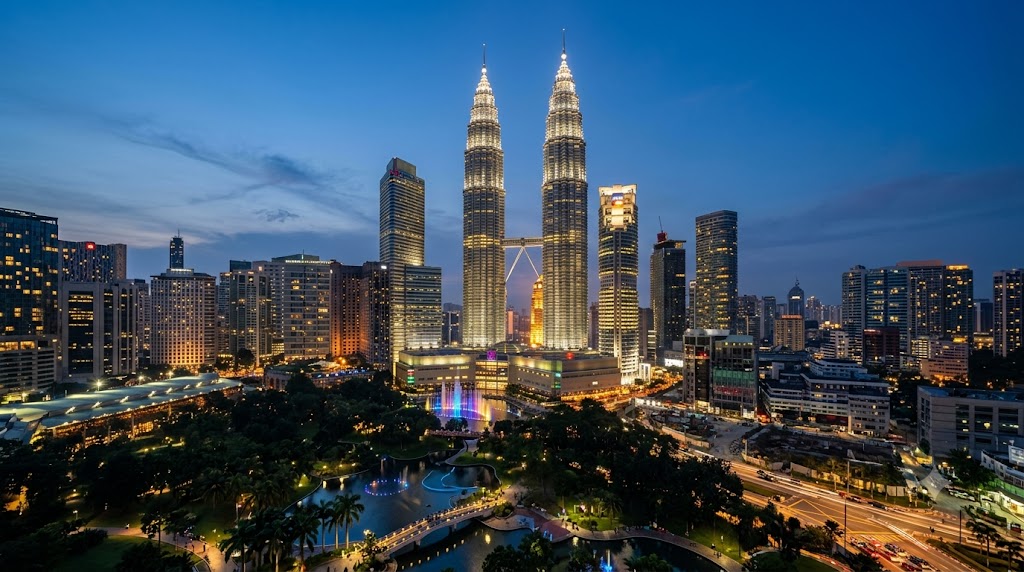
    • Petronas Twin Towers: the city’s defining landmark — the Skybridge and observation deck tickets sell out early in the day, so book ahead or go first thing.
    • KLCC Park: the green space at the foot of the towers, best for the classic sunset photo with the towers lit up behind the fountain show.
    • Batu Caves: limestone temple caves just outside the city, marked by a towering golden statue of Lord Murugan and a steep flight of colourful stairs — a half-day trip that works well early morning before the heat builds.
    • Bukit Bintang: KL’s shopping-and-nightlife district, from malls to street-level hawker stalls, busiest and most atmospheric after dark.
    • Merdeka Square and the old colonial quarter: for a change of pace from the modern skyline, KL’s historic administrative buildings and Central Market sit within easy walking distance of each other.
    • Aquaria KLCC and KL Bird Park: two easy, air-conditioned-or-shaded options that work particularly well for families with younger children.

    City Two: Genting Highlands — Malaysia’s Hill Station in the Clouds

    Sitting at roughly 1,800 metres above sea level, Genting Highlands keeps a steady 15–25°C year-round — a genuine hill-station climate barely an hour from tropical KL, reached via the Genting Skyway, one of Southeast Asia’s longest cable car systems.

    • The Genting Skyway itself: the cable car ride up is an attraction in its own right, gliding over jungle canopy with the temperature dropping as you climb.
    • Genting SkyWorlds: a large-scale theme park with rides across multiple zones, Malaysia’s answer to a proper theme-park day.
    • Casino and entertainment complex: Genting is home to Malaysia’s best-known casino resort, alongside shopping and dining built for the cooler climate.
    • Simply the weather: after a few sweaty days in KL, many travellers say the cool air itself is Genting’s best feature — walkable outdoor spaces without the tropical heat.
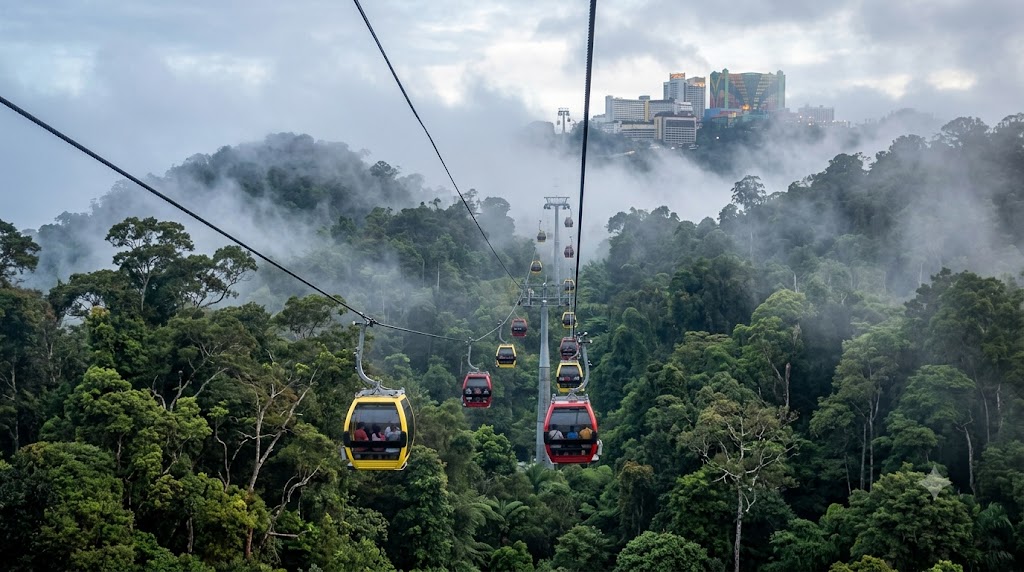
    Genting Highlands Skyway cable car rising through cool misty hills above Kuala Lumpur — Genting Highlands day trip
    The Genting Skyway cable car — the moment Malaysia’s trip contrast becomes physical, as tropical KL heat gives way to hill-station cool over a single ride.

    What to Eat: Malaysia’s Food Is Half the Trip

    Malaysia’s multicultural mix of Malay, Chinese and Indian influences makes it one of Southeast Asia’s most rewarding food destinations — and refreshingly easy for Indian palates, since spice and familiar flavours run through much of the local cuisine:

    • Nasi lemak: Malaysia’s unofficial national dish — coconut rice, sambal, fried anchovies, peanuts and egg, eaten any time of day.
    • Roti canai and teh tarik: a breakfast staple with clear South Indian roots — flaky flatbread with dhal or curry, alongside “pulled” milk tea.
    • Satay: grilled skewered meat with peanut sauce, found at hawker stalls across both KL and Genting.
    • Bak kut teh: a fragrant herbal pork-rib soup representing Malaysia’s strong Chinese culinary influence, for travellers open to trying it.
    • Little India, Brickfields (KL): for a familiar anchor amid new flavours, this neighbourhood serves excellent South Indian food alongside spice and textile shopping.

    Jalan Alor in Bukit Bintang is KL’s best-known night food street — a long strip of open-air stalls and restaurants that turns into the city’s liveliest dinner scene after dark.

    Shopping in Kuala Lumpur

    • Bukit Bintang malls: from luxury flagship stores to accessible fashion, this is KL’s dense central shopping district.
    • Central Market: a heritage building turned crafts-and-souvenir market — batik, pewter and local handicrafts under one roof.
    • Petaling Street (KL’s Chinatown): a busy market strip for bargain shopping, alongside some of the city’s best-known street food.
    • Mid Valley Megamall and Pavilion KL: two of the city’s largest, most modern malls, popular for a full air-conditioned shopping day when the heat outside gets intense.

    Worth the Detour: Melaka and Penang

    For trips of 7 days or more, two UNESCO World Heritage cities extend the Malaysia story beyond KL and Genting:

    • Melaka (Malacca): roughly two hours from KL by road, a colourful historic port city with Dutch and Portuguese colonial architecture, best known for Jonker Street’s night market and river cruise.
    • Penang (Georgetown): a short domestic flight or longer drive from KL, famous for street art, colonial heritage, and widely considered Malaysia’s food capital — even more food-focused than KL itself.

    Neither is essential for a first Malaysia trip, but both are natural additions once KL and Genting are familiar territory.

    How to Split Your Days: Sample Itineraries

    Trip Length Kuala Lumpur Genting Highlands
    4 days / 3 nights 2 nights — Petronas, Bukit Bintang, Batu Caves 1 night — Skyway, SkyWorlds, cool-air reset
    5 days / 4 nights 3 nights — full city coverage plus a leisure day 1 night — focused theme-park and Skyway day
    7 days / 6 nights 3–4 nights — add Melaka or Penang as a side trip 2 nights — unhurried, with an extra SkyWorlds day

    Our general rule: KL gets the larger share of nights since it holds more variety, while Genting works best as a shorter, high-impact stay — one full day is usually enough to feel the contrast and hit the main attractions without needing to fill extra time at altitude. Groups travelling with elderly parents sometimes flip this ratio, extending the Genting leg for its cooler, calmer pace and trimming a day of KL’s heat and walking instead — tell us who’s travelling and we’ll weight the split accordingly.

    Malaysia’s Visa-Free Entry for Indians: What to Know for 2026

    Malaysia offers Indian passport holders visa-free entry for stays of up to 30 days, and this policy has been extended through 2026 as part of Visit Malaysia Year — one of the more traveller-friendly entry arrangements in Southeast Asia right now. As always with visa-free entry, “no visa” doesn’t mean “no documents”: carry a passport valid for at least 6 months from your travel date, a return or onward flight ticket, proof of accommodation, and evidence of sufficient funds for your stay. Given how entry policies have shifted elsewhere in the region this year (see our Thailand visa rules explainer), we still recommend confirming the live rule with our desk close to your travel date rather than assuming it’s permanently fixed.

    Best Time to Visit Malaysia from India

    Months Conditions Verdict
    December – February Drier, slightly cooler, peak tourist season Best time to visit — comfortable weather in both KL and Genting
    March – June Warm with occasional showers Good value shoulder season, still pleasant overall
    July – September Warm and humid, brief afternoon showers common Workable, especially since Genting’s altitude offers natural relief from KL’s heat
    October – November Monsoon season, heavier and more frequent rain The least ideal window; if travelling, lean on Genting’s covered attractions

    One quiet advantage of the KL + Genting combination: even in warmer or wetter months, a day or two at Genting’s cooler altitude breaks up the tropical heat in a way a single-city Malaysia trip can’t.

    Getting to Malaysia from Chandigarh and Amritsar

    Kuala Lumpur is well connected from India, with flight time running roughly 5–6 hours on routes mainly via Delhi, alongside some direct options from other Indian metros. Chandigarh and Amritsar travellers connect through Delhi, and our ticketing desk prices the combined routing as one itinerary — following the same booking-window principle from our cheap flights guide, aiming for the 4–6 week booking window for the best combined fare.

    Getting Between KL and Genting Highlands

    • Genting Skyway cable car: the classic, scenic route — most Malaysia packages build the transfer around this, combining transport with the trip’s most memorable ride.
    • Private transfer by road: roughly an hour’s drive, useful with heavy luggage or when the cable car has long queues on weekends and public holidays.
    • Shuttle coach services: a budget-friendly option connecting KL Sentral and other hubs directly to Genting, with the Skyway or road transfer for the final stretch.

    What to Pack for a KL + Genting Trip

    • Light, breathable clothing for Kuala Lumpur’s tropical heat and humidity.
    • A jacket or warm layer for Genting — easy to forget when you’re sweating in KL the same morning, but genuinely needed at altitude.
    • Comfortable walking shoes — both cities involve a fair amount of walking, and Batu Caves has a steep staircase.
    • A universal power adapter — Malaysia uses UK-style three-pin sockets.
    • A light rain jacket or umbrella, especially outside the December–February peak window.

    Money-Saving Tips from Our Desk

    1. Book Petronas Towers tickets in advance. Same-day slots sell out early, and pre-booking avoids losing a morning to a sold-out ticket counter.
    2. Eat where the hawker stalls are busiest. Bukit Bintang’s street-level food is excellent and a fraction of the cost of mall food courts.
    3. Use the Skyway for the KL–Genting transfer rather than a private cab — it’s often cheaper and undeniably more memorable.
    4. Travel in the shoulder months (March–June) for softer hotel rates with still-workable weather.
    5. Bundle Genting SkyWorlds tickets with your package rather than buying separately at the gate, where queues and walk-up prices both run higher.

    Malaysia Culture and Etiquette Notes

    • Multicultural and multi-faith: Malaysia’s Malay-Muslim majority coexists with large Chinese and Indian communities — mosques, Buddhist and Taoist temples, and Hindu temples all sit within the same city, often streets apart.
    • Modest dress at religious sites: shoulders and knees covered at mosques and temples; robes are often provided for visitors at major sites.
    • Friday prayers: some businesses and government offices adjust hours around midday Friday prayers — worth building light buffer time into that day’s plans.
    • Halal food is the default in most restaurants, which works well for large groups with mixed dietary preferences.
    • English is widely spoken alongside Bahasa Malaysia, making Malaysia one of the more language-easy Southeast Asian destinations for Indian travellers.

    What’s Genuinely Worth the Splurge

    A few upgrades consistently earn their keep on this trip, based on client feedback over the years:

    • Petronas Towers Skybridge + observation deck combo ticket, booked well ahead — the single most-requested “don’t miss it” experience in KL.
    • A KLCC-facing hotel room for at least one night — waking up to the towers is worth the small premium for most first-time visitors.
    • Genting SkyWorlds express-access tickets on weekends or school holidays, when queues otherwise eat into a short highland stay.
    • The Skyway cable car over a road transfer, purely for the experience — it’s often similarly priced but far more memorable.

    Common Malaysia Myths We Correct Every Week

    What People Assume The Reality
    “Malaysia needs a visa like most of Southeast Asia.” Indian passport holders get visa-free entry for up to 30 days, extended through 2026 under Visit Malaysia Year.
    “Genting Highlands is just a casino town.” The casino is one part of a much larger complex — theme parks, cool-climate walking, and the Skyway ride itself are the bigger draw for most Indian family travellers.
    “KL and Genting are basically the same trip.” They’re a genuine climate and character contrast — tropical skyline city versus cool hill-station altitude, barely an hour apart.
    “You need a week to do Malaysia properly.” 4–5 days comfortably covers both cities without feeling rushed — this is very much a short-haul, high-impact trip.

    Malaysia vs Thailand vs Singapore: An Honest Comparison

    Since these three routinely compete for the same short-haul travel slot from India, here’s how Malaysia actually stacks up:

    Malaysia Thailand Singapore
    Visa for Indians Visa-free, 30 days Visa-free, 30 days e-Visa, mandatory in advance
    Signature contrast Tropical city + cool hill station in one trip City + beach/island combinations Ultra-modern, highly compact city-state
    Best for First-timers, families, short 4-5 day trips Beach-and-city groups, value-conscious travellers Food lovers, families, efficient short trips
    Flight time from India ~5–6 hours ~4–5 hours via Delhi ~5–6 hours

    Malaysia’s edge is specifically the KL–Genting contrast delivered without inter-city flights or long transfers — Thailand’s contrast (city to island) usually needs a domestic flight, and Singapore, while compact and efficient, doesn’t have Malaysia’s hill-station cooling-off option built in. Many experienced travellers eventually do all three; for a first Southeast Asia trip, Malaysia’s visa-free simplicity and short internal transfer make it one of the easiest starting points.

    Who This Trip Is Perfect For

    • First-time international travellers: Malaysia’s visa-free entry, English-friendly signage and short flight time make it one of the easiest first international trips from India.
    • Families with kids: Genting’s theme parks alongside KL’s Aquaria and Bird Park give children plenty to do without long transfer times.
    • Weekend-scale international trips: at 4–5 days total, Malaysia fits inside a long weekend plus a couple of leave days more easily than most international destinations.
    • Travellers wanting variety without complexity: the two-city contrast delivers a genuinely varied trip without the multi-country visa juggling that variety usually requires.
    • Honeymooners on a shorter timeline: Genting’s cool-climate resorts offer a romantic change of pace from KL’s city energy, without needing the longer trip length Bali or the Maldives typically ask for.
    • Groups mixing interests: shoppers and foodies can stay content in KL while thrill-seekers head up to Genting’s rides — a rare itinerary that keeps a mixed-interest group happy without splitting up entirely.

    Booking a Package vs Planning Malaysia Yourself

    DIY Flywings Malaysia Package
    City split Guesswork on how many nights each city deserves Balanced based on years of client feedback
    Petronas & SkyWorlds tickets Risk of sold-out same-day slots Pre-booked as part of the itinerary
    KL–Genting transfer Booked separately, sometimes at inflated rates Bundled into one seamless itinerary
    Hotel locations Easy to book somewhere inconvenient for sightseeing Matched to your planned attractions in each city
    When something goes wrong App support queues A human in Mohali, a phone call away

    Frequently Asked Questions

    Do Indians need a visa for Malaysia?

    No — Malaysia offers visa-free entry to Indian passport holders for stays up to 30 days, a policy extended through 2026 as part of Visit Malaysia Year. Standard travel documents (valid passport, return ticket, accommodation proof, sufficient funds) are still required at entry.

    How many days are needed for Kuala Lumpur and Genting Highlands?

    4–5 days comfortably covers both cities — roughly 2–3 nights in KL and 1–2 nights in Genting. Shorter trips can compress this to a single overnight in Genting; longer trips (7 days) can add a side trip to Melaka or Penang.

    What is the distance between Kuala Lumpur and Genting Highlands?

    About 51 km, typically covered by the Genting Skyway cable car (the scenic, popular option) or a roughly one-hour road transfer.

    Is Malaysia good for a family trip?

    Yes — Genting’s theme parks and cool climate, combined with KL’s Aquaria, Bird Park and easy-to-navigate city, make Malaysia one of the more family-friendly short-haul international trips from India.

    What’s the weather like in Genting Highlands?

    A steady 15–25°C year-round thanks to its 1,800-metre altitude — genuinely cool compared to tropical Kuala Lumpur, and one of the main reasons travellers build it into a Malaysia itinerary.

    Is there a direct flight from India to Kuala Lumpur?

    Some direct options exist from major Indian cities, though most Chandigarh and Amritsar travellers connect via Delhi. Total flight time runs roughly 5–6 hours; our desk prices the full combined routing for the best fare.

    Can Flywings arrange the full KL + Genting itinerary as one package?

    Yes — flights, hotels in both cities, the Skyway or road transfer between them, and key attraction tickets (Petronas, SkyWorlds) are all bundled into one itemised quote. Tell us your dates and group size to get started.

    Should I add Melaka or Penang to my Malaysia trip?

    Only if you have 7+ days — for a first trip, KL and Genting alone deliver a complete, well-paced experience. Melaka (a 2-hour drive) and Penang (a short flight or longer drive) are excellent additions once you’re ready for a longer, deeper Malaysia trip.

    Is Malaysian food suitable for Indian travellers?

    Very much so — Malaysia’s large Indian community means South Indian food (roti canai, teh tarik, banana leaf meals) is widely available alongside Malay and Chinese cuisine, and halal food is the default in most restaurants, easing mixed-group dining.

    What currency does Malaysia use, and should I carry cash?

    Malaysia uses the Malaysian Ringgit (MYR). Cards are widely accepted in KL’s malls, hotels and larger restaurants, but carrying some cash is useful for hawker stalls, local markets and smaller Genting Highlands vendors, where card acceptance is less consistent.

    Is Genting Highlands worth visiting if I don’t want to gamble?

    Completely — the casino is only one part of the complex. Genting SkyWorlds theme park, the Skyway cable car ride, cool-climate walking, shopping and dining are the bigger draw for most Indian family and leisure travellers, with the casino barely factoring into a typical itinerary.

    Two Very Different Cities, One Easy Trip

    Malaysia’s KL-and-Genting combination is one of the best-value, most varied short-haul trips available from India right now — and with visa-free entry extended through 2026, the paperwork has never been simpler. Explore our Malaysia package, browse more international tour packages from Chandigarh, or reach us directly:

    Written by Sukhjinder Kaur, Senior Travel Content Writer at Flywings Tour & Packages Pvt Ltd — booking flights and holidays from Mohali, Punjab since 2005. Visa requirements and seasonal guidance verified as of July 2026; entry rules can change, so confirm current details when you enquire.
  • Singapore Tour Package from Chandigarh: 5 Itinerary Tracks for Every Kind of Traveller (2026)

    Singapore Tour Package from Chandigarh: 5 Itinerary Tracks for Every Kind of Traveller (2026)

    Singapore is the rare international destination that genuinely works for every kind of traveller — first-time flyers, food-obsessed friend groups, families with young kids, couples wanting a skyline dinner, and even travellers who just want quiet green space between meetings. The reason is simple: Singapore is compact, spotlessly organised, and built almost entirely around modular attractions you can mix and match. At Flywings Tour & Packages Pvt Ltd, we stopped giving every Singapore client the same generic day-by-day itinerary years ago — instead, we plan by track: pick the traveller type that matches your trip, and build from there. This guide lays out all five.

    Quick facts before you plan: Singapore requires an e-Visa for Indian passport holders — there is no visa-on-arrival, so this must be arranged before you fly. Direct flights from Delhi run 5–6 hours; Chandigarh and Amritsar travellers connect via Delhi. Best weather window is February–April. Most first-time trips run 4–5 days.

    Why “Tracks” Work Better Than a Generic Day-by-Day Plan

    Most Singapore itineraries online read identically — Gardens by the Bay, Sentosa, Chinatown, Orchard Road, in some order, regardless of who’s travelling. But a honeymoon couple and a family with two kids under ten shouldn’t be doing the same evening in Singapore, and a first-timer’s priorities look nothing like a repeat visitor’s. Below are five tracks; most travellers combine two or three of them into a single 4–5 day trip.

    Track 1: The First 48 Hours (Essential Singapore)

    If this is your first Singapore trip and you have limited time, this track covers the icons — everything that makes Singapore instantly recognisable in photos:

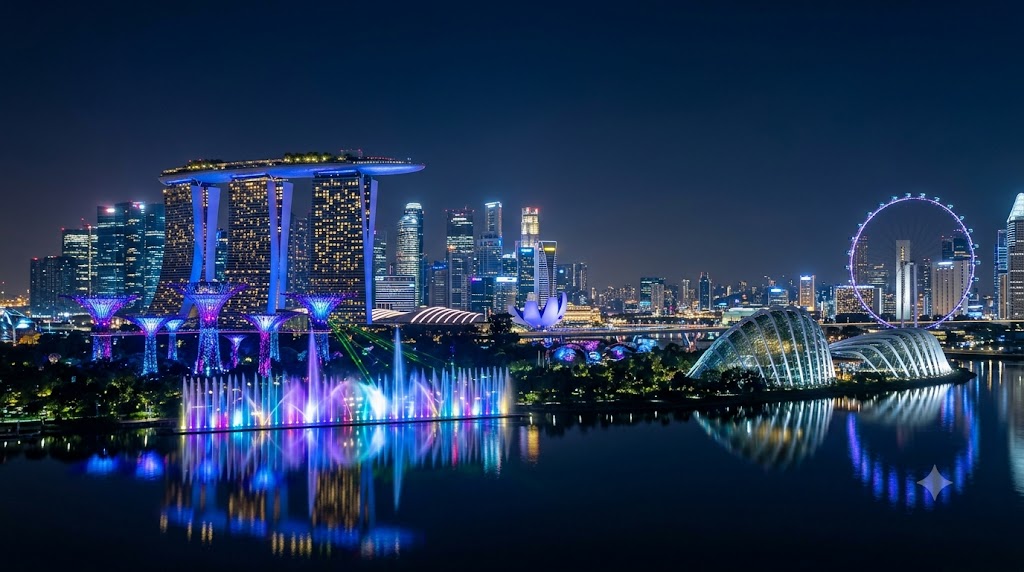
    • Marina Bay Sands and the SkyPark: the infinity pool is for hotel guests only, but the observation deck is open to all visitors for the same panoramic skyline view.
    • Gardens by the Bay: the Supertree Grove’s nightly light-and-sound show is free to watch from ground level; the Cloud Forest and Flower Dome domes are ticketed and worth the entry.
    • Merlion Park: Singapore’s iconic half-lion, half-fish statue, best photographed early morning or blue hour to avoid both crowds and harsh midday light.
    • Helix Bridge and the Marina Bay waterfront: a scenic evening walk connecting the bay’s major landmarks, especially striking after dark.
    • A river cruise or Singapore Flyer ride: an easy way to see the skyline from a different angle without much walking.

    Two focused days can realistically cover this entire track, making it the natural anchor for any Singapore itinerary regardless of what else you add.

    Track 2: The Family Track

    Singapore consistently ranks among Asia’s most family-friendly cities — clean, safe, English-speaking, and genuinely built with kids in mind:

    • Singapore Zoo and Night Safari: widely regarded as among the world’s best zoos, with the Night Safari offering a completely different (and popular with kids) after-dark experience.
    • River Wonders: a river-and-boat-themed section adjoining the zoo, home to giant pandas and a manatee habitat.
    • Universal Studios Singapore (Sentosa): a full-day theme park with rides scaled for various ages, plus character meet-and-greets younger kids love.
    • S.E.A. Aquarium (Sentosa): one of the world’s largest aquariums, an easy, air-conditioned half-day that pairs naturally with a Sentosa beach afternoon.
    • Science Centre Singapore: hands-on exhibits that work well as a rainy-day backup or a change of pace from theme parks.
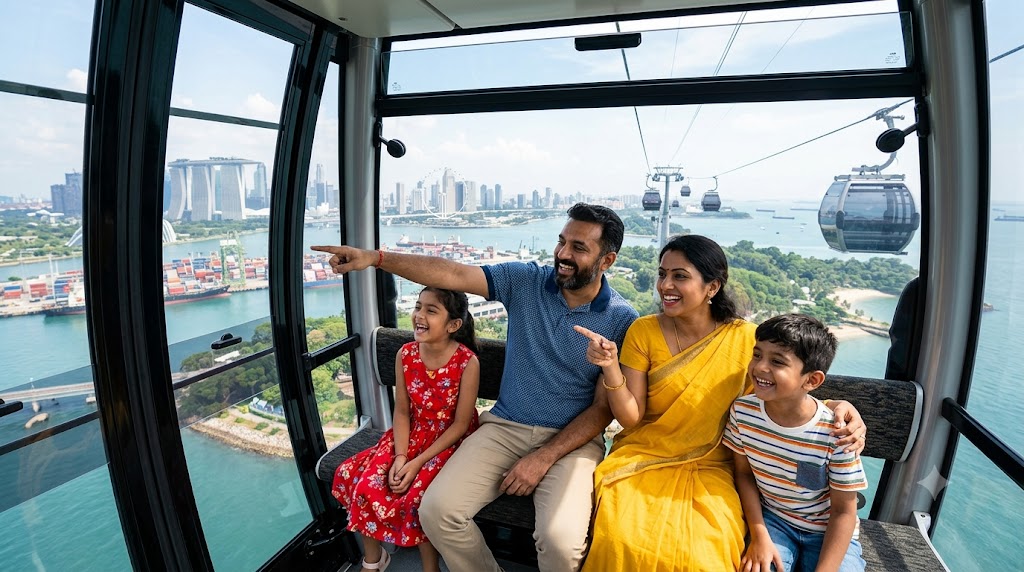
    Family riding the Sentosa cable car with Singapore skyline views — Sentosa Island Singapore family itinerary
    The Sentosa cable car turns a routine island transfer into one of the trip’s best views — a small detail that makes a big difference for families.

    Sentosa Island alone can anchor 1.5–2 days of a family trip, connected to the mainland by cable car, monorail or a short causeway walk/drive — we typically recommend the cable car at least once for the views alone.

    Track 3: The Foodie Track

    Singapore’s food scene is a genuine attraction in its own right, built around hawker centres — government-regulated food courts where some stalls have held Michelin recognition while still charging hawker prices:

    • Maxwell Food Centre and Lau Pa Sat: two of the most famous hawker centres, central and easy to combine with sightseeing.
    • Chinatown: beyond temples and shophouses, a dense cluster of both hawker stalls and Michelin-recognised local eateries.
    • Little India: for travellers wanting familiar flavours or a cultural contrast, with excellent South Indian and North Indian food alongside the neighbourhood’s temples and spice shops.
    • Newton Food Centre: a popular evening hawker spot for satay and seafood, especially atmospheric after dark.
    • Dishes to seek out: chilli crab, Hainanese chicken rice, laksa, char kway teow and kaya toast with soft-boiled eggs for breakfast.

    A half-day “hawker crawl” across two or three centres, spaced between sightseeing, is one of the most consistently loved additions we build into Singapore itineraries.

    Track 4: The Shopping and Nightlife Track

    For couples, friend groups, or anyone wanting Singapore’s more grown-up evening side:

    • Orchard Road: Singapore’s main shopping boulevard, from luxury flagship stores to accessible malls, at its best lit up in the evening.
    • Clarke Quay and Boat Quay: riverside dining and nightlife districts, with everything from casual bars to late-night clubs.
    • Rooftop bars: Marina Bay Sands and several nearby hotels offer skyline rooftop bars — not the infinity pool itself, but the view comes close.
    • Haji Lane and Kampong Glam: a compact, colourful district of independent boutiques, street art and café culture around the Sultan Mosque.

    Track 5: The Nature and Offbeat Track

    For repeat visitors or anyone wanting to see a quieter side of Singapore beyond the obvious icons:

    • Singapore Botanic Gardens: a UNESCO World Heritage Site and genuinely peaceful escape, including the National Orchid Garden.
    • Southern Ridges: a series of connected parks and elevated walkways (including the striking Henderson Waves bridge) offering some of the city’s best skyline views without the crowds.
    • Pulau Ubin: a short bumboat ride away, this rustic island feels like stepping back decades — kampong villages, mangroves and cycling trails, a sharp contrast to mainland Singapore.
    • Tiong Bahru: a heritage residential neighbourhood turned café-and-bookshop district, popular with locals rather than tour groups.

    Don’t Skip Jewel Changi — Even on a Layover

    Changi Airport is, by a wide margin, the most attraction-worthy airport most travellers will ever pass through — and if your flight to Bali, Australia or elsewhere connects through Singapore, it’s worth knowing what’s here even without a full trip. Jewel Changi’s centrepiece is the Rain Vortex, the world’s tallest indoor waterfall, surrounded by a multi-level indoor forest, walking trails and a canopy park with a bouncing net and mazes. Butterfly gardens, a rooftop pool (for transit passengers with day-use hotel access), and an enormous range of dining sit within the same terminal complex. Travellers with a layover of 5+ hours can genuinely step out, explore Jewel, and return airside without needing a full visa-run mindset — though the e-Visa requirement above still applies if you plan to properly exit and re-enter Singapore, so check your layover’s transit rules with us first.

    Singapore Etiquette and Culture Notes

    • Cleanliness is taken seriously: littering, jaywalking and eating on the MRT carry real, enforced fines — not just guidebook warnings.
    • Multicultural by design: Chinese, Malay, Indian and Peranakan cultures are all visibly present — Chinatown, Kampong Glam and Little India are living neighbourhoods, not recreations.
    • Tipping isn’t expected: most restaurants include a service charge; additional tipping is appreciated but not the norm.
    • Escalator etiquette: stand on the left, walk on the right — Singaporeans notice, even if visitors don’t.
    • English is the working language, alongside Mandarin, Malay and Tamil — signage and service are almost entirely English-friendly for Indian travellers.

    Combining Tracks: Sample 4-Day and 6-Day Itineraries

    Days 4-Day Trip (First-Timer + Family blend) 6-Day Trip (Adds Foodie + Nightlife)
    1 Arrival, Marina Bay evening walk Arrival, Marina Bay evening walk
    2 Gardens by the Bay, Merlion Park, river cruise Gardens by the Bay, Merlion Park, hawker lunch at Lau Pa Sat
    3 Full day Sentosa (Universal Studios or S.E.A. Aquarium) Full day Sentosa, cable car, beach time
    4 Zoo/Night Safari or Orchard Road shopping, departure Chinatown + Little India food crawl
    5 Zoo and Night Safari
    6 Botanic Gardens morning, Clarke Quay evening, departure

    Singapore e-Visa: What Indian Travellers Must Arrange in Advance

    Unlike Thailand or Bali, Singapore does not offer visa-on-arrival for Indian passport holders — an e-Visa must be obtained before you fly, and this is the single most common planning mistake we catch for first-time Singapore travellers. The requirements are straightforward: a passport valid for at least 6 months, a recent passport photograph, a completed application form, proof of a return flight, proof of accommodation, and a bank statement showing sufficient funds. Processing typically takes 3–5 working days, so we recommend starting this at least two to three weeks before departure to build in a comfortable buffer. We file this application as part of every Singapore package we book.

    Best Time to Visit Singapore from India

    Months Conditions Verdict
    February – April The most pleasant window — drier, slightly cooler Best time to visit for comfortable outdoor sightseeing
    May – September Hot and humid with regular short showers Fine if you balance outdoor and indoor/air-conditioned attractions
    November – December Wetter monsoon season, but mild temperatures Festive season energy (Christmas light-ups) offsets the rain

    Singapore sits near the equator, so temperatures stay warm year-round — the real variable is rainfall, not heat, and even wet months bring short afternoon showers rather than all-day rain.

    Getting to Singapore from Chandigarh and Amritsar

    Direct Delhi–Singapore flights run 5–6 hours on carriers including Singapore Airlines, IndiGo and Air India, making Delhi the obvious connection point for Chandigarh and Amritsar travellers. Our ticketing desk prices the Chandigarh–Delhi–Singapore routing as one combined itinerary, applying the same booking-window principles from our cheap flights guide — 4–6 weeks ahead typically secures the best combined fare.

    Getting Around Once You’re There

    • MRT (metro): clean, frequent, and covers almost every attraction on this list — the default way to move around for most visitors.
    • EZ-Link or contactless card: tap-and-go on the MRT and buses; most international debit/credit cards now work directly on Singapore’s transit gates too.
    • Grab (ride-hailing): widely used and reliable for late nights or when travelling with young kids and stroller/luggage.
    • Walking: central Singapore is highly walkable and covered, with sheltered walkways connecting many MRT stations to malls and attractions — genuinely useful in both heat and rain.

    What to Pack

    • Light, breathable clothing — Singapore is hot and humid nearly year-round.
    • A light jacket for indoors — malls, the MRT and restaurants are often heavily air-conditioned.
    • A compact umbrella — short showers are common even outside the wet season.
    • Comfortable walking shoes — most tracks above involve a fair amount of walking, even with excellent transit.
    • A reusable water bottle — Singapore’s tap water is safe to drink, refill stations are common.

    Money-Saving Tips from Our Desk

    1. Eat at hawker centres, not hotel restaurants. The food is often better, and the price difference is significant — save hotel dining for one special evening.
    2. Book Sentosa attraction combos (Universal Studios + Aquarium, for example) rather than separate single tickets.
    3. Use the MRT day pass if you’re moving around frequently — it usually beats paying per trip.
    4. Book your e-Visa and flights together, early. Late e-Visa applications sometimes force last-minute (pricier) flight changes if processing runs long.
    5. Visit paid Gardens by the Bay domes on a weekday morning — shorter queues and occasionally better rates than weekend evening slots.

    What’s Genuinely Worth the Splurge

    Based on years of client feedback, a handful of upgrades consistently earn their keep in Singapore:

    • One night at or near Marina Bay Sands, even if the rest of the stay is elsewhere — the location and view are simply unmatched for a Singapore trip’s centrepiece night.
    • A proper Chinese or Peranakan fine-dining meal, booked ahead — Singapore’s food scene at the top end genuinely rivals its hawker-centre reputation.
    • Skip-the-line tickets for Universal Studios on weekends or school holidays, where queue times otherwise eat hours of a short trip.
    • A river cruise at dusk rather than daytime — the skyline lighting up around you is worth the small timing premium.

    Where to save instead: hawker centres genuinely rival restaurant quality at a fraction of the price, and Singapore’s public transport is efficient enough that private transfers are rarely necessary beyond airport pickup.

    Singapore vs Its Southeast Asia Neighbours

    Since Singapore, Bali and Thailand often compete for the same travel slot, here’s an honest comparison for travellers deciding between them:

    Singapore Bali Thailand
    Vibe Ultra-modern city-state, spotless and efficient Tropical island, nature and culture-forward Mix of cities, beaches and temples
    Visa for Indians e-Visa, mandatory in advance Visa on arrival Visa-free, 30 days
    Best for First-timers, families, food lovers, short trips Honeymoons, wellness, longer relaxed trips Value-conscious groups, beach-and-city combos
    Trip length 4–5 days 6–7 days 5–7 days

    Many of our clients don’t actually have to choose — Singapore’s position as a flight hub makes it an easy stopover addition to a Bali or Australia-bound trip, covered above in the Jewel Changi section.

    Common Singapore Myths We Correct Every Week

    What People Assume The Reality
    “Singapore has visa-on-arrival like Thailand or Bali.” No — Indian passport holders need an e-Visa arranged before departure. This is the most common Singapore planning mistake we see.
    “It’s too expensive for a family trip.” Singapore can be pricey at the top end, but hawker food, free attractions (Merlion Park, Supertree light show, Southern Ridges) and efficient transit keep a family trip very manageable.
    “You need a week to see everything.” 4–5 days comfortably covers two or three tracks — Singapore’s compactness is exactly what makes shorter trips work well here.
    “Chewing gum will get you arrested.” An exaggeration — importing/selling gum is restricted, but carrying a small personal pack isn’t the dramatic offence internet lists suggest. Littering and vandalism fines, on the other hand, are real and strictly enforced.

    Who Each Track Is Perfect For

    • First-time visitors: Track 1 (Essential Singapore) plus a half-day from Track 3 (Foodie) covers the trip’s greatest hits efficiently.
    • Families with kids: Track 2 anchors the trip, with Track 1’s Marina Bay evening as a natural bookend.
    • Couples and honeymooners: Track 1 plus Track 4 — skyline views by day, rooftop bars and riverside dinners by night. Compare it against our other honeymoon options in the Bali vs Maldives vs Dubai guide.
    • Friend groups: Track 3 and Track 4 combined make for a food-and-nightlife-forward trip with Sentosa as a beach-day break.
    • Repeat visitors: Track 5 is where Singapore surprises people who think they’ve “done” it already.

    Booking a Package vs Planning Singapore Yourself

    DIY Flywings Singapore Package
    e-Visa filing Self-navigated, easy to submit incomplete documents Filed correctly the first time, timed to your travel dates
    Track planning Generic day-by-day templates found online Built around who’s actually travelling
    Sentosa logistics Separate tickets, cable car, and transfers booked individually Bundled as one seamless day
    Hotel location Easy to book somewhere inconvenient for your chosen tracks Matched to the attractions you actually plan to visit
    When something goes wrong App support queues A human in Mohali, a phone call away

    Frequently Asked Questions

    Do Indians need a visa for Singapore?

    Yes — an e-Visa is mandatory and must be arranged before you travel; there is no visa-on-arrival option for Indian passport holders. Processing typically takes 3–5 working days, so apply at least two to three weeks ahead of your trip.

    How many days are enough for a Singapore trip?

    4–5 days covers Singapore comfortably for most travellers, combining two or three of the tracks above. First-timers on a tighter schedule can see the essentials in 3 days, though Sentosa alone benefits from a full day.

    Is Singapore expensive for Indian travellers?

    It can be, at the top end — but hawker centre food, free attractions like the Supertree light show and Southern Ridges, and an efficient, affordable metro system mean a well-planned trip stays reasonable. We build cost-conscious itineraries without cutting the experiences that matter.

    What is the best itinerary for a family with young children?

    The Family Track — Singapore Zoo, Night Safari, Sentosa’s Universal Studios and S.E.A. Aquarium — anchored by 1.5–2 days on Sentosa Island, with a Marina Bay evening added as an easy, low-effort bookend.

    Sentosa or Gardens by the Bay — which is better?

    They’re not competing for the same time slot — Gardens by the Bay is a half-day (or an evening for the light show) best paired with central sightseeing, while Sentosa is a destination in itself worth a full day, especially with kids. Most itineraries should include both rather than choosing one.

    What is the best time of year to visit Singapore?

    February to April offers the most comfortable weather with lower humidity and less rain. Singapore is warm year-round, so the real planning factor is rainfall rather than temperature — even wetter months bring short afternoon showers rather than days of rain.

    Can Flywings arrange the Singapore e-Visa as part of the package?

    Yes — visa filing, hotel booking matched to your chosen tracks, Sentosa logistics and airport transfers are all handled as one itemised package. Tell us your travel dates and who’s coming, and we’ll build the itinerary around it.

    Is Jewel Changi worth visiting even without a full Singapore trip?

    Yes — if you have a layover of several hours connecting through Changi Airport, Jewel’s indoor waterfall, forest trails and canopy park are accessible without a full city visit. Just confirm your transit visa situation with us first, since rules differ between staying airside and formally exiting the airport.

    Is Singapore good for solo travellers?

    Very much so — it’s one of Asia’s safest cities for solo travel, with excellent public transport, English widely spoken, and enough compact, walkable neighbourhoods (Track 5’s offbeat spots especially) to fill a comfortable few days without needing a group.

    Should I choose Singapore or Bali for my trip?

    They suit different moods more than they compete directly — Singapore for a polished, efficient, food-and-family-friendly city trip in 4–5 days; Bali for a longer, slower, nature-and-honeymoon-oriented island trip. If you have 10+ days, combining both via Singapore’s convenient stopover position is increasingly popular among our clients.

    Pick Your Tracks, We’ll Build the Trip

    Singapore rewards a plan that matches who’s actually travelling — and that’s exactly what these five tracks are built for. Tell us your dates, group, and which tracks appeal most, and we’ll turn it into an itemised itinerary within 24 hours. Explore our Singapore Escape 4N/5D package, browse more international tour packages from Chandigarh, or reach us directly:

    Written by Sukhjinder Kaur, Senior Travel Content Writer at Flywings Tour & Packages Pvt Ltd — booking flights and holidays from Mohali, Punjab since 2005. Visa requirements and seasonal guidance verified as of July 2026; entry rules can change, so confirm current details when you enquire.