Category: Flight Tips

  • Bachelor and Bachelorette Trip Destinations from Chandigarh: The Squad’s Decision Guide

    Bachelor and Bachelorette Trip Destinations from Chandigarh: The Squad’s Decision Guide

    Every bachelor or bachelorette trip starts with the same group chat argument: does the squad want a beach, a mountain, a different country entirely, or whatever is cheapest given half the group just spent their savings on the wedding gift. At Flywings Tour & Packages Pvt Ltd, we have booked enough of these trips out of Chandigarh to know the argument usually is not really about the destination, it is about what kind of trip everyone actually wants, which is a slightly different question and a much easier one to actually answer as a group. This guide sorts destinations by vibe and budget first, so your group chat can skip straight to the fun part.

    Quick context: Most bachelor and bachelorette trips from the Tricity fall into one of four vibes: beach and nightlife, mountains and adventure, a short international escape, or budget-friendly and close. Picking the vibe first, then the destination, ends the group chat argument faster than debating individual cities.

    Start With the Vibe, Not the Destination

    The fastest way to end a stalled group chat is to stop debating specific cities and start agreeing on what kind of trip everyone actually wants. Once the vibe is settled, the destination shortlist usually picks itself.

    • Beach and nightlife: daytime pool or beach time, proper nights out, a trip built around energy rather than sightseeing.
    • Mountains and adventure: road trips, trekking, genuine physical activity, and the kind of photos that do not look like everyone else’s bachelor trip.
    • A short international escape: the novelty and photos of a foreign trip without needing two weeks off work.
    • Budget-friendly and close: a real trip without the price tag of the other three, often the right call when half the group is also paying for wedding expenses the same season.

    How Many Days Does Each Vibe Actually Need

    One of the most common planning mistakes is picking a destination that suits the vibe but not the actual number of days the group can realistically get away for. Matching trip length to destination avoids the two most common regrets we hear afterward, a rushed trip that felt like more travel than celebration, or a longer booking that half the group could not actually commit to.

    • A weekend (2-3 days): Amritsar, Kasauli, or a tight Goa trip. Anything requiring a long-haul international flight will feel almost entirely like travel days on this timeline.
    • A long weekend (4 days): Dubai’s direct flight makes it genuinely workable here, as does a relaxed Goa trip or Rishikesh with a bit of buffer.
    • A proper week (5-7 days): Thailand, Bali or Leh Ladakh all come into their own at this length, giving enough time to actually settle into the destination rather than rushing through a checklist.

    The Squad Decision Matrix

    Destination Vibe Trip Length Getting There from Chandigarh
    Goa Beach and nightlife 3-4 days Via Delhi, well-connected
    Leh Ladakh Mountains and adventure 5-7 days Via Delhi, seasonal (May-September)
    Rishikesh Mountains and adventure, budget-friendly 2-3 days Road trip, no flight needed
    Thailand Beach, nightlife, international escape 4-5 days Via Delhi, visa-free entry
    Bali Beach, adventure, international escape 5-6 days Via Delhi/KL, visa on arrival
    Dubai Nightlife, international escape, short trip 3-4 days Direct from Chandigarh (IXC)
    Amritsar or Kasauli Budget-friendly, close 1-2 days Under 4 hours by road

    Beach and Nightlife: Goa vs Thailand

    This is the most common comparison we field, and the honest answer depends on what the group actually values more, familiarity and lower cost, or novelty and a genuinely different scene.

    • Goa wins on simplicity: no visa, no international flight, and a well-worn playbook for exactly this kind of trip. It is also more forgiving on a tight budget and last-minute planning, since domestic bookings have more flexibility than international ones.
    • Thailand wins on novelty and, for many groups, better value than people expect once you compare like for like, since visa-free entry removes the paperwork friction and the nightlife scene in Bangkok or on the islands is built specifically for exactly this kind of trip.

    Our rule of thumb: if the trip is being planned inside six weeks of the wedding, Goa. If there is genuine lead time and everyone’s passport is sorted, Thailand usually wins the group vote once people see real options side by side. It is also worth checking each group member’s passport validity before this decision gets made, since a passport with less than six months’ validity from the travel date rules out the international option entirely regardless of what the group actually wants.

    Mountains and Adventure: Leh Ladakh vs Rishikesh

    Both scratch the same itch differently. Leh Ladakh is the bigger trip in every sense, higher altitude, longer duration, a proper road-trip-through-dramatic-scenery experience that has become something of a bachelor trip cliché precisely because it delivers every time. It needs more planning, a seasonal window (roughly May to September), and a group genuinely up for the physical demands of altitude. Rishikesh is the accessible version of the same energy, closer, shorter, no altitude concerns, with river rafting and a livelier scene than its spiritual reputation might suggest, making it the better choice when the group has less time or a lower risk appetite for a first big group trip.
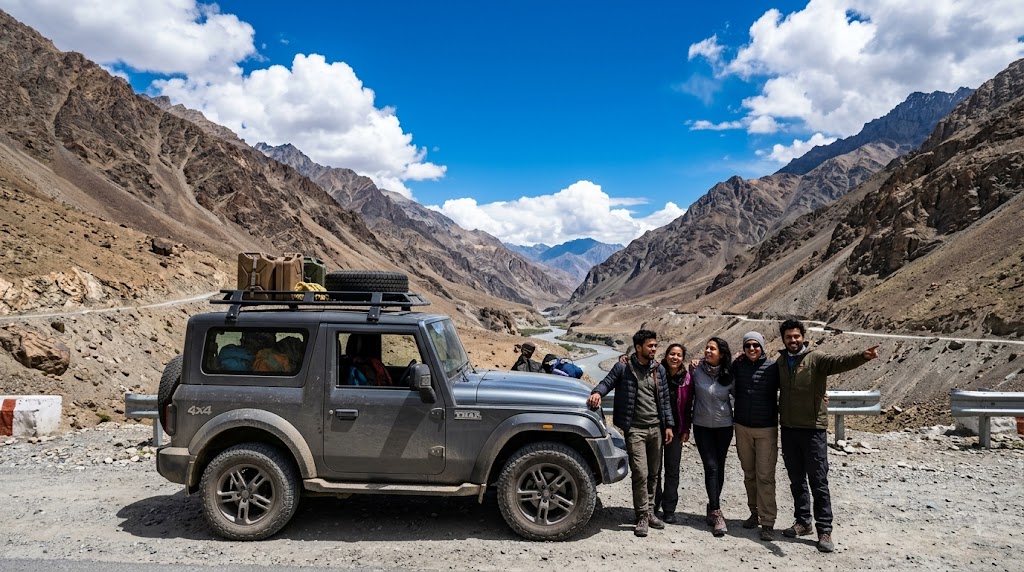
    Group of friends on a road trip with a jeep against dramatic Leh Ladakh mountain scenery - Leh Ladakh bachelor trip guide
    Leh Ladakh has become a bachelor trip staple for a reason: few destinations deliver this much dramatic scenery and genuine adventure in one trip.

    The International Escape: Thailand vs Bali vs Dubai

    Thailand Bali Dubai
    Visa Visa-free, 30 days Visa on arrival Pre-arranged, we handle it
    Flight from Chandigarh Via Delhi Via Delhi or KL, longer Direct, ~3h 40m
    Vibe Islands, nightlife, value Beach clubs, villas, longer trip energy Glamour, shortest travel time
    Best if The group wants value and nightlife You have 5-6 days to spend properly Time is tight but the trip should still feel big

    Dubai deserves more consideration than it usually gets for this specific trip type, purely because the direct flight from Chandigarh means a genuinely short trip still delivers an international bachelor party without eating an entire week of everyone’s leave balance, covered in more detail in our Dubai guide.

    Budget-Friendly and Close: When the Wedding Already Ate the Budget

    Not every bachelor trip needs a flight. Amritsar, Kasauli, and the wider Himachal circuit covered in our weekend getaways guide deliver a genuine group trip, good food, a change of scenery, actual time together, without the cost of flights or the planning overhead of visas and international bookings. This is very often the right call when the group is also collectively funding wedding gifts, outfits, and other wedding-season expenses in the same few months.

    Timing It Around the Wedding Calendar

    Most bachelor and bachelorette trips happen four to eight weeks before the wedding itself, close enough that the trip still feels connected to the upcoming event, far enough that everyone has recovered in time for wedding-week responsibilities. This window tends to clash with the same peak wedding season that drives up domestic flight and hotel demand generally, which is worth knowing before assuming a domestic trip will automatically be the cheaper, easier option. If the wedding falls in the busy November to February window covered in our long weekend calendar, booking the bachelor or bachelorette trip early matters just as much as it does for the wedding guest travel itself.

    Planning the Group Booking

    Bachelor and bachelorette trips have a specific booking challenge: the group usually confirms in stages, a few people commit early, several more “probably” for weeks, and final numbers often only lock a few weeks before departure. This is exactly what group fare blocks and flexible hotel bookings are built for, similar in principle to the wedding guest coordination covered in our destination wedding travel guide, just at a smaller scale and a much less formal tone. Booking as a coordinated group, even a group of six to eight, tends to beat everyone booking individually once flights and rooms are compared side by side.

    Bachelorette-Specific Considerations

    Much of the destination logic above applies equally to bachelor and bachelorette trips, but a few things are worth planning differently for a bachelorette group specifically:

    • Spa and wellness time tends to matter more, which makes Bali, with its strong spa and villa culture, a consistently popular bachelorette pick even among groups that considered Thailand first.
    • Photography-friendly settings get requested often, and destinations with a strong visual identity, Bali’s rice terraces, Dubai’s skyline, Leh Ladakh’s landscapes, tend to score well specifically for this reason.
    • Villa stays with a shared pool and common space are frequently preferred over standard hotel rooms, since much of a bachelorette trip’s best moments happen in shared downtime rather than out at venues.
    • Safety and comfort for an all-women group is a legitimate factor in destination choice, and we are always upfront about which destinations and specific areas we would and would not recommend for exactly this reason.

    Budgeting Honestly Across the Group

    Bachelor and bachelorette trip budgets vary enormously depending on destination and length, and the most common planning mistake is not disagreeing about the number, but never actually agreeing on one before booking starts. A few practical habits that keep the trip fun rather than financially stressful for anyone:

    • Set a per-person range early, before anyone starts sending destination ideas, so the shortlist is realistic from the start rather than needing to be cut down later.
    • Decide who is covering the guest of honour’s share, a common bachelor and bachelorette trip tradition that needs agreeing on early, not assumed.
    • Book flights and the main accommodation as a group even if daily spending stays individual, since the biggest costs benefit most from group rates and coordinated timing.
    • Build in one genuinely free, no-spend day for destinations like Goa or Thailand, since a trip that is non-stop paid activities from morning to night burns out both budgets and energy faster than expected.

    Real Group Trips We Have Actually Planned

    • “Eight of us, four different budgets.” A Mohali group planning a Thailand bachelor trip had a genuine spread from tight-budget to happy-to-splurge within the same friend group. We priced a shared flight and hotel base with optional add-on experiences, so the core trip stayed affordable for everyone while a few could add extras without the whole group needing to match spending.
    • “We want Leh Ladakh but nobody has done a high-altitude trip before.” A Chandigarh group building genuine anxiety about altitude sickness got a slower, more gradual itinerary with extra acclimatisation time built in, the same logic covered in our Spiti Valley altitude guidance, which turned a nervous group into a confident one by departure day.
    • “The bachelorette needs to work around three different flight cities.” A bride’s college friends were flying in from three different Indian cities to join the Chandigarh-based core group for a Bali trip. We coordinated arrival windows so nobody landed more than a few hours apart, avoiding the common problem of half the group waiting around at the destination for the rest to arrive.

    What to Book in Advance vs Decide on Arrival

    Not everything needs locking down before departure, and over-planning a bachelor or bachelorette trip can drain some of its spontaneous energy just as much as under-planning creates chaos. A practical split:

    • Lock in advance: flights, main accommodation, and any single big-ticket experience the whole group wants guaranteed, a specific beach club table, a desert safari slot, entry to a particular event or venue that could sell out.
    • Decide on arrival: daily activities, restaurant choices, and how each day actually unfolds. Group energy on a bachelor or bachelorette trip is unpredictable in a good way, and leaving room for a spontaneous late night or a lazy recovery morning usually produces better memories than a rigid hour-by-hour itinerary.

    The goal of booking the big pieces early is removing stress, not removing spontaneity. A group that has to worry about whether tonight’s flight or tomorrow’s hotel is actually confirmed enjoys the trip less than one that already has that settled and can focus entirely on the celebration itself.

    Frequently Asked Questions

    What is the best bachelor party destination from Chandigarh?

    It depends on the group’s vibe and timeline more than any single “best” answer. Goa suits a beach and nightlife trip with minimal planning, Leh Ladakh suits an adventure-focused group with a longer window, and Dubai suits a group wanting an international trip without eating a full week of leave, thanks to the direct flight.

    Goa or Thailand for a bachelor trip?

    Goa wins on simplicity, cost and last-minute planning. Thailand wins on novelty and, with visa-free entry, is often more straightforward internationally than people expect. Groups planning further ahead tend to lean Thailand once they compare real options; groups planning inside six weeks tend to land on Goa.

    How far ahead should a bachelor or bachelorette trip be booked?

    Six to eight weeks ahead gives the best combination of fare savings and group coordination time, similar to the booking-window principle in our cheap flights guide, though domestic budget-friendly options like Amritsar or Kasauli can work on shorter notice.

    What is a good budget-friendly bachelor trip option near Chandigarh?

    Amritsar, Kasauli and the wider Himachal circuit deliver a genuine group trip without flights or visas, ideal when the group is also funding wedding-season expenses. Rishikesh adds river rafting and adventure to the budget-friendly, close-to-home category.

    Can Flywings handle group bookings for a bachelor or bachelorette trip?

    Yes, group flight and hotel coordination for exactly this kind of trip, including staged confirmations as the group finalises numbers, is something we handle regularly. Tell us the destination shortlist and rough group size to get a comparison quote.

    Is Leh Ladakh actually manageable for a group unfamiliar with high altitude?

    Yes, with sensible planning, gradual acclimatisation and a driver experienced with the region, similar to the altitude guidance in our Spiti Valley guide. It is not a trip to rush, but it is very achievable for a reasonably fit group with the right pacing.

    When should a bachelor or bachelorette trip happen relative to the wedding?

    Four to eight weeks before the wedding is the most common window, giving the group enough separation to recover and refocus on wedding preparations. This timing often overlaps with peak wedding season demand, so booking the trip early matters as much as it does for any other festive-season travel.

    How do you handle a group flying in from multiple cities?

    We coordinate arrival and departure windows across everyone’s starting city so the group lands within a reasonable window of each other, rather than some members waiting hours at the destination for others. This is a common scenario for college friend groups scattered across India and abroad.

    Let the Group Chat Move On to Planning the Fun Part

    Tell us the vibe your group has landed on and roughly how many people, and we will turn the shortlist above into real flight and hotel options rather than another round of unresolved group chat debate. Explore our Dubai, weekend getaway and Spiti Valley guides for more on specific options, or reach us directly:

    Written by Sukhjinder Kaur, Senior Travel Content Writer at Flywings Tour & Packages Pvt Ltd – planning group trips from Mohali, Punjab since 2013. Seasonal and visa guidance reflects current requirements as of August 2026 and can change, so confirm current details when you enquire.
  • Christmas and New Year 2026-27 Travel from Chandigarh: Where to Go and When to Book

    Christmas and New Year 2026-27 Travel from Chandigarh: Where to Go and When to Book

    Somewhere around the second week of December, every year, the same thing happens. Fares that looked perfectly reasonable in October suddenly do not, hotel rooms in the obvious destinations disappear, and half the Tricity is trying to book the same handful of routes at the same time. The window that matters most, roughly 20 December 2026 through 4 January 2027, is the single busiest international travel corridor of the Indian calendar, and it arrives every year with the same predictable pattern of early planners getting the trip they wanted and late planners settling for whatever is left. At Flywings Tour & Packages Pvt Ltd, this guide exists to help you make two decisions early: where you actually want to go, and when to book it so the fare still makes sense.

    Quick context: The core Christmas-New Year travel window runs from around 20 December 2026 to 4 January 2027. Trending international picks for this window include Dubai, Thailand, Bali, Singapore, the Maldives, Vietnam and Turkey. Domestic favourites include Kerala, Goa, Jaipur and Delhi. Booking 8-12 weeks ahead, meaning starting now, is what separates a normal fare from a peak-week fare.

    Why This Window Behaves Differently From a Normal Holiday

    Most travel planning follows a simple rule: book a few weeks ahead and you will generally be fine. Christmas and New Year break that rule for the same reason Diwali does, covered in detail in our Diwali travel guide. Demand does not spread evenly across December, it concentrates hard into the ten days surrounding Christmas and New Year’s Eve specifically. Two festivals, one extended school and work break, and an entire country deciding to travel in the same narrow window, all at once. Fare buckets on the popular routes empty out far earlier than travellers expect, which is exactly why this guide starts in August rather than November. By the time festive decorations go up in shopping malls, the best fares for this window are usually already gone, booked by travellers who started planning while it still felt too early to bother.

    Destination Comparison: Where to Spend the Season

    Destination Why It’s Trending Best For
    Dubai Direct flight from Chandigarh, spectacular New Year’s Eve fireworks displays, winter weather is genuinely pleasant Couples and families wanting glamour without a long flight
    Thailand Visa-free entry, island New Year parties, December sits in the dry season Friend groups and value-conscious travellers
    Bali December falls in the dry season, beach club New Year’s Eve events, our full Bali guide covers the zones Longer trips, honeymooners, wellness-focused travellers
    Singapore Marina Bay’s New Year fireworks are a genuine spectacle, efficient and family-friendly Families and first-time international travellers
    Maldives December-March is the dry season peak, resort New Year’s Eve packages are a signature experience Honeymooners and milestone celebrations
    Kerala Houseboat New Year’s Eve on the backwaters, Kochi’s carnival atmosphere Travellers wanting a peaceful, festive domestic option
    Goa India’s default New Year party destination, beach clubs and countdown events Friend groups and younger travellers wanting energy over relaxation
    Jaipur and Delhi Heritage properties, winter weather, New Year events blending tradition and nightlife Shorter domestic breaks without international booking pressure

    International vs Domestic: The Honest Trade-Off

    International trips for this window need to be booked earliest, since visa processing, longer flights and higher demand all stack together. Domestic options offer more flexibility on booking timeline and no visa consideration at all, but the popular ones, particularly Goa and Kerala’s backwater resorts, sell out their best properties just as early as international flights do. Neither category is automatically the safer late-booking choice. Both reward early planning, just for slightly different reasons.

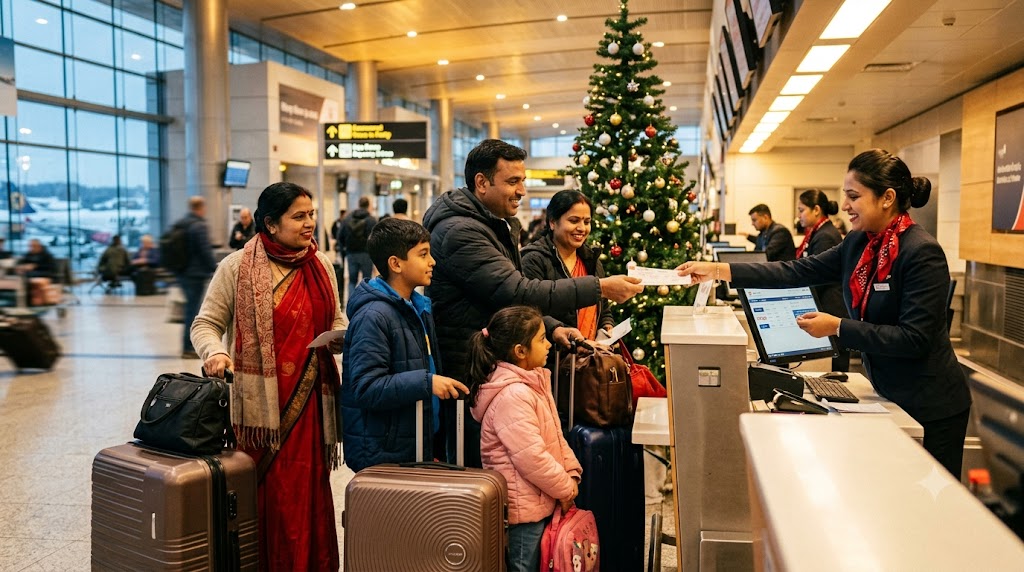
    Family with luggage checking in at an airport counter during the winter holiday travel season - Christmas December travel booking tips
    The second week of December is when most families realise how far fares have moved since October. Booking early avoids this entirely.

    When to Book: A Simple Timeline

    • Now through September: the best window for international bookings, especially Dubai, Thailand, Bali, Singapore and the Maldives. Visa processing, where needed, also has comfortable breathing room at this stage.
    • October: still workable for most destinations, though the easiest fare buckets on the most popular routes are starting to close. This is the last comfortable window for Goa and Kerala’s best properties too.
    • November: options narrow noticeably. Flexibility on exact dates becomes more valuable than flexibility on destination at this point.
    • December, before the 15th: late but not lost, particularly for less obvious routings or slightly less mainstream destinations. Our desk tracks live inventory rather than relying on what a portal search shows as unavailable.
    • After 15 December: genuinely difficult for the most popular destinations. This is when a live ticketing desk’s daily fare tracking matters most, finding what is actually still bookable rather than what a static search result gives up on.

    December Weather Across the Shortlist

    Destination December Weather What It Means for Your Trip
    Dubai Pleasant, 15-25°C, minimal rain Comfortable for outdoor events and desert evenings alike
    Thailand Dry season, warm and sunny Among the best months of the year to visit
    Bali Dry season, warm with occasional short showers Reliable beach and outdoor conditions for New Year’s Eve events
    Singapore Warm and humid, wetter month Short showers are common, indoor and covered attractions balance this well
    Maldives Dry season, one of the best windows of the year Peak season for a reason, book resorts and villas early
    Kerala Cool and pleasant, minimal rain Ideal backwater and hill weather
    Goa Warm, dry, peak beach season Perfect conditions, which is exactly why it is also peak crowd season
    Jaipur and Delhi Cold, particularly at night, occasional winter fog Pack proper layers, mornings can be genuinely chilly

    New Year’s Eve Specifically: What to Book Separately

    Beyond the flight and hotel, New Year’s Eve itself often needs its own booking, particularly at destinations with signature countdown events. Dubai’s fireworks viewing spots, Maldives resort gala dinners, Bali and Goa’s beach club New Year parties and Singapore’s Marina Bay celebrations all sell tickets or require reservations well ahead of the night itself. Travellers who assume this can be sorted on arrival are consistently the ones who end up watching the fireworks from a hotel room instead of the vantage point they actually wanted. We build this into the itinerary at booking stage specifically to avoid this.

    What Tricity Families Are Actually Booking This Window

    Patterns from our own desk over the past few festive seasons are fairly consistent. Dubai remains the single most-booked international option for Chandigarh and Punjab travellers specifically, largely because the direct flight removes the biggest source of holiday-travel stress for a family that already has enough to coordinate. Thailand and Bali follow close behind, typically booked by slightly younger groups and honeymoon couples willing to accept a longer routing for a different kind of trip. On the domestic side, Kerala has grown noticeably as a New Year choice over Goa for families specifically, largely because backwater properties offer a calmer countdown experience with young children or elderly parents in the group, while Goa remains the default for friend groups without that consideration. None of this should dictate your own choice, but it is a useful reality check against whatever a generic online listicle suggests is universally trending, since national travel trends and Tricity travel patterns do not always line up exactly.

    Getting There From Chandigarh and Amritsar

    Dubai remains the standout option for direct connectivity, with the daily non-stop IndiGo flight from Chandigarh covered in our Dubai guide. Most other international options on this list route through Delhi, and our ticketing desk prices the full combined itinerary together, applying the same booking-window logic from our cheap flights guide. For Amritsar travellers, the international connections covered in our Chandigarh and Amritsar flights guide are worth checking against the Delhi routing for this specific window, since ATQ’s international schedule occasionally offers a real advantage during peak season.

    Packing for the December Window

    • Layers, even for warm destinations. Dubai and Bangkok evenings cool down more than daytime heat suggests, and outdoor New Year’s Eve events often run late into a cooler night.
    • Proper winter clothing for Jaipur, Delhi or any North Indian option. December mornings and nights are genuinely cold, more than many travellers expect from a domestic trip.
    • Festive or smart-casual outfits. Many New Year’s Eve events, from resort galas to beach club parties, have dress expectations worth checking in advance.
    • A power bank and offline maps. Peak-season crowds strain mobile networks at popular countdown venues more than an ordinary day would.
    • Travel insurance, particularly for international trips during the year’s busiest travel period, when disruptions are statistically more likely simply due to volume.

    Why Booking Together Beats Booking Piecemeal

    It is tempting to book a flight the moment a good fare appears, then figure out the hotel later, then look at the New Year’s Eve event closer to the date. For most of the year this staggered approach works fine. For this specific window, it tends to backfire, since the flight, hotel and marquee event all compete for the same shrinking inventory on the same handful of dates. Booking them together, even roughly, means a coordinated plan rather than three separate gambles that may not actually fit together by the time all three are confirmed. This is exactly the coordination a single travel desk handles better than three separate bookings across three different platforms, since one call catches a scheduling conflict that three unrelated confirmations never would.

    Booking Mistakes We See Every December

    • Assuming “there’s still time” through late November. By the time this feeling sets in, the best fare buckets on popular routes have usually already closed.
    • Booking the flight but not the New Year’s Eve event. Signature countdown experiences at popular resorts and venues need their own advance booking, not an assumption of walk-up availability.
    • Ignoring visa timelines for international options. Processing volume rises industry-wide during peak booking months, so applications filed in November for a December trip carry more risk than the same application filed in September.
    • Comparing only the flight price, not the total trip cost. A slightly pricier flight paired with much better hotel availability often beats a cheap flight into a destination where nothing decent is left to book.
    • Splitting a group’s bookings across different dates or routings to chase marginally lower individual fares, which usually costs more in coordination stress than it saves in money.

    What a Comfortable Booking Timeline Actually Looks Like

    Rather than treat this as one big decision made all at once, it helps to break it into three smaller ones spread across the coming weeks. First, agree on a shortlist of two or three destinations with whoever you are travelling with, rather than a single fixed choice, since flexibility between two good options often finds a meaningfully better fare than commitment to one. Second, get a live quote from our desk across that shortlist, so the fare comparison is based on actual current pricing rather than a number remembered from a previous year’s trip. Third, confirm within the same week the quote comes back, since peak-season fare buckets do not wait for a decision to be made at leisure. Families who follow roughly this sequence consistently end up with both a better price and a calmer December than those who start the same conversation in November.

    Choosing by Traveller Type

    • Couples and honeymooners: the Maldives or Bali for a slower, more romantic countdown, or Dubai for glamour with the shortest flight. See our full comparison in the Bali vs Maldives vs Dubai guide.
    • Families with kids: Singapore’s efficiency and family-friendly infrastructure, or Kerala’s calmer backwater houseboats, both work well without the late-night party focus of some other options.
    • Friend groups: Thailand or Goa for energy, nightlife and value, or Bali’s Canggu and Seminyak zones for a slightly more polished version of the same idea.
    • Multi-generational family trips: Jaipur or Delhi for a domestic option with heritage character and no visa complexity for elderly travellers, or Dubai if the group wants an international trip with a short, direct flight.
    • Solo travellers and small groups: Vietnam or Turkey for something further off the usual circuit, both trending picks for this window among more adventurous travellers.

    Christmas Day and New Year’s Eve: Two Different Trips in One Window

    It is worth separating these mentally, since they are not quite the same trip even though they often get booked together. Christmas Day itself tends to matter more in destinations with a genuine Christian heritage or strong festive culture, such as Kerala’s Christmas markets and church celebrations, or European-style Christmas experiences in some international destinations. New Year’s Eve is the more universally celebrated date across almost every destination on this list, with countdown events, fireworks and parties forming the centrepiece regardless of local religious tradition. Some travellers want both moments to matter equally across a longer trip, while others treat Christmas as a quiet travel day and build the whole trip around New Year’s Eve itself. Knowing which version you want shapes both the destination choice and the itinerary pacing.

    The 12-Day Window: Fitting Both Festivals Into One Trip

    Because Christmas and New Year sit less than a week apart, many travellers use this stretch for one longer trip rather than two separate short ones. A twelve-day window from around 23 December to 4 January comfortably covers a full international holiday, including a destination that might otherwise feel rushed on a standard five or six day trip. This is particularly worth considering for destinations like Bali or Vietnam, which reward a longer stay, or for combining two destinations, such as a Dubai stopover paired with a longer Maldives or Thailand leg. If your workplace shuts down for the season regardless, this is often the single best-value travel window of the entire year in terms of leave days spent versus trip length gained.

    Frequently Asked Questions

    When is the peak Christmas-New Year travel window in 2026-27?

    Roughly 20 December 2026 through 4 January 2027 sees the heaviest demand, driven by school and work breaks stacking on top of both festivals. Fares and hotel rates across this window rise well ahead of the actual dates as inventory sells through.

    How far ahead should I book for New Year 2027?

    Eight to twelve weeks ahead is the safest window for international destinations, which means starting the process now through September gives the most options and the best fares. Domestic bookings have slightly more flexibility but still reward early planning for the most popular properties.

    Which international destination is trending most for New Year 2027?

    Dubai, Thailand, Bali, Singapore and the Maldives are the consistently trending picks for Indian travellers this window, alongside newer entries like Vietnam and Turkey for those wanting something less familiar.

    Is Goa or Kerala better for New Year celebrations?

    Goa suits travellers wanting beach clubs, nightlife and countdown parties, while Kerala offers a calmer, more scenic New Year’s Eve, particularly on a backwater houseboat. Neither is objectively better, the choice comes down to whether you want energy or relaxation.

    Do I need to book New Year’s Eve events separately from my hotel?

    Often, yes, particularly at destinations with signature countdown experiences like Dubai’s fireworks viewpoints or Maldives resort gala dinners. These sell out or require reservations independently of the room booking itself, and we build this into every itinerary at the planning stage.

    Can Flywings arrange a Christmas-New Year trip for a family or friend group?

    Yes, this is one of our busiest periods every year. Group flight coordination, matched hotel rooms and New Year event bookings are all handled as one itemised package. Tell us your destination preference, group size and dates to get started.

    Should I book flights and hotels separately or through one desk?

    Through one desk, ideally, especially for this specific window. Because flights, hotel rooms and marquee New Year’s Eve events all compete for the same limited inventory on the same dates, coordinating them together avoids the situation where one piece is confirmed and the others no longer fit the plan.

    Is it worth combining Christmas and New Year into one longer trip?

    Often, yes, particularly if your workplace or school schedule already provides a break across this window. A ten to twelve day trip makes better use of the same leave days than two separate short trips would, and suits destinations like Bali or Vietnam that reward a longer stay.

    Decide the Destination, We Will Handle the Timing

    The hardest part of this trip is usually picking where to go. Once that decision is made, the booking calendar takes care of itself if you start now rather than in November. Explore our international tour packages from Chandigarh, browse India tour packages for the domestic options, or reach us directly:

    Written by Sukhjinder Kaur, Senior Travel Content Writer at Flywings Tour & Packages Pvt Ltd – booking flights and holidays from Mohali, Punjab since 2013. Destination trends and booking guidance reflect data available as of August 2026, and fares and availability change, so confirm current details when you enquire.
  • Destination Wedding Guest Travel from Chandigarh: The Family Coordinator’s Guide (2026)

    Destination Wedding Guest Travel from Chandigarh: The Family Coordinator’s Guide (2026)

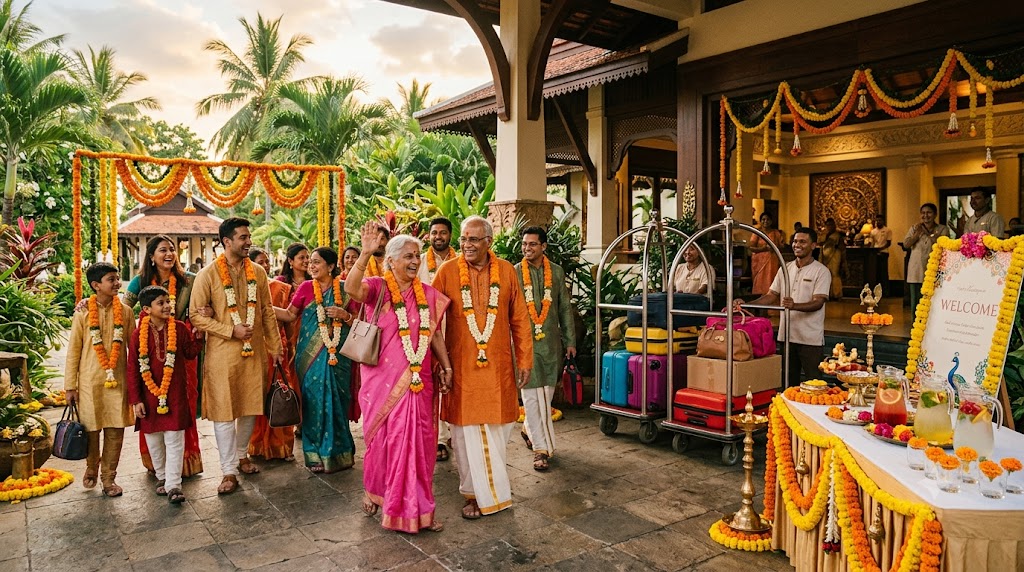
    Every big fat Punjabi wedding now has an unofficial job title that never appears on the invitation card: the one relative who ends up coordinating everyone’s travel. If a destination wedding is in the plans, whether it lands in Bali, Thailand, Goa or Kerala, that person is usually managing flights, hotel rooms and sometimes visas for anywhere between fifty and three hundred guests, on top of everything else a wedding already demands. At Flywings Tour & Packages Pvt Ltd, we have quietly become that coordinator’s second phone call, right after the venue is booked. This guide is written for that person, whoever it turns out to be in your family.

    Quick context: Destination wedding guest travel is fundamentally a group logistics problem, not a venue problem. Wedding planners handle the ceremony, decor and catering. Almost none of them handle fifty families’ flights, passports and hotel rooms, and that gap is exactly where a coordinated travel desk earns its place. Start guest travel planning the same week the venue is confirmed, not after the invitations go out.

    Why This Job Always Falls on One Person

    A destination wedding has two separate logistics problems that get treated as one. The couple and the wedding planner handle the venue, the ceremony and the celebration itself. Nobody officially owns getting fifty or a hundred and fifty guests there, with working passports, sensible flight connections and rooms that do not put three generations of one family on opposite ends of a resort. That job lands on whichever relative is most organised, most available, or simply could not say no fast enough. It is a real, demanding role, and it deserves real support rather than a spreadsheet and good intentions. Most coordinators discover the scale of the job only after agreeing to it, somewhere around the moment the guest list crosses fifty names and the first three flight fare quotes come back at three different prices for the same route.

    Stage One: Understand Your Guest List Before You Book Anything

    Before a single flight gets booked, the coordinator needs a working guest map, because a wedding guest list is never one uniform group. It typically splits into distinct travel needs:

    • Elderly guests who need direct or minimal-connection routes, aisle seating and wheelchair assistance arranged in advance rather than requested at the airport.
    • Young families with children who need adjoining or nearby rooms, and flight timings that do not fight nap schedules.
    • NRI guests flying in from abroad who need their international leg coordinated with the domestic or onward connection, often with a very different booking timeline than local guests.
    • Local Chandigarh and Punjab guests who may want to travel together as a group rather than book individually.
    • The couple’s close bridal party who often arrive earlier and leave later than the main guest block, for pre-wedding events and photography.

    Mapping this early, even roughly, is what lets a group booking actually work, rather than fifty separate PNRs booked in fifty separate moments of panic.

    Stage Two: Group Flights, and Why They Are Not Just Fifty Individual Tickets

    Once the guest map exists, group flight booking becomes possible, and it works completely differently from individual booking. Airlines release group fare blocks that hold a set number of seats at a negotiated rate, with names submitted later than a normal booking deadline allows. This single feature solves the most stressful part of wedding travel coordination: guests confirming attendance on their own timeline, without the coordinator racing a fare that changes every time someone finally replies to the invitation. It also means the whole travelling block sits together on the aircraft, rather than scattered across a flight in whatever seats were left by the time everyone individually booked.

    Stage Three: Hotel Room Blocks That Actually Reflect Family Groups

    A wedding guest list is not a random collection of individuals, it is a set of family units that need to stay together, and a good hotel block reflects that rather than assigning rooms in whatever order bookings arrived. This means:

    • Adjoining or same-floor rooms for immediate family groups, particularly with young children or elderly members.
    • A flexible rooming list that can absorb late changes, since wedding guest numbers shift right up to the final weeks.
    • A shared group rate that beats what any individual guest would find booking the same resort independently.
    • Coordination with the wedding planner’s own room blocks for the couple, bridal party and close family, so the two blocks do not accidentally compete for the same inventory.
    Family member reviewing a wedding guest travel spreadsheet with flight and hotel details on a laptop - wedding travel coordination
    The unofficial job of most destination weddings: one relative, one spreadsheet, fifty families’ worth of flights and rooms to track.

    Stage Four: Visas, the Part Almost Everyone Underestimates

    If the wedding is international, visa requirements rarely match across the guest list the way people assume. NRI guests holding different passports may face different requirements than Indian-passport guests flying from Chandigarh. Elderly guests’ documents may need renewal timelines checked well ahead. And whichever destination is chosen, from our own coverage of Bali’s visa on arrival to Thailand’s recently updated entry rules, the requirement itself can be simple while still needing someone to actually verify it against fifty different passports rather than assume it is the same for everyone. This is precisely the kind of detail a coordinator juggling a hundred other wedding tasks should not be personally chasing down passport by passport.

    Stage Five: The Week-Of Logistics Nobody Plans For Until It Is Urgent

    • Airport pickup coordination for staggered guest arrivals across several days, rather than assuming everyone will simply find their own way.
    • A single point of contact guests can call if a flight is delayed or a connection is missed, so the coordinator is not personally fielding calls during the wedding itself.
    • Return flight reminders for guests who booked early and may have genuinely forgotten their own return date by the time the celebrations wind down.
    • A contingency plan for at least one flight disruption, since with a large enough guest list, statistically something will be delayed or rescheduled.

    Choosing the Destination With Guest Travel in Mind

    Couples usually choose a destination for how it looks in photographs, which is entirely fair, but the coordinator should have a voice in the conversation too, because some destinations are dramatically easier to move a hundred guests through than others:

    Destination Guest Travel Reality
    Goa or Kerala No visa needed for any Indian guest, the simplest option for a large, mixed-age guest list
    Thailand Visa-free entry for Indian passport holders, a direct or easy-connection flight, strong hotel group-block availability
    Bali Visa on arrival, longer connecting flight, worth it for the visuals but needs more advance planning for elderly guests
    Dubai Pre-arranged visa needed for every guest, but the direct Chandigarh-Dubai flight is a genuine advantage for a Tricity-heavy guest list

    None of this should override what the couple actually wants. It simply means the coordinator walks in prepared, rather than discovering the guest logistics challenge only after the venue contract is already signed. Raising these questions early, even briefly, tends to save far more stress in month three of planning than it costs in a single early conversation.

    Real Coordination Scenarios We Have Actually Solved

    • “Half our guest list has never left India before.” A Mohali family’s Thailand wedding had a guest list split almost evenly between well-travelled NRI relatives and first-time-international-flyer local guests. We ran a simple document checklist for the first-timers, since a passport that had never been used before needed a different level of hand-holding than a frequent traveller’s.
    • “The groom’s side and bride’s side booked separately and now nobody is on the same flight.” By the time we were brought in, two competing WhatsApp groups had already booked guests across four different flights on the same day. We consolidated what could still be moved onto a shared group block and left the rest, a lesson in why guest travel coordination should start before individual bookings happen, not after.
    • “One grandmother’s passport expires six weeks before the wedding.” A routine passport renewal check during our standard document review caught this early enough to fix calmly, rather than becoming a wedding-week crisis discovered at check-in.
    • “We have 40 confirmed guests and 60 maybes.” This is normal, not a planning failure. Group fare blocks exist specifically to hold capacity for exactly this kind of uncertain confirmation curve, letting the coordinator avoid booking (and paying for) seats that might not be needed.

    Budgeting for Guest Travel Without Fixed Numbers

    Every family asks the same early question: what will this actually cost. The honest answer is that guest travel cost depends on too many moving parts, destination, season, guest count, and how far ahead booking happens, to quote a single figure responsibly. What we can say is that a coordinated group booking consistently beats the total of fifty individual bookings for the same dates and destination, sometimes substantially, simply because negotiated group rates and early booking both work in the family’s favour rather than against it. We prepare an itemised group quote once the guest map and destination are confirmed, broken down clearly enough that the coordinator can share relevant portions with guests who are covering their own travel.

    What a Coordinated Travel Desk Actually Takes Off Your Plate

    Coordinator Handling It Alone Working With a Group Travel Desk
    Flight booking Fifty individual bookings, fifty individual fare risks One group fare block, held seats, flexible name submission
    Hotel rooms Manually requesting adjoining rooms and hoping the property honours it A managed rooming list matched to family groups
    Visa checks Guessing which guests actually need what, and when Verified per guest, with documentation support
    Disruption on the day The coordinator’s personal phone, ringing constantly One desk fielding guest calls, freeing the coordinator to actually attend the wedding
    Guest communication WhatsApp groups and spreadsheets managed solo One shared source of truth guests can be pointed to

    Working Alongside Your Wedding Planner, Not Replacing Them

    It is worth being clear about where this service starts and stops, since the two roles are genuinely different jobs. Your wedding planner owns the venue, decor, catering, ceremony logistics and the overall creative vision of the event itself. A travel desk owns getting guests there and back safely, comfortably and on budget. The best destination weddings we have supported are the ones where these two functions communicate directly rather than the coordinator relaying messages between them. We are always happy to join a call with your planner early, so room block numbers, arrival schedules and any venue-specific transport needs are aligned from the start rather than discovered as a conflict two weeks before the wedding.

    Managing the WhatsApp Group Without Losing Your Mind

    Every destination wedding eventually grows a guest travel WhatsApp group, and every coordinator eventually dreads it a little. The volume of repeated questions, most of them some version of “what time is my flight” or “can I bring an extra bag”, is genuinely exhausting on top of everything else a wedding demands. A structured travel plan reduces this considerably, since guests with a single shared document listing their own flight, hotel and transfer details ask far fewer scattered questions than guests relying entirely on memory and group chat scrollback. We build exactly this kind of shared reference as part of every group booking, which on its own tends to be the detail coordinators thank us for most once the wedding is over.

    A Realistic Planning Timeline

    1. As soon as the venue is confirmed: start the guest travel map, even roughly. Waiting for a final headcount before starting delays everything downstream.
    2. 8-12 weeks before the wedding: lock the group flight block and hotel room block, the same booking-window logic that applies to any large travel group.
    3. 6-8 weeks before: begin visa documentation for any guest who needs it, since processing times vary and some guests will be slower to send documents than others.
    4. 2-4 weeks before: finalise the rooming list and confirm any late guest additions or drop-offs against the held block.
    5. Wedding week: hand the day-to-day guest queries to the travel desk, and actually enjoy the wedding you spent months coordinating everyone else’s way to.

    Why Punjab Families Face a Slightly Different Version of This Problem

    Punjabi weddings tend to run larger and more multi-generational than many other regional wedding traditions, and destination weddings from the Tricity inherit that scale. It is common for a single guest list to include grandparents who have never flown internationally, NRI relatives flying in from Canada, the UK or Australia on entirely different timelines, and a large contingent of local friends and extended family travelling together for the first time as a group. This is precisely the mix that makes generic destination wedding advice, most of it written for smaller, more uniform guest lists, less useful for a genuinely large Punjabi wedding. The travel content available online is largely written for a hundred-guest wedding in a single country with a single passport type among the group, which simply is not the reality most Chandigarh and Punjab families are actually planning around. A coordinator working with a desk that understands this specific guest composition, rather than a one-size-fits-all wedding travel template, tends to have a noticeably calmer few months leading up to the event.

    Frequently Asked Questions

    Who should actually coordinate wedding guest travel?

    In most families, one relative ends up doing it informally, alongside their own wedding responsibilities. The role works far better when that person has a travel desk backing them up for the actual bookings, documentation and disruption handling, rather than managing all of it personally on top of everything else a wedding demands.

    How far in advance should we book group flights for wedding guests?

    Eight to twelve weeks ahead is the sweet spot for most destinations, similar to the booking-window principle covered in our cheap flights guide. Group blocks specifically benefit from early booking since name submission can happen later, giving guests more time to confirm attendance without losing the fare.

    Do all wedding guests need the same visa for an international destination?

    Not necessarily. Requirements can differ by passport, particularly for NRI guests holding foreign passports attending alongside Indian-passport family members. Every guest’s documentation should be checked individually rather than assumed to match the majority.

    Can hotel rooms really be blocked for family groups rather than assigned randomly?

    Yes, this is one of the core benefits of a managed group booking. Rooming lists can be built around actual family units and adjusted as guest numbers shift, rather than leaving room assignment to whatever order individual bookings happened to arrive in.

    What happens if a guest’s flight is delayed during the wedding week?

    With a coordinated travel desk, guests have one number to call, and disruptions get managed centrally rather than becoming the coordinator’s personal emergency in the middle of wedding events. This is one of the most appreciated parts of the service by families who have coordinated a wedding without it.

    Can Flywings handle guest travel for a wedding the venue and planner are managing separately?

    Yes, this is exactly how most of our destination wedding work happens. The venue and ceremony stay with your wedding planner, while we handle flights, hotel blocks and visa coordination for the guest list, working alongside the planner’s own timeline rather than competing with it.

    How many guests are needed before group booking makes sense?

    Group fare blocks typically become available from around ten travellers, though the coordination benefit, one point of contact, one rooming list, one source of truth for guests, is valuable well before that threshold too, especially for multi-generational family groups.

    What if some guests want to book their own flights independently?

    That is completely normal and easy to accommodate. We simply need those guests’ arrival details to fold them into the hotel rooming list and the on-ground coordination plan, so they are not left out of transfers and communication just because they booked their own ticket.

    Can you help with pre-wedding events that need separate travel, like a mehendi or sangeet at a different location?

    Yes, multi-location wedding functions are increasingly common, and we coordinate the full sequence rather than just the main event, including bridal party members who often need to arrive earlier and stay later than the main guest block.

    Let Someone Else Carry the Spreadsheet

    If you have been handed the job of getting everyone to the wedding, you did not sign up to become a part-time travel agent for fifty families. Tell us the destination, the rough guest count and the wedding date, and we will build the flight blocks, hotel rooming and visa checklist around it. Explore our group travel desk, browse destination guides for Bali, Dubai and Thailand, or reach us directly:

    Written by Sukhjinder Kaur, Senior Travel Content Writer at Flywings Tour & Packages Pvt Ltd – coordinating group and wedding travel from Mohali, Punjab since 2013. Visa and booking guidance reflects current requirements as of August 2026, and can change, so confirm current details when you enquire.

  • Diwali 2026 Travel from Chandigarh: The Countdown Guide to Booking Before Prices Spike

    Diwali 2026 Travel from Chandigarh: The Countdown Guide to Booking Before Prices Spike

    Diwali 2026 falls on Sunday, 8 November, and if that date feels far away right now, it is not. It sits exactly inside the booking window that decides whether your festival trip costs a fair fare or a panic fare. At Flywings Tour & Packages Pvt Ltd, the weeks before Diwali are the busiest of our year, and the single biggest factor separating a smooth trip from a stressful one is not the destination. It is when the booking actually happened. This guide is built as a countdown, so wherever you are reading it, you know exactly what to do next.

    Quick facts before you plan: Diwali 2026 is Sunday, 8 November. The five-day festival window runs from Dhanteras on 6 November to Bhai Dooj on 10 November. The best outbound days are 5, 8 or 9 November, with 6 and 7 November typically the most expensive. Fares booked 60-90 days ahead run meaningfully cheaper than last-week bookings.

    12 Weeks Out: Lock Your Dates and Start Watching Fares

    At twelve weeks before Diwali, most people have not started thinking about travel yet, which is exactly why this is the best time to start. Decide roughly where you want to go and how many days you can take off. You do not need a firm booking yet, but you do need a firm date range, because every week you wait from here narrows your options and raises your likely fare. This is also the point to start a fare watch on your preferred route with our desk, the same approach we cover in detail in our cheap flights guide. Twelve weeks feels early to most people, and that instinct is exactly why so many festival trips end up costing more than they needed to. The travellers who move first are not being anxious. They are simply the ones who understand how festival demand actually behaves.

    8-10 Weeks Out: Book Flights Now, Not Later

    This is the single most important window on this entire calendar. Fares booked 60-90 days ahead of Diwali are consistently the cheapest available, and every week you wait after this point trades away savings. If your dates are fixed by family plans or leave approval, this is when you commit. Two tactical details worth knowing:

    • Flying on Diwali day itself (8 November) is often 20-40% cheaper than flying the Friday or Saturday before it, since most travellers want to be home for the actual festival evening rather than in transit.
    • Return flights on 12 or 13 November tend to be the best-value return dates, just after the festival crowd has already gone home.

    If you are travelling as a family group or planning a joint trip with relatives, this is also the point to ask about group fare blocks, which we cover in our group travel desk.

    6-8 Weeks Out: Confirm Hotels and Visas

    With flights locked, hotel rooms in popular Diwali destinations begin filling fast, particularly anywhere with its own festival draw. If your trip is international, this is also the last comfortable window to file a visa application without rushing processing. For destinations we have covered in detail, cross-check the current entry rules before booking non-refundable stays, especially given how quickly rules can shift, as our Thailand visa update showed earlier this year.

    4 Weeks Out: The Last Comfortable Booking Window

    By four weeks out, the easiest fares and room categories are already gone, but a good trip is still very achievable. This is the point where we start actively working around constraints rather than simply booking the obvious choice. If your first-choice flight has gone up sharply, we look at nearby dates, alternate routings through Delhi, or a different departure time that still gets you home for the festival.

    2 Weeks Out: Damage Control, Not Panic

    If you are reading this with two weeks left, the message is simple: it is late, not hopeless. Fares will be higher and the best hotels will be gone, but options still exist, particularly if you have some flexibility on exact dates or are open to a less obvious destination. This is exactly where a ticketing desk that tracks live inventory daily earns its keep over a portal search that only shows what is left rather than what could still work with a small adjustment.

    Airport departure board and travellers with luggage during festival travel season - Diwali flight booking tips
    Festival-week airports fill fast. The travellers who booked eight to ten weeks out are the ones moving through security calmly.

    Why Festival Fares Behave Differently From Normal Fares

    On a normal route, fares mostly follow the booking-window pattern we cover in our cheap flights guide: book four to six weeks out and you generally do fine. Diwali breaks that pattern because demand is not spread across the month, it is compressed into a handful of specific days. Airlines know exactly which dates the whole country wants to fly on, and fare buckets on those dates empty out far faster than on an ordinary week. This is why the 60-90 day window matters more for Diwali than for almost any other trip you will book all year. It is not a general rule of thumb here, it is the difference between a normal fare and a genuinely inflated one.

    What Actually Happens to a Route You Wait On

    It helps to see this as a real pattern rather than an abstract warning. A route that shows a comfortable, ordinary fare in early August will typically show a noticeably higher fare by mid-September, purely because the cheapest seat buckets have sold. By late October, the same route often has only the highest fare classes left, and by the first week of November, some flights on the peak days are simply full. None of this happens as one dramatic jump. It happens in small increments every week, which is exactly why it is easy to underestimate until the week you actually try to book.

    Diwali 2026: The Full Festival Calendar

    Date Occasion
    Friday, 6 November Dhanteras
    Saturday, 7 November Choti Diwali / Naraka Chaturdashi
    Sunday, 8 November Diwali / Lakshmi Puja
    Monday, 9 November Govardhan Puja
    Tuesday, 10 November Bhai Dooj

    Knowing this full calendar matters for travel planning specifically because it shapes demand. The Friday and Saturday before Diwali are when everyone wants to already be home, which is exactly why those two days carry the highest fares of the entire window.

    Best and Worst Days to Fly: A Simple Rule

    Day Fare Pattern Why
    Thursday, 5 November Good value Ahead of the main rush, before demand peaks
    Friday, 6 November Most expensive Everyone wants to be home for Dhanteras and the run-up to Diwali
    Saturday, 7 November Most expensive Last full travel day before Diwali itself
    Sunday, 8 November Often 20-40% cheaper Diwali day itself, when most travellers prefer to already be settled at home
    Monday, 9 November Good value Festival mood continues, but travel demand has eased
    Thursday-Friday, 12-13 November Best return value The return rush has already passed

    Where to Go for Diwali: Three Directions

    Stay in Punjab, See the Festival Itself

    You do not need to leave the region to have a memorable Diwali trip. Amritsar’s Golden Temple during Diwali is lit with thousands of lamps in one of the most photographed sights of the entire festival calendar, covered in full in our Golden Temple visitor guide. If a short domestic trip fits your leave better than an international one, this is very often the best single option on this list.

    A Long Weekend Escape

    With Diwali falling on a Sunday, a few strategically placed leave days either side create a genuine long weekend without using much annual leave. Our weekend getaways guide covers the full shortlist of hill and heritage options within a few hours of Chandigarh, several of which are at their most pleasant in early November.

    An International Trip Timed Around It

    For travellers using Diwali as the anchor for a longer international holiday, November sits inside the good-weather window for several of our most-booked destinations, including Dubai, Malaysia and Singapore. Since Diwali leave often stacks with a following weekend, this is one of the few windows all year where a proper international trip fits inside a realistic leave balance.

    How This Is Different From a Normal Long Weekend

    Our weekend getaways guide covers the general 2026 long-weekend calendar, and much of that logic still applies here, but Diwali deserves its own treatment for one reason: it is the single highest-demand travel week of the entire Indian calendar, well above Republic Day, Independence Day or even most wedding-season weekends. That scale changes the maths. A booking strategy that comfortably works for an ordinary long weekend, such as booking three to four weeks out, simply does not hold for Diwali, where the same timeline often means choosing from whatever fares happen to be left rather than the fare you actually wanted.

    Diwali Booking Mistakes We See Every Year

    • Waiting for a sale that never quite arrives. Diwali is peak season everywhere in India. Airlines rarely need to discount a route that will sell out anyway.
    • Booking the outbound flight without checking the return date’s price. A cheap outbound on a bad return date can cost more overall than a slightly pricier outbound paired with a smart return.
    • Ignoring tier-2 routing options. Sometimes flying via a slightly less obvious connection, rather than the first result a search shows, saves meaningfully during peak weeks.
    • Assuming hotel rooms will still be there. Popular Diwali destinations, especially Amritsar and hill towns, genuinely sell out their best properties weeks ahead.
    • Forgetting visa timelines for international trips. A visa that normally takes a few days can slow down during any high-demand travel season, so file early rather than assuming standard processing speed will hold.

    Packing and Practical Diwali Travel Notes

    • Carry sweets and gifts in checked luggage, not hand baggage, since many airlines restrict certain packaged food items and loose sweets in the cabin, and checked bags avoid the question entirely.
    • Firecrackers cannot be carried on any flight, checked or hand baggage, under standard aviation safety rules. Buy them locally at your destination if that is part of your celebration plan.
    • Book airport transfers in advance for late Diwali-night arrivals, since taxi availability in many cities drops sharply on the festival evening itself as drivers head home to celebrate.
    • Keep a printed copy of hotel bookings and ID for every traveller, particularly for group trips, since front desks during peak season move faster with paperwork ready rather than searched for on the spot.
    • If travelling with elderly family members, confirm wheelchair or priority boarding assistance at the time of booking rather than at the airport, since festival-week staff are stretched thinner than usual.

    Group and Family Diwali Travel

    Diwali is one of the few times of year when extended families genuinely try to travel together, and this is exactly where a coordinated booking beats everyone booking separately. Group fare blocks hold seats and allow later name confirmation, room blocks keep everyone in the same wing of a hotel rather than scattered floors apart, and one point of contact means a schedule change affects one phone call instead of ten confused family group chats. If your Diwali plan involves more than a handful of travellers, tell us the headcount early. This is a peak-season constraint that only gets tighter the closer you get to the date, and group flexibility on dates tends to shrink faster than individual flexibility does, simply because more people need to agree on the same days.

    Diwali Travel by Traveller Type

    • Students coming home: book the moment your college calendar confirms the break, since student routes to smaller cities often have fewer flight options to begin with, and those thin out fastest of all.
    • Couples planning a Diwali honeymoon or anniversary trip: pair the festival with an international window like our Bali vs Maldives vs Dubai guide covers, since November sits inside good weather for most of those routes.
    • Families with school-going kids: school Diwali breaks are usually announced well ahead, so this is often the easiest group to plan early for, provided the booking actually happens as soon as dates are known rather than closer to the break itself.
    • Working professionals with limited leave: since Diwali falls on a Sunday in 2026, a well-placed single leave day either side can create a genuine long weekend without a heavy leave-balance cost.
    • Senior citizens visiting family: book earlier rather than later specifically to secure aisle seating, wheelchair assistance slots and convenient flight timings, all of which get harder to arrange as a route fills up.

    What This Costs to Get Wrong

    The honest version of this guide is simple: nothing about Diwali travel is complicated, but the cost of delay compounds quietly. A route that is comfortably affordable at ten weeks out can be significantly pricier at four weeks out, not because of any single dramatic price jump, but because each week a few more of the cheapest seats and rooms disappear. Nobody notices the individual week that mattered. Everyone notices the total by the time they are booking in a hurry. The fix is not complicated. It is simply acting on this countdown at whichever stage you are reading it, rather than filing it away for later and rediscovering it in October with fewer options left.

    Diwali Travel Within India vs an International Trip

    Both are genuinely good options for Diwali, and the right choice depends less on budget than on what kind of break you actually want. A domestic trip, particularly to somewhere with its own festival atmosphere like Amritsar or a nearby hill town, lets you stay connected to the Diwali mood itself, the lights, the food, the sense of the whole country celebrating around you. An international trip trades that atmosphere for a genuine change of scene, which some travellers specifically want after a demanding year, and November’s weather works well for several of our most-booked routes. Neither is the better answer in general. We usually ask one simple question to help clients decide: do you want Diwali to be the destination, or do you want Diwali to be the excuse to finally take the trip you have been planning anyway. The answer usually settles it quickly.

    A Simple Test to Know Which Week You Are In

    If you are unsure where you fall on this countdown, a quick way to check is to look at what a normal search shows you right now. If your preferred route and dates still show a range of reasonable fare options across several airlines, you are still in a comfortable booking window. If you notice most flights on your exact dates only show one or two remaining fare classes, or prices have visibly jumped compared to nearby dates, you have moved into the later, more constrained part of the calendar. Either way, calling our desk at this point gets you an honest read on whether to book immediately, wait a short window for a specific fare release, or adjust dates slightly for meaningfully better value.

    Frequently Asked Questions

    When is Diwali in 2026?

    Diwali falls on Sunday, 8 November 2026. The full five-day festival window runs from Dhanteras on 6 November to Bhai Dooj on 10 November.

    Is it actually cheaper to fly on Diwali day itself?

    Often, yes. Since most travellers prioritise being home before the festival evening, flights on 8 November itself can run 20-40% cheaper than the Friday or Saturday immediately before it, when demand peaks hardest.

    How far in advance should I book Diwali flights?

    Sixty to ninety days ahead is the sweet spot for most routes. At the time of publishing this guide, that window is open now. Every week that passes narrows the gap between a fair fare and a peak-week fare.

    Where should I go for a short Diwali trip from Chandigarh?

    Amritsar is one of the most rewarding short options, since the Golden Temple during Diwali is genuinely spectacular and it is only a few hours from the Tricity. For something further, our weekend getaways guide covers hill and heritage options that suit a long weekend built around the festival dates.

    Can Flywings arrange a Diwali trip for an extended family group?

    Yes, and this is one of our busiest services every festival season. Group flight blocks, coordinated hotel rooms and one point of contact for the whole family are exactly what we build for Diwali group trips. Share your headcount and rough dates as early as possible.

    What if I am only booking a few weeks before Diwali?

    It is late, not hopeless. Fares and room categories will be more limited, but a live desk that checks actual current inventory can usually still find a workable option, particularly with a little flexibility on exact dates.

    Should I book Diwali flights and hotels separately or together?

    Together, ideally, and through one desk. Booking a flight without confirming hotel availability for the same dates risks landing a great fare with nowhere good left to stay, particularly in smaller Diwali-popular towns where room inventory is limited. We check both before confirming either.

    Do visa rules change or slow down during Diwali season?

    Processing speed does not officially change, but volume does, since many travellers file applications in the same weeks. Filing your visa application as early as possible in the countdown, rather than assuming standard turnaround will hold under higher demand, is the safer approach for any international Diwali trip.

    Start the Countdown Today

    Diwali 2026 is close enough to plan properly and far enough away to still get it right. Tell us your dates, your destination ideas and your group size, and we will build the itinerary around the calendar above rather than around a rush. Explore our tour packages, browse India tour packages from Chandigarh, or reach us directly:

    Written by Sukhjinder Kaur, Senior Travel Content Writer at Flywings Tour & Packages Pvt Ltd – booking flights and holidays from Mohali, Punjab since 2013. Dates and fare patterns reflect published festival calendars and industry booking data as of August 2026. Confirm current fares and availability when you enquire.

  • Corporate Travel Management for Chandigarh Companies: The Complete 2026 Guide

    Corporate Travel Management for Chandigarh Companies: The Complete 2026 Guide

    Somewhere between “book it on the company card and expense it later” and a full enterprise travel programme, most growing companies in Chandigarh and Mohali are stuck in an expensive middle ground — travel bookings scattered across apps and inboxes, no visibility into what the company actually spends, and a finance team reconciling GST invoices manually every month-end. Corporate travel management exists to fix exactly this, and it doesn’t require the scale of a national enterprise to make sense. At Flywings Tour & Packages Pvt Ltd, we’ve run the travel desk for Tricity businesses since 2013 — this guide covers what a real corporate travel programme includes, what it actually saves, and how to know if your company needs one.

    Quick context: Indian companies are notably bullish on 2026 travel — the large majority expect stable-to-growing travel budgets this year. Well-run corporate travel programmes typically deliver 15–30% savings through negotiated rates and policy enforcement, and over half of Indian companies report ongoing challenges with GST input tax credit compliance on travel spend — one of the easiest problems a managed programme solves.

    The Real Cost of “Just Booking It Yourself”

    Unmanaged corporate travel doesn’t look expensive line by line — a flight here, a hotel there — but it compounds in ways most finance teams only notice at audit time:

    • No negotiated rates: every employee pays retail fare, every time, with no volume discount ever building up.
    • Policy drift: without enforcement, “book economy, standard hotel category” quietly becomes optional, and costs creep upward employee by employee.
    • GST leakage: input tax credit on air travel and hotel stays requires correctly formatted invoices with the company’s GSTIN — something individual employee bookings frequently get wrong, costing the company recoverable tax.
    • Disruption costs: a cancelled flight or a rescheduled meeting means an employee alone on the phone with an airline call centre, often paying full change fees that a managed booking would have avoided.
    • Zero visibility: finance can’t answer “how much did we spend on travel last quarter, by department” without manually collecting expense reports — a data gap that makes budgeting close to guesswork.

    Signs Your Company Needs a Managed Travel Programme

    • Employees are booking flights and hotels on personal cards and expensing them, with no consolidated view of total spend.
    • Your finance team struggles to claim GST input tax credit on travel because invoices arrive inconsistently formatted or addressed to individuals.
    • There’s no written travel policy, or one exists but nobody enforces it.
    • A cancelled flight or hotel issue becomes the travelling employee’s personal problem to solve, mid-trip.
    • Leadership has asked “what are we spending on travel?” and nobody had a fast, confident answer.
    • Your company is planning its first offsite, conference or incentive trip and has no one internally who’s run one before.

    If two or more of these sound familiar, a managed corporate account — even a lightweight one — will very likely pay for itself within the first few bookings. None of these signs require a company of any particular size to show up; they’re symptoms of informal booking habits, and they appear just as reliably in a 15-person startup as in a 500-person enterprise.

    What a Real Corporate Travel Programme Includes

    1. A Dedicated Booking Desk

    Instead of each employee booking independently, one desk (a named contact, not a rotating call centre) handles every booking against your company’s profile — travel preferences, approved airlines and hotel tiers, and billing details captured once, used every time.

    2. Negotiated Corporate Rates

    Airlines and hotels offer meaningfully better pricing to agencies booking consistent volume than to individual travellers booking one-off — this is where a chunk of that 15–30% savings figure typically comes from, without asking employees to fly less comfortably or stay somewhere worse.

    3. A Travel Policy That’s Actually Enforced

    A written policy is a start; enforcement at the point of booking is what makes it work. This means the desk simply doesn’t book outside policy tiers without an approval step — removing the awkward conversation of finance rejecting an expense claim after the trip is already done.

    4. GST-Compliant Invoicing

    Every booking carries your company’s GSTIN correctly from the start, with consolidated monthly invoices your finance team can reconcile without chasing down individual receipts — directly addressing the input-tax-credit compliance gap that affects the majority of Indian companies managing travel informally.

    5. Reporting and Visibility

    A monthly statement showing spend by department, by traveller, and by category turns “what did we spend on travel” from a research project into a two-minute question with an immediate answer.

    6. 24/7 Disruption Support

    When a flight cancels at 9 PM the night before a client meeting, your travelling employee calls one number and someone reworks the itinerary — rather than navigating an airline’s call centre alone, on their own time, mid-trip.

    7. International Business Travel and Visa Support

    For companies sending employees abroad — client visits, trade fairs, overseas offices — business visa documentation is its own specialised process, distinct from tourist visas. Invitation letters, company documentation, and express processing options for time-sensitive trips are exactly where a desk with more than a decade of visa experience (see our visa assistance service) earns its keep, especially when a deal-closing trip can’t wait on a standard processing timeline.

    8. Duty of Care

    Knowing where your travelling employees are, and being able to reach or reroute them quickly if something goes wrong at their destination, is a basic responsibility that informal booking simply can’t deliver. A managed programme keeps a live record of who’s travelling where, which matters most exactly when it’s needed least — during a disruption, a health issue, or a regional safety concern.

    Corporate team at an offsite conference venue meeting room — MICE travel planning Chandigarh Mohali
    MICE (Meetings, Incentives, Conferences, Exhibitions) travel brings its own logistics — venue, room blocks, and group transport — that a leisure-travel mindset doesn’t cover.

    MICE Travel: When Business Travel Becomes an Event

    MICE — Meetings, Incentives, Conferences and Exhibitions — is corporate travel’s more complex cousin, and it’s where many companies discover they need outside help fastest:

    • Meetings and offsites: a leadership offsite in the Himachal hills or a sales kickoff in Goa needs venue sourcing, room blocks, AV setup coordination, and group transport — quite different from booking individual business trips.
    • Incentive trips: reward travel for top performers, often international, needs a different planning lens than routine business travel — the experience itself is the point.
    • Conferences and exhibitions: group flight blocks, hotel room blocks with flexible rooming lists, and on-ground coordination for a delegation attending (or hosting) an industry event.

    We plan MICE trips the same way we plan large family or pilgrimage groups (see our group travel desk) — group fare blocks, room blocks with flexible name lists, and one point of coordination instead of each attendee booking independently. The planning horizon matters here more than in routine business travel: venue availability for a 50-person offsite in peak season can require locking dates two to three months ahead, while a group flight block for a conference delegation needs early commitment to secure the seat allocation at all, let alone at a good rate.

    2026 Corporate Travel Trends Shaping What “Good” Looks Like

    Trend What It Means for Your Company
    Budget confidence is high The large majority of Indian companies expect stable-to-growing travel spend in 2026 — this is a year to set up a programme properly, not defer it.
    Policy tightening Many companies are revisiting travel policies and renegotiating supplier contracts — a sign that “informal” travel management is increasingly seen as a cost leak worth fixing.
    Rising “bleisure” travel A majority of organisations report employees extending business trips into personal leisure time — worth a clear policy on what the company covers versus what the employee pays for the extension.
    GST/ITC compliance pressure Over half of Indian companies cite ongoing challenges claiming input tax credit on travel — one of the most concrete, quantifiable reasons to formalise booking through one compliant channel.
    Technology expectations Companies increasingly expect approval workflows and reporting to just work, not be assembled from spreadsheets — even a lightweight managed programme should deliver this.

    Building a Simple Travel Policy: What to Include

    Companies without any written policy don’t need to start with a fifty-page document — a working first version covers just a few decisions clearly:

    1. Booking class by trip length or seniority. E.g., economy for domestic trips under a set duration, a defined upgrade threshold for long-haul international travel.
    2. Hotel category and location guidelines. A star-rating band and a “within reasonable distance of the meeting/office” rule prevents both overspending and inconvenient bookings.
    3. Advance booking expectations. Requiring bookings a set number of days ahead (except genuine emergencies) captures most of the 15–30% savings available through early booking.
    4. Approval workflow. Who signs off on international travel, MICE spend, or bookings above a certain value — kept simple enough that it doesn’t become a bottleneck.
    5. Bleisure policy. A clear line on what the company covers if an employee extends a business trip personally — flights typically stay company-booked, with the employee covering extra nights and personal activities.
    6. Expense and reconciliation process. How travel spend flows into monthly accounting, ideally through consolidated invoicing rather than individual reimbursement claims.

    We help first-time clients draft exactly this kind of lightweight policy as part of onboarding — enough structure to control cost and compliance, without the bureaucracy that makes employees quietly ignore it.

    Choosing a Corporate Travel Partner: Questions Worth Asking

    • “Do you offer GST-compliant invoicing with our GSTIN as standard?” If the answer is vague, your input tax credit will likely stay a recurring headache.
    • “What happens if a flight cancels at 11 PM?” A real answer names a person or a live desk, not a support ticket system.
    • “Can you handle both routine bookings and a 40-person offsite?” Many providers are good at one and weak at the other — worth confirming both are genuinely covered.
    • “How is pricing structured — is there a minimum volume commitment?” Understand what you’re committing to before your first booking, not after.
    • “Do you handle business visa documentation for international travel?” This is where generalist booking apps consistently fall short of a proper travel desk.

    Real Scenarios We’ve Solved for Tricity Companies

    • “Our sales team books flights on five different apps.” A Mohali IT company consolidated all flight and hotel bookings for a 40-person sales team through one desk — the immediate win wasn’t even the fare savings, it was finance finally seeing total travel spend in one monthly statement instead of forty expense reports.
    • “We’re planning our first company offsite and have no idea where to start.” A growing Chandigarh startup needed a 25-person leadership offsite in the hills within six weeks. We handled venue sourcing, room blocks, transport from Chandigarh, and on-site coordination — the founders’ only job was showing up.
    • “Our GST credits on travel keep getting rejected.” A manufacturing client’s accounts team was losing input tax credit because employee-booked hotel invoices didn’t carry the company GSTIN correctly. Routing bookings through one compliant channel fixed this within the first billing cycle.

    Setting Up Your First Corporate Account: What to Expect

    1. A short discovery call. We map your typical routes, travel volume, and current pain points — usually 20–30 minutes.
    2. A proposal tailored to your scale. Fare/rate structure, policy tiers, SLAs and billing terms scaled to how much your company actually travels — no enterprise-sized programme forced onto a small team.
    3. Onboarding your travellers. Employees get one contact for bookings; no new software to learn, no app to install.
    4. First bookings and reporting. Within the first billing cycle, your finance team receives its first consolidated, GST-compliant statement.

    There’s no meaningful minimum size for this to make sense — companies booking even a handful of trips a month already save time and gain visibility from day one; the savings and reporting benefits simply scale up from there. Most clients tell us the biggest surprise isn’t the fare savings, which take a booking cycle or two to become obvious — it’s how quickly the mental overhead of “who’s handling travel this week” disappears once one desk owns it. For an office manager or finance lead who’s been juggling this alongside their actual job, that alone is often reason enough to make the switch.

    Corporate Travel Needs by Company Stage

    • Early-stage startups: travel is infrequent but high-stakes — a founder flying to close a deal or meet an investor can’t afford booking friction or a missed connection. Even without volume, a single point of contact who picks up the phone matters disproportionately at this stage.
    • Growing SMEs (20–200 employees): this is where informal booking habits start costing real money — enough travel volume to unlock negotiated rates, but usually still without a formal policy or consolidated invoicing. Most of our new corporate accounts start here.
    • Established companies with regular travel: the priority shifts to reporting, compliance and MICE capability — leadership wants department-wise spend visibility, and offsites/conferences become a recurring, not occasional, need.
    • Companies with international operations: business visa turnaround time becomes a genuine bottleneck for deal timelines, making visa-desk integration (not just flight booking) a core requirement rather than a nice-to-have.

    We structure every corporate proposal around which of these stages a company is actually in, rather than offering one fixed package regardless of size.

    Corporate Travel vs Ad-Hoc Booking: The Honest Comparison

    Ad-Hoc (Employees Book Themselves) Managed Corporate Account
    Pricing Retail fares every time Negotiated corporate rates
    Policy compliance Discovered after the fact, if at all Enforced at the point of booking
    GST invoicing Inconsistent, often unclaimable Correctly formatted every time
    Reporting Manually assembled from expense reports Monthly statement, ready to reconcile
    Disruption handling Employee’s problem, mid-trip One call to a desk that already knows the itinerary
    MICE/group events Ad-hoc, usually a stressed internal team member’s extra job Planned by a desk experienced in group logistics

    Why a Local Chandigarh/Mohali Desk Beats a National Call Centre

    Large national travel management companies exist, and they work fine for large national companies. For most Tricity businesses, though, a local desk has practical advantages that scale doesn’t replace:

    • Someone who actually knows your team. A named contact who recognises your frequent travellers by name books faster and catches preference mismatches a rotating call-centre agent won’t.
    • Face-to-face onboarding. Walking into an office in Phase 7, Mohali to set up a corporate account is simply easier than a chat-support thread with a national provider.
    • Regional route expertise. Knowing when IXC beats a Delhi departure, or which Amritsar international connections work best for your team’s routes, is exactly the kind of detail a Chandigarh-based desk gets right by default.
    • Faster escalation. When something needs fixing urgently, a local relationship with decades of history moves faster than a ticket number in a national queue.

    Frequently Asked Questions

    Is there a minimum company size for corporate travel management?

    No rigid minimum — companies booking even a few trips a month already benefit from consolidated billing and basic policy structure. Pricing and service level scale with your volume, and many of our longest-standing accounts started small.

    How much can a company actually save with managed corporate travel?

    Industry data points to 15–30% savings through negotiated rates, policy enforcement and supplier consolidation — the exact figure depends on your current booking habits and travel volume, which we assess honestly in the first discovery call rather than promising a fixed number upfront.

    Do you provide GST-compliant invoices for corporate travel?

    Yes — every booking carries your company’s GSTIN correctly, with monthly consolidated statements designed for straightforward input tax credit reconciliation, directly addressing the compliance gap that affects most companies managing travel informally.

    What is MICE travel, and does my company need it?

    MICE stands for Meetings, Incentives, Conferences and Exhibitions — essentially, travel that becomes an event rather than a simple point-to-point trip. If your company runs offsites, sales kickoffs, incentive trips or attends/hosts industry conferences, this is a distinct planning need from routine business travel, and one we handle end to end.

    Can you handle bleisure (business + leisure) travel requests?

    Yes — with rising numbers of employees extending business trips into personal time, we help companies set a clear policy on what’s covered versus what the employee arranges and pays for separately, then book accordingly without complicating the company’s travel policy.

    How quickly can we set up a corporate account?

    Most companies are booking their first trip within days of the discovery call — there’s no lengthy procurement process or software rollout, since the “system” is a dedicated desk your team calls or emails directly.

    Can you plan a company offsite or conference from scratch?

    Yes — venue sourcing, room blocks, group flight bookings, on-ground transport and coordination are all part of our MICE planning service. Tell us your group size, dates and rough goals, and we’ll build a proposal from there.

    Does a startup with infrequent travel really need a managed programme?

    Even without volume, having one reliable contact for high-stakes trips (an investor meeting, a deal-closing client visit) reduces the risk of booking friction at exactly the wrong moment. Many of our startup clients began with occasional bookings and formalised the relationship as travel frequency grew.

    How do you handle business visas for international company travel?

    Through the same visa desk that has processed tourist and business visas since 2013 — invitation letter guidance, company documentation, and express processing options for time-sensitive trips, integrated directly with your corporate travel bookings rather than handled as a separate process.

    What happens to our current travel policy when we onboard with you?

    If you have one, we work within it and enforce it at the point of booking. If you don’t, we help draft a simple first version — booking classes, hotel tiers, approval thresholds and a bleisure policy — during onboarding, scaled to your company’s actual travel patterns rather than a generic template.

    Put a Real System Behind Your Company’s Travel

    Whether it’s twenty flights a month or one big annual offsite, the gap between “employees book it themselves” and a properly run corporate travel programme is usually smaller — and faster to close — than most companies expect. Explore our corporate travel management services, our group and MICE travel desk, or start the conversation directly:

    Written by Sukhjinder Kaur, Senior Travel Content Writer at Flywings Tour & Packages Pvt Ltd — managing business travel for Tricity companies from Mohali, Punjab since 2013. Industry figures reflect 2026 travel-industry research as of July 2026; every company’s savings and setup will vary, so treat these as planning benchmarks, not guarantees.

  • Thailand Visa Rules for Indians in 2026: What Actually Changed (May Panic → July U-Turn, Explained)

    Thailand Visa Rules for Indians in 2026: What Actually Changed (May Panic → July U-Turn, Explained)

    Quick answer: Yes — Thailand is visa-free for Indian passport holders in 2026, for stays of up to 30 days. A May 2026 proposal to scrap visa-free entry entirely caused weeks of panic and a real dip in bookings, but Thailand’s Cabinet reversed course on 14 July 2026 and made the 30-day visa-free arrangement permanent. If you searched this because of the May headlines, you’re reading slightly old news — here’s the full story.

    Few visa stories have confused Indian travellers as much as Thailand’s in 2026. In the space of two months, Indians went from a 60-day visa-free arrangement, to headlines announcing it was being scrapped for a 15-day paid visa-on-arrival, to a Cabinet U-turn that landed on a permanent 30-day visa-free entry. At our Mohali desk, Flywings Tour & Packages Pvt Ltd fields dozens of “wait, do I need a Thailand visa now or not?” calls a week — so here is the complete, dated timeline of what happened, exactly what the rules are today, and what it means for your next Bangkok or Phuket trip.

    The Timeline: How We Got Here

    • Before May 2026: Indian passport holders enjoyed visa-free entry to Thailand for stays of up to 60 days — one of the most generous arrangements Thailand offered any nationality, and a major reason Thailand became a top short-haul destination for Indian travellers.
    • 19 May 2026 — the announcement that caused panic: Thailand’s Cabinet approved a restructuring of its immigration framework that would have removed India from the visa-free list entirely, replacing it with a 15-day visa-on-arrival requiring a fee of roughly 2,000 THB (about ₹5,000) paid at the airport.
    • Late May – June 2026 — the fallout: The proposal triggered real confusion among Indian travellers — many assumed Thailand had become visa-required overnight — and bookings from one of Thailand’s most important source markets measurably declined in the following weeks.
    • 14 July 2026 — the reversal: Facing the drop in Indian arrivals, Thailand’s Cabinet reversed the May decision. Instead of reverting to the old 60-day scheme, it went further: India was added to Thailand’s 30-day visa-free list on a permanent basis — a lasting entry, not a temporary extension.

    What the Rules Actually Are Today

    This table is the one to bookmark — it settles the “60 days, 15 days, or 30 days?” confusion in one look:

    Before May 2026 The Scrapped May Proposal The Rule Today (Since 14 July 2026)
    Visa requirement Visa-free Visa-on-arrival required Visa-free
    Maximum stay 60 days 15 days 30 days
    Cost at the border None ~2,000 THB (~₹5,000) None
    Status Was in effect Never actually implemented Permanent, current rule

    In short: the scary version — a paid 15-day visa-on-arrival — never actually came into force. What did come into force is better than most travellers realise: visa-free entry, permanently, for a full month.

    Bangkok's Wat Arun temple at golden hour on the Chao Phraya river — Thailand travel for Indians 2026
    Wat Arun on the Chao Phraya River — one of the reasons Bangkok remains one of the most-booked short-haul trips for Indian travellers, visa-free rules or not.

    Why Did Thailand Almost Scrap Visa-Free Entry?

    The May proposal was framed around tightening Thailand’s broader immigration and tourism-visa framework — addressing concerns about long-stay visitors overstaying tourist terms and, in some cases, working informally while on a tourist entry. India was one of several nationalities caught in a wider policy tightening, not singled out specifically. The reversal in July reflects something Thailand’s tourism economy takes very seriously: Indian travellers are one of its largest and fastest-growing inbound markets, and the dip in bookings after the May announcement made the economic cost of the stricter rule clear within weeks.

    Setting the Record Straight: Myths vs Facts

    What People Are Saying The Actual Fact
    “Thailand needs a visa for Indians now.” False. Entry is visa-free for stays up to 30 days, as of the 14 July 2026 ruling.
    “You have to pay 2,000 THB at the airport.” False for the current rule. That fee applied only to the May proposal, which was reversed before it took effect.
    “The old 60-day stay is still available.” Not currently — the permanent arrangement from July 2026 is 30 days visa-free, not the earlier 60.
    “This could change again.” True, and worth planning around — Thailand’s rules for Indian travellers have shifted twice in two months in 2026. Confirm live rules close to your travel date.

    Real Scenarios: Three Calls We’ve Actually Taken

    Numbers and rulings are one thing — here’s what the confusion has actually looked like across our counter since May:

    • “I already paid for flights in June — do I need to cancel?” A Mohali family had booked a Bangkok trip for August right after the May headlines broke, convinced they’d now need a paid visa-on-arrival they hadn’t budgeted for. They didn’t need to change a thing — by the time they travelled, the July reversal was already in effect and entry was visa-free.
    • “My travel agent app still shows the old 60-day rule.” Several clients found outdated visa information on booking apps and blogs that hadn’t been updated since before May. This is exactly why we verify live rules per booking rather than trusting a cached FAQ page — including our own, which we keep current.
    • “We’re planning a 45-day trip — is that still possible visa-free?” Not under the current 30-day rule. For this client, we mapped out a simple visa-run to Cambodia at the 28-day mark, resetting a fresh 30-day window for the second half of their trip — a common workaround for travellers used to the old 60-day allowance.

    How Thailand’s Rules Compare to Its Neighbours in 2026

    Since Thailand’s visa status has been genuinely volatile this year, it’s worth seeing where it stands next to the other Southeast Asian destinations Indian travellers routinely compare it with — all covered in more depth in our visa-free countries guide:

    Destination Entry Type for Indians (2026) Typical Stay
    Thailand Visa-free 30 days
    Malaysia Visa-free Up to 30 days
    Indonesia (Bali) Visa on arrival ~30 days, extendable
    Singapore e-Visa Per approval, typically 30 days
    Vietnam e-Visa Per approval, typically 30–90 days
    Cambodia e-Visa Per approval, typically 30 days

    Thailand and Malaysia are now the two genuinely visa-free options on this list for Indian passport holders — which is part of why Thailand’s near-miss in May mattered so much to travellers who’d built entire multi-country itineraries around not needing paperwork for it.

    Best Time to Visit Thailand Now That the Rules Have Settled

    With the visa question resolved, the only planning variable left is weather — and Thailand’s calendar rewards getting this right:

    Months Conditions Verdict
    November – February Cool, dry, 20–32°C Peak season. The best weather nationwide; book flights and island resorts 6–8 weeks out.
    March – May Hot, up to 35–40°C, especially in Bangkok Good for island beach time; city sightseeing is more comfortable early morning or evening.
    June – October Southwest monsoon, humid with regular showers Lower rates and fewer crowds; the Andaman coast (Phuket, Krabi) sees more rain than the Gulf side.

    What This Means If You’re Planning a Trip

    For most travellers booking a standard Thailand holiday — Bangkok’s temples and markets, Phuket or Krabi’s beaches, a Phi Phi Islands day trip — 30 days visa-free is more than enough runway, and nothing practically changes versus what you may have assumed. Where it matters more:

    • Longer stays: if you were planning 45 or 60 days (a common pattern for retirees or long workations), you now need to either exit and re-enter to reset the 30-day clock, or look at a formal longer-stay visa category — our desk can walk you through both options.
    • Multi-country Southeast Asia trips: a Thailand + Vietnam + Cambodia route, for instance, is easier to sequence now that Thailand’s window is a known, permanent 30 days rather than a moving target.
    • Booking confidence: because this was reversed rather than left ambiguous, you can book Thailand flights and hotels without worrying about a surprise visa fee appearing at check-in — but as always, we verify the live rule before you fly, since it has moved twice already this year.

    Documents to Carry Regardless of Visa-Free Status

    “Visa-free” is not “document-free” — Thai immigration, like most countries, still checks the following on every visa-free entry:

    • Passport valid for at least 6 months from your travel date
    • A confirmed return or onward flight ticket
    • Proof of accommodation for your stay (hotel booking or address)
    • Evidence of sufficient funds for the trip, if asked

    These are exactly the documents we prepare as a checklist for every Thailand booking — visa-free entry removes the application, not the paperwork discipline.

    Where to Go in Thailand: A Quick Route Map

    With entry sorted, the actual trip-planning question is which of Thailand’s very different regions to prioritise:

    • Bangkok: temples (Wat Arun, Wat Pho, the Grand Palace), floating markets, rooftop bars and some of Asia’s best street food — 2–3 days is the usual anchor for any Thailand itinerary.
    • Phuket: Thailand’s biggest beach resort island, with nightlife in Patong and quieter bays further south — the easiest beach add-on for a first Thailand trip.
    • Phi Phi Islands: a day-trip staple from Phuket or Krabi — limestone cliffs, Maya Bay, and some of the clearest water in the Andaman Sea.
    • Krabi: a calmer alternative to Phuket, with Railay Beach’s dramatic cliffs and easier access to island-hopping.
    • Chiang Mai: the north’s cultural capital — temples, night markets, and cooler hill weather, best paired with Bangkok on a longer trip.

    Our Thailand tour packages combine two or three of these into a single itinerary, timed to make the most of your visa-free 30 days without feeling rushed.

    Who This News Actually Matters Most For

    Not every Thailand traveller experienced this the same way. Here’s how the 2026 back-and-forth lands for different kinds of trips:

    • First-time short-haul travellers: the least affected group in practice — a standard 5–7 day Bangkok-and-beach trip fits comfortably inside 30 days visa-free, exactly as it always would have. The May scare was mostly noise for this group, but understandably alarming noise.
    • Honeymooners and couples: Thailand remains a strong value pick against Bali or the Maldives for a 6–8 day trip — see our Bali vs Maldives vs Dubai comparison for how it stacks up, and ask us to slot Thailand into that same comparison for your dates.
    • Families with school-holiday timing: since bookings are often made months ahead for summer or winter breaks, this group is exactly who got caught mid-plan by the May announcement — and exactly who benefits most from a desk that tracks the rule rather than assuming a booking made in April is still accurate in July.
    • Long-stay and repeat visitors: the group genuinely affected by the drop from 60 to 30 days. If you previously treated Thailand as a 45–60 day workation base, this is the one real, lasting change worth re-planning around.
    • Multi-country backpacker itineraries: Thailand’s new permanent 30-day window is actually easier to plan around than the old uncertainty — pairing it with Vietnam or Cambodia’s e-Visas (see our visa-free countries guide) now has one less moving variable.

    Getting There from Chandigarh, Amritsar or Delhi

    Thailand doesn’t yet have a direct flight from Chandigarh or Amritsar, so every Thailand trip from Punjab routes through Delhi — the good news is that connection is short and frequent. Bangkok sees multiple daily departures from Delhi across full-service and low-cost carriers, keeping total journey time (including the Chandigarh–Delhi leg) to well under half a day gate to gate. Our ticketing desk prices the Chandigarh–Delhi–Bangkok routing against a Chandigarh–Delhi road transfer plus flight, and books whichever combination gives you the best total fare and the least airport waiting — the same booking-window logic we cover in our cheap flights guide applies here too: booking 4–6 weeks out typically beats a last-week fare by a wide margin.

    Five-Minute Pre-Departure Checklist

    1. Confirm the live visa rule for your exact travel date — call us or check Thailand’s immigration site directly, since 2026 has already shown the rule can move.
    2. Check your passport validity — 6 months from your travel date, non-negotiable at check-in.
    3. Have your return ticket ready to show — immigration and airline staff both ask for this on visa-free entries.
    4. Carry proof of your hotel booking, printed or on your phone with offline access in case of patchy airport Wi-Fi.
    5. Keep a card or cash buffer accessible in case of a funds check — rare, but worth being ready for.

    The Bigger Picture: Why This Story Matters Beyond Thailand

    The Thailand episode is a useful reminder for every international trip, not just this one destination: visa rules are policy decisions, and policy decisions can change with very little warning — in either direction. The safest habit for any traveller is the one our desk practises by default: verify the live entry requirement close to your travel date, from a source that’s actually checking in real time, rather than trusting a headline (or a blog post, including this one) as a permanent fact. We update this page and our internal guidance the moment official rules shift again.

    How Flywings Handles This for You

    Because Thailand’s rule has changed twice within one travel season, we don’t rely on a static checklist for Thailand bookings — our desk confirms the live entry requirement for your exact travel dates before we finalise flights or hotels, and we brief you on exactly what to carry at the airport. If Thailand’s rules move again before your trip, we update your booking guidance directly rather than leaving you to find out at immigration. This is the same live-verification approach we use for every visa question, whether it’s Thailand’s evolving rules or the standard UAE visa process for Dubai.

    Frequently Asked Questions

    Do Indians need a visa for Thailand in 2026?

    No — as of the 14 July 2026 ruling, Indian passport holders can enter Thailand visa-free for stays of up to 30 days. The stricter 15-day paid visa-on-arrival proposed in May 2026 was withdrawn before it ever took effect.

    Why did people think Thailand ended visa-free entry for Indians?

    Because it briefly, officially planned to. Thailand’s Cabinet approved a shift to a 15-day paid visa-on-arrival on 19 May 2026, which made headlines and caused real confusion. That decision was reversed on 14 July 2026, before it was implemented, in favour of a permanent 30-day visa-free arrangement — better than what almost happened, though shorter than the original 60-day scheme.

    How long can Indians stay in Thailand without a visa now?

    Up to 30 days per entry, visa-free, under the current permanent rule. This is down from the earlier 60-day visa-free arrangement but well clear of the 15-day paid entry that was proposed and scrapped.

    Is the 30-day visa-free rule permanent or could it change again?

    Thailand’s Cabinet has framed the July 2026 decision as a permanent arrangement, not a temporary extension. That said, given two policy shifts inside two months earlier this year, we recommend confirming the live rule with our desk shortly before you travel — it costs nothing and takes minutes.

    What if I need to stay in Thailand longer than 30 days?

    You have two practical options: exit to a neighbouring country and re-enter to start a fresh 30-day visa-free period, or apply for a formal Thai visa category suited to longer stays before you travel. Tell us your planned duration and we’ll advise the cleaner route for your situation.

    Does this affect Thailand tour package prices?

    Not directly — since the paid visa-on-arrival proposal never took effect, there’s no new visa fee to factor into your Thailand trip cost. As always, we quote every Thailand package individually based on your dates, hotel category and season.

    Is there a direct flight from Chandigarh to Thailand?

    Not currently — Thailand trips from Punjab route via Delhi, which has frequent daily Bangkok departures. Total journey time stays well under half a day, and our desk books the combined Chandigarh–Delhi–Bangkok routing at the best available fare for your dates.

    Where can I check the official, current Thailand visa rule myself?

    Thailand’s Ministry of Foreign Affairs and immigration authorities publish official updates, and Indian embassy advisories mirror them. Given how quickly this has changed in 2026, we’d still recommend confirming with a desk that checks live, like ours — a two-minute call beats relying on a search result that may already be outdated by the time you read it.

    Book Thailand With Confidence — We Track the Rules So You Don’t Have To

    Thailand remains one of the best-value, best-connected short-haul holidays for Indian travellers — the 2026 visa back-and-forth doesn’t change that, it just means the rules are worth double-checking before you fly. Our desk verifies live entry requirements on every Thailand booking, files any paperwork you do need, and keeps you updated if anything shifts again. Explore our international tour packages from Chandigarh, browse the Thailand destination guide, or get a free quote:

    Written by Sukhjinder Kaur, Senior Travel Content Writer at Flywings Tour & Packages Pvt Ltd — booking flights and visas from Mohali, Punjab since 2013. This timeline reflects official announcements as of 14 July 2026; visa policy can change again with little notice, so always confirm the live rule for your travel dates before booking.

  • Visa-Free Countries for Indians in 2026: The Complete List (Visa-Free, Visa-on-Arrival & e-Visa)

    Visa-Free Countries for Indians in 2026: The Complete List (Visa-Free, Visa-on-Arrival & e-Visa)

    One of the best-kept secrets of the Indian passport is how much of the world it already opens up — no embassy visit, no stack of documents, sometimes not even an online form. In the latest 2026 passport rankings, Indian passport holders have visa-free, visa-on-arrival or e-visa access to roughly 55 to 57 destinations worldwide. At Flywings Tour & Packages Pvt Ltd, our Mohali visa desk fields this question every week — “where can we go without the visa hassle?” — and the honest answer is: more places than most travellers realise. This guide breaks down exactly which countries fall into which category, what documents you still need even when there’s “no visa”, and how to turn this list into an actual trip from Chandigarh or Amritsar.

    Key Takeaways

    • ~55–57 destinations are open to Indian passport holders via visa-free entry, visa-on-arrival (VOA), or electronic visa (e-Visa) as of 2026 — no embassy appointment needed for any of them.
    • Three different categories, three different processes: true visa-free (just show your passport), VOA (a stamp or sticker paid for at the airport), and e-Visa (apply online before you fly, approval usually in days).
    • “No visa” does not mean “no documents” — return tickets, hotel proof, sufficient funds and 6-month passport validity are still checked at every one of these destinations.
    • Best short-haul picks from Chandigarh/Amritsar: Thailand, Malaysia, Maldives, Indonesia and Sri Lanka cover most of what Indian leisure travellers want, with minimal paperwork.
    • Rules change without much notice — a country visa-free today can add conditions next year. Always confirm the current requirement before booking non-refundable flights.
    • Our visa desk checks live requirements and files any e-Visa needed as part of every Flywings package — get a free travel consultation.

    The Three Categories, Explained Simply

    “Visa-free” gets used loosely online, but for a traveller it makes a real difference which of these three you’re dealing with:

    Category What It Actually Means When You Deal With It
    Visa-Free No visa, no fee, no pre-approval — immigration simply stamps your passport on arrival Nothing before you fly; just carry the standard documents (see below)
    Visa on Arrival (VOA) A visa is issued at the airport itself, usually against a fee and a passport photo At the immigration counter after landing — budget extra queue time
    e-Visa An online application approved before departure, then shown (printed/digital) at check-in and arrival Before you fly — apply at least a few days to a couple of weeks ahead

    Visa-Free Countries for Indians: Popular Picks by Region

    These destinations require no visa application and no on-arrival fee for Indian passport holders — just your passport and the standard entry documents:

    Region Popular Visa-Free Destinations Typical Stay
    South Asia Nepal, Bhutan (permit-based, no visa fee) Nepal: effectively unlimited; Bhutan: permit duration
    Africa Mauritius, Seychelles, Rwanda, Senegal, Gambia, Angola Mauritius & Seychelles: up to 90 days
    Caribbean & Americas Barbados, Jamaica, Dominica, Grenada, Trinidad & Tobago, Haiti, St. Vincent & the Grenadines Typically 14–90 days depending on the island
    Oceania & Pacific Fiji, Vanuatu, Micronesia, Kiribati, Cook Islands Typically 30–120 days

    Visa-on-Arrival Countries: The Traveller Favourites

    These are the destinations our clients book most often — the visa itself is a formality handled at the airport, and several are practically next door from Chandigarh via Delhi or Dubai:

    Country Typical Stay on VOA Why Travellers Love It
    Maldives Free 30-day visa on arrival The easiest entry of any luxury honeymoon destination — see our Bali vs Maldives vs Dubai guide
    Indonesia (Bali) Visa on arrival, roughly 30 days (extendable) Private-pool villas and Ubud’s jungle calm, paperwork-light
    Thailand Extended stay windows for Indian passport holders in recent years Bangkok’s energy plus island time — always confirm the current entry scheme before booking
    Madagascar, Comoros, Mozambique, Tanzania, Kenya Varies by country, generally 30–90 days Emerging safari and beach circuits with minimal red tape
    Jordan Visa on arrival for most tourist visits Petra and the Dead Sea without an embassy visit
    Tropical overwater bungalows and turquoise lagoon — visa-on-arrival island destinations for Indians
    Free visa on arrival is one of the reasons the Maldives remains the easiest luxury escape to book from India — land, stamp, and you’re on the jetty.

    e-Visa Countries: Apply Before You Fly

    A little more planning than visa-free or VOA, but still far simpler than an embassy visit — apply online, get an approval in your inbox, and travel:

    Country Typical Processing Good to Know
    Sri Lanka Usually a few days An easy weekend-scale beach and heritage trip — confirm the current ETA scheme, as it has changed more than once
    Vietnam 3–5 working days typically Halong Bay and Hanoi’s old quarter on relatively simple paperwork
    Cambodia A few working days Angkor Wat, often paired with a Vietnam or Thailand itinerary
    Kazakhstan (Almaty) A few working days Central Asia’s rising star — see our new Almaty destination guide
    Azerbaijan, Uzbekistan A few working days Silk Road cities gaining fast popularity with Indian travellers
    Turkey Typically issued within 24–48 hours Istanbul and Cappadocia — one of the quickest e-Visas on this list

    A quick honesty note: the UAE (Dubai) is not on any of these lists — it needs a pre-arranged tourist visa, which we process in 3–4 working days as part of every Dubai booking. See our Dubai visa guide for the full process.

    Documents You Still Need — Even Without a Visa

    “Visa-free” trips up more travellers at the airport than expected, because immigration officers everywhere check the same basics regardless of visa category:

    • Passport valid for at least 6 months from your travel date — the single most common reason for denied boarding, visa or no visa.
    • A confirmed return or onward ticket — airlines and immigration both ask for this before letting you board or enter.
    • Proof of accommodation — a hotel booking or invitation letter, even for a “no visa” country.
    • Proof of sufficient funds — a bank statement or cash/card access sized to your trip length.
    • Travel insurance — not always checked, but mandatory on paper for several visa-free and VOA destinations, and simply sensible everywhere.

    We prepare this exact checklist for every client regardless of destination, precisely because “no visa” leads people to under-pack paperwork.

    Pick by Trip Length: What Fits Your Leave Balance

    The paperwork-light list above is most useful once you match it to how many days you actually have — this is the shortlist our desk runs through on every enquiry:

    • Long weekend (3–4 days): Sri Lanka (e-Visa in days) or the Maldives (free VOA) both work as a genuine short-haul escape without burning much leave.
    • Standard break (5–7 days): Thailand, Bali (Indonesia), Malaysia and Vietnam all suit a week comfortably, with visa-on-arrival or a quick e-Visa clearing the paperwork fast.
    • Bigger trip (8+ days): Combine two visa-light destinations on one routing — Bali + Singapore, or Sri Lanka + Maldives — since neither leg adds real visa complexity to the plan.
    • Offbeat/first-mover trips: Kazakhstan (Almaty), Uzbekistan and Azerbaijan reward travellers who want something different from the usual circuit, all on manageable e-Visas.

    Visa-Free Doesn’t Mean One-Size-Fits-All

    The right visa-light destination also depends on who’s travelling — the paperwork may be simple everywhere on this list, but the experience is not the same:

    • Honeymooners: Maldives (free VOA, ultimate privacy) or Bali (visa on arrival, villa culture) — both covered in depth in our honeymoon comparison guide.
    • Families with kids: Thailand and Malaysia balance easy entry with kid-friendly theme parks, beaches and short flight times.
    • Friends’ groups: Vietnam and Sri Lanka combine visa-light entry with budget-friendly stays and adventure activities.
    • First-time international travellers: Nepal is about as low-friction as international travel gets — no visa, a short flight, and a gentle introduction to travelling abroad.
    • Repeat/offbeat travellers: Kazakhstan, Uzbekistan and Azerbaijan offer a fresh circuit once the usual visa-free favourites are done.

    Why the List Keeps Changing

    Visa-free access is a moving target — it shifts with bilateral diplomacy, tourism policy and reciprocity, not just once a year. Countries have added Indians to visa-free lists, removed them, switched from visa-on-arrival to e-Visa-only, or extended stay durations, sometimes with only weeks of notice. The India passport ranking itself moves year to year as new agreements are signed. Our practical rule: treat every list — including this one — as a starting shortlist, and let our visa desk confirm the live requirement for your exact passport and travel dates before you book non-refundable flights.

    Turning This List Into an Actual Trip

    A list of countries is a start; a booked trip is the point. Here’s how we usually help travellers move from “we could go anywhere” to a confirmed itinerary:

    1. Match the list to your calendar. A long weekend suits Sri Lanka or the Maldives; a proper break suits Bali or Vietnam. Our weekend getaways guide covers the domestic side of this same logic.
    2. Check the live requirement together. One call confirms whether your destination is genuinely visa-free this month, or needs a quick e-Visa.
    3. Book flights from the right airport. Chandigarh, Amritsar or Delhi — see our international flights guide for what flies direct from Punjab.
    4. Let us handle any e-Visa filing. Even “simple” e-Visas have form fields that trip up first-timers — we file it correctly the first time.
    5. Pack the standard documents anyway. Return ticket, hotel proof, funds, insurance — regardless of category.

    Frequently Asked Questions

    How many countries can Indians visit without a visa in 2026?

    Roughly 55 to 57 destinations are accessible via visa-free entry, visa-on-arrival, or e-Visa combined, per the latest 2026 passport ranking data. The exact count varies slightly by source depending on how VOA and e-Visa are classified — the practical number for planning purposes is “just under 60.”

    What is the easiest visa-free country for Indians to visit from Chandigarh?

    The Maldives is usually the easiest — a free 30-day visa on arrival, and reachable via Delhi with straightforward connections. For something closer to a city break, Nepal is visa-free with essentially unlimited stay and a short flight from North India.

    Is Thailand visa-free for Indians right now?

    Thailand’s entry scheme for Indian passport holders has extended and changed more than once in recent years, so “visa-free” today is not a permanent guarantee. Always confirm the live rule for your travel dates before booking — our desk checks this in minutes.

    Do I need travel insurance for visa-free countries?

    It varies by destination, but several visa-free and visa-on-arrival countries require proof of travel insurance on paper, and immigration can ask for it. We recommend it for every international trip regardless of what’s checked at the border — the cost is small next to what it covers.

    What happens if my passport has less than 6 months validity?

    Most countries — visa-free or not — will deny boarding or entry if your passport has less than 6 months’ validity from the travel date. If yours is close to that window, renew before booking; our visa desk can guide you on renewal timelines too.

    What’s the difference between visa-on-arrival and an e-Visa?

    Visa on arrival is issued at the destination airport — you queue, pay and get stamped in after landing. An e-Visa is applied for and approved online before you fly, so there’s no paperwork queue on arrival, just a stamp check. e-Visas are generally the smoother experience since the approval risk is resolved before you’ve even packed.

    Can Flywings help even if a country doesn’t need a visa?

    Yes — “no visa” still means flights, hotels, transfers and the document checklist need to be right, and for e-Visa destinations we file the application itself. Tell us your shortlist and travel window and we’ll build the itinerary and confirm entry requirements together.

    Your Next Trip Might Need Less Paperwork Than You Think

    Between visa-free, visa-on-arrival and e-Visa destinations, a genuinely large part of the world is closer than the embassy-queue reputation suggests. Tell us your dates and the kind of trip you want — beach, mountains, city, honeymoon — and our desk will shortlist destinations that match your calendar and your appetite for paperwork. Explore our visa assistance desk, browse tour packages, or reach us directly:

    Written by Sukhjinder Kaur, Senior Travel Content Writer at Flywings Tour & Packages Pvt Ltd — booking flights, visas and holidays from Mohali, Punjab since 2013. Visa categories and country lists reflect published rankings and entry rules as of July 2026; these change frequently and without much notice, so always confirm current requirements for your passport and dates before booking.

  • International Flights from Chandigarh & Amritsar (2026): Every Direct Route + the Smart Connections

    International Flights from Chandigarh & Amritsar (2026): Every Direct Route + the Smart Connections

    Punjab is one of the few Indian states with two international gateways of its own — and if you live in the Tricity or anywhere across Punjab, knowing what actually flies from each one changes how you plan every foreign trip. Between Chandigarh (IXC) and Amritsar (ATQ), you can today board direct flights to the Gulf, the UK, Europe, Southeast Asia, Central Asia and — in season — even Canada, without touching Delhi at all. At Flywings Tour & Packages Pvt Ltd, our ticketing desk in Mohali books these routes every single day, for holidaymakers, students and the huge Punjabi diaspora flying between home and the world. This guide maps every direct international route from both airports as of mid-2026, the smart one-stop connections for everywhere else, and the booking rules that matter most in NRI season.

    Key Takeaways

    • Chandigarh (IXC): the daily non-stop to Dubai (~3h 40m) is the Tricity’s international workhorse — and Dubai’s mega-hub opens one-stop connections to most of the planet.
    • Amritsar (ATQ): Punjab’s true long-haul gateway — direct flights to London and Birmingham, Milan and Rome, Doha, Dubai, Sharjah, Singapore, Kuala Lumpur, Tashkent, and seasonal non-stops to Toronto.
    • Schedules are seasonal: airlines add and trim these routes through the year — always confirm live schedules for your dates before locking plans.
    • NRI peak windows — Baisakhi, summer holidays and Diwali–wedding season — sell out first; book 8–12 weeks ahead for these, as fares booked 4+ weeks early typically run 20–25% cheaper.
    • Pick the airport by route, not habit: London/Europe/Canada favour ATQ, Dubai favours IXC from the Tricity, and Delhi remains the fallback for everything neither flies.
    • Our desk quotes all three airports on every international enquiry — send your route for a free fare check.

    Chandigarh (IXC): The Tricity’s International Doorstep

    Chandigarh International Airport’s marquee international route is the one we have written about in detail before — the daily non-stop to Dubai, roughly 3 hours 40 minutes gate to gate. For Tricity travellers this flight is far more than a Dubai holiday shuttle:

    • Dubai as a springboard: from DXB’s mega-hub you connect onward to Europe, the UK, Africa, the USA and the Gulf on one ticket — often cheaper than driving to Delhi for a direct, once you count the ~250 km road journey.
    • Gulf workforce travel: for the Tricity’s large workforce in the UAE, the direct flight means leaving home after breakfast and reaching the job site the same day.
    • Seasonal additions: IXC’s international map has seen Sharjah and other Gulf services come and go by season — our desk checks live schedules for your dates, because a route that paused last quarter may be flying again this one.

    For everything IXC does not fly internationally, the choice becomes ATQ versus Delhi — and that is where most travellers leave money on the table by defaulting to Delhi without checking Amritsar first.

    Amritsar (ATQ): Punjab’s Long-Haul Gateway

    Sri Guru Ram Das Ji International Airport is the most underrated long-haul airport in North India. As of mid-2026, around ten airlines connect Amritsar to dozens of destinations, and the international spread is remarkable for a non-metro airport — built on the back of Punjab’s global diaspora:

    Region Direct Destinations from ATQ Good to Know
    UK London (Gatwick/Heathrow services), Birmingham Air India’s year-round non-stops — the pride of Punjabi UK travel; ~8.5 hours to London
    Europe Milan, Rome Neos’ Italy non-stops serve Punjab’s fast-growing Italian diaspora
    Gulf Dubai, Sharjah, Doha Multiple weekly frequencies; Doha (Qatar Airways) opens one-stop connections worldwide
    Southeast Asia Singapore, Kuala Lumpur Scoot and AirAsia keep fares aggressive; both are strong onward hubs for Australia & Bali
    Central Asia Tashkent Uzbekistan Airways — also a budget-friendly one-stop route toward Europe
    Canada Toronto (seasonal) Seasonal non-stops timed around Baisakhi, summer and Diwali — the fastest Punjab-to-Canada option when operating

    Schedules on every route above shift with airline seasons — treat this as the mid-2026 map, and confirm live availability for your travel dates with our desk before you plan around any single flight.

    Indian family with luggage at an international departure gate — NRI travel from Punjab airports
    Two airports, one state: between IXC and ATQ, Punjab’s travellers can reach four continents without touching Delhi.

    Which Airport for Which Trip? The Decision Table

    This is the exact logic our ticketing desk runs on every international enquiry from the Tricity and Punjab:

    Where You’re Going First Check Why
    Dubai / UAE IXC direct (Tricity) or ATQ (Majha/Doaba) Both fly non-stop — pick the nearer airport and the better fare that week
    London / Birmingham ATQ direct Non-stop beats any Delhi connection on total time — often on price too
    Italy / Schengen Europe ATQ (Milan/Rome), else one-stop via Gulf Direct where it exists; Doha/Dubai connections cover the rest of Europe
    Singapore / Malaysia / Bali / Australia ATQ (SIN/KUL) or via Delhi Scoot/AirAsia fares from ATQ are frequently the value winners
    Canada (Toronto) ATQ seasonal direct, else one-stop via Delhi/Europe/Gulf When the seasonal non-stop operates, nothing beats it for Punjab families
    USA One-stop via Dubai/Doha from IXC/ATQ, or Delhi non-stops No direct from Punjab — the Gulf one-stops from home airports are very competitive
    Thailand / Vietnam Via Delhi or via KL/Singapore from ATQ We price both routings — the winner changes with season

    The Smart-Connection Playbook

    Direct routes are only half the story — the other half is using the right hub so the rest of the world stays one stop away from home:

    1. Dubai (from IXC or ATQ): the world’s busiest international hub — Europe, UK, USA, Africa and the Gulf on a single stop, with the IXC departure saving the Delhi road trip entirely.
    2. Doha (from ATQ): Qatar Airways’ network quality makes ATQ–DOH the quiet star for Europe and the Americas — often with the shortest total journey times.
    3. Singapore / Kuala Lumpur (from ATQ): the gateway pair for Australia, New Zealand, Bali and Vietnam — and both cities deserve a stopover day themselves.
    4. Delhi (fallback): unbeatable network, but be honest about the true cost — ~5 hours by road each way from the Tricity, tolls, meals and often a hotel night. We include the IXC–DEL connecting flight or a comfortable cab in the same booking when Delhi genuinely wins.

    Booking Rules for NRI Season (Learn These Before December)

    Punjab’s international travel runs on a diaspora calendar, and it bends every fare rule in the book:

    1. Book peak windows 8–12 weeks out. Baisakhi (April), summer holidays (June–August) and the Diwali-to-wedding stretch (October–December) sell out first on UK, Canada and Gulf routes — waiting never wins in these windows.
    2. Fly mid-week where possible. The Friday–Sunday premium applies double on diaspora routes; a Tuesday departure often funds an extra suitcase.
    3. Watch the seasonal routes early. Toronto non-stops and Italy frequencies are announced by season — we maintain waitlists and book the day schedules open.
    4. Family groups: use group fares. Ten or more travellers unlock airline group blocks with held seats and name flexibility — the biggest saving in wedding-season travel. Our group travel desk handles these end to end.
    5. Check baggage rules per airline, not per habit. Low-cost carriers on SIN/KUL routes price bags separately; UK/Canada legacy fares usually include generous allowances — compare checkout totals, not headline fares.
    6. Keep passports 6+ months valid and check transit-visa rules for your connection point — our visa desk confirms both before you pay for a ticket.
    7. Price all three airports every time. IXC, ATQ and DEL swap the crown week by week — one enquiry to our desk quotes all three, free.

    Students Flying Out of Punjab: A Special Word

    Every intake season, a huge share of our international ticketing is students leaving for the UK, Canada and Australia — and student travel has its own rules worth knowing. One-way international fares are priced very differently from return halves, and the cheapest one-way is not always the airline with the best student baggage allowance — several carriers offer student fare types with extra checked baggage and free date changes, which matter enormously when a visa or accommodation date shifts. From Punjab, the ATQ London non-stops and Gulf one-stops carry the bulk of UK-bound students, Canada intakes swing between the seasonal Toronto non-stop and Delhi/Gulf routings, and Australia flows through Singapore or Kuala Lumpur from ATQ. Our desk books student fare types specifically, checks the two-piece baggage rules against your university city, and times the booking against your visa decision so a delay doesn’t burn the ticket. One honest tip that saves families money every season: do not book a rigid cheap fare before the visa is stamped — the flexi student fare is almost always cheaper in expectation.

    First International Flight from IXC or ATQ? Quick Checklist

    • Reach 3 hours before departure — international check-in counters typically close 60 minutes before the flight, and that cutoff is unforgiving.
    • Passport 6+ months valid from the travel date, plus printed visa/approval where required — soft copies are not always accepted at check-in.
    • Match the name on the ticket to the passport exactly — spelling mismatches are the most common (and most avoidable) airport disaster we fix.
    • Know your transit rules: most Dubai/Doha/Singapore connections on one ticket need no transit visa, but self-transfer bookings on separate tickets can — we verify this before you pay.
    • Web check-in the night before and keep boarding passes offline; airport Wi-Fi has ruined more departures than fog has.

    Frequently Asked Questions

    Which international flights operate directly from Chandigarh airport?

    The flagship is the daily IndiGo non-stop to Dubai (~3h 40m). Other international services from IXC have operated seasonally over the years, so the honest answer for your dates comes from a live schedule check — call +91 99143 10333 and we will confirm in minutes, along with one-stop options via Dubai for onward destinations.

    Does Amritsar have direct flights to London and Canada?

    Yes to London — Air India flies non-stop from Amritsar to the UK (London and Birmingham services) year-round, at roughly 8.5 hours. Toronto operates as a seasonal non-stop timed around peak diaspora windows; outside those months we route via Delhi, the Gulf or Europe on one stop.

    What is the cheapest way to fly to Europe from Punjab?

    It changes by season: ATQ’s direct Milan/Rome and London flights are often surprisingly competitive, while one-stops via Doha, Dubai or Tashkent can undercut them in off-peak months. The reliable rule is booking 6–10 weeks ahead and letting us price the direct against the one-stops for your exact dates.

    Should I fly from Chandigarh, Amritsar or Delhi?

    Route first, then geography: if a direct exists from your nearer Punjab airport, it almost always wins once you count Delhi’s ~5-hour road journey, tolls and hotel-night risk. Delhi earns the trip only for routes neither IXC nor ATQ serves — and even then, we often connect you from IXC by air in the same booking.

    When should I book flights for Diwali or wedding-season travel?

    Eight to twelve weeks ahead, minimum — these are the weeks that break every discount rule, and NRI-heavy routes (UK, Canada, Gulf) fill from the back of the aircraft first. If your dates are fixed by a wedding card, book the moment the card is printed.

    Do I need a transit visa for connections via Dubai, Doha or Singapore?

    On a single ticket with a normal layover, generally no — you stay airside and transit visa-free at these hubs. The exceptions are long layovers where you want to exit the airport, and self-transfer bookings on two separate tickets, where you may need to clear immigration to re-check bags. We confirm the transit rules for your exact routing and passport before issuing any ticket.

    Are there special fares for students flying abroad?

    Yes — several airlines file student fare types on UK, Canada and Australia routes with extra baggage and flexible date changes. They occasionally look slightly costlier than the cheapest promo fare, but with visa timelines in play, the flexibility almost always wins. Share your university city and intake month and we will quote the student options side by side.

    Can Flywings book group travel for a family function abroad?

    Yes — this is a Punjab speciality of ours. Groups of 10+ get airline group blocks with held seats and later name submission, plus coordinated hotels and visas. One WhatsApp with your headcount and dates starts the quote.

    Fly International from Your Own Backyard

    The days when every foreign trip from Punjab began with a taxi to Delhi are over. Between IXC’s Dubai doorway and ATQ’s long-haul network, most of the world is now one flight — or one smart stop — from home. Send us your route and dates, and our ticketing desk will quote Chandigarh, Amritsar and Delhi side by side, with honest advice on which wins. Explore our flight booking desk, read the cheap-flights playbook, or reach us directly:

    Written by Sukhjinder Kaur, Senior Travel Content Writer at Flywings Tour & Packages Pvt Ltd — booking flights from Mohali, Punjab since 2013. Route information reflects published schedules as of July 2026; airlines revise international schedules seasonally, so confirm live options for your dates when you enquire.

  • Direct Flights from Chandigarh Airport (IXC): The Complete 2026 Route Guide

    Direct Flights from Chandigarh Airport (IXC): The Complete 2026 Route Guide

    Ask most Tricity travellers to name the direct flights from Chandigarh, and they will get to Delhi, Mumbai and Dubai before running out. The real list is far longer — and it changes how you should plan every trip. Shaheed Bhagat Singh International Airport (IXC), sitting between Chandigarh and Mohali, now connects the Tricity non-stop to metros, beaches, deserts and some of the highest airstrips in the world, with four airlines operating and more seasonal routes joining every year. At Flywings Tour & Packages Pvt Ltd, our ticketing desk works these routes every single day — so here is the complete, honest 2026 guide: every destination IXC serves non-stop, which routes are seasonal, what each one unlocks for your holiday, and how to handle the cities IXC does not fly to yet.

    Key Takeaways

    • IXC now serves roughly two dozen destinations non-stop across India plus the Gulf — most Tricity trips no longer need to start with a drive to Delhi.
    • Four airlines operate from Chandigarh — IndiGo (the largest), Air India, Air India Express and Alliance Air — with Gulf carriers joining on international routes.
    • International = the Gulf: Dubai, Sharjah and Abu Dhabi fly non-stop from IXC — and each is also a world-class connecting hub for Europe, Africa and beyond.
    • Mountain routes are IXC’s superpower: Leh, Srinagar (seasonal), Kangra/Dharamshala and Jammu put the Himalayas under 90 minutes away.
    • Schedules are seasonal — airlines add, pause and resume routes with demand, so always confirm live schedules for your dates before planning around a route.
    • Booking window still rules: as we covered in our cheap flights guide, 4–6 weeks ahead is the domestic sweet spot; last-week fares run 25–35% higher.

    Chandigarh Airport (IXC) in 60 Seconds

    Officially renamed Shaheed Bhagat Singh International Airport in 2022, IXC is the Tricity’s shared gateway — the modern terminal actually sits on the Mohali side, barely 20–40 minutes from most of Chandigarh, Mohali and Panchkula. It is the airport equivalent of a well-run mid-size city: big enough for wide route choice, small enough that kerb-to-gate takes minutes rather than hours. Domestic travellers are comfortable arriving 90 minutes before departure; international check-in needs 3 hours, since counters close a strict hour before the flight. For travellers from Himachal, western Haryana and half of Punjab, it has quietly replaced Delhi as the default starting point.

    Domestic Direct Flights from Chandigarh (2026)

    Here is the domestic non-stop map as of July 2026 — durations are approximate, and frequencies shift with airline seasons, so treat this as your planning shortlist and confirm live schedules for exact dates:

    Destination Approx. Non-Stop Time What It Unlocks
    Mumbai ~2h 10m Business hub, cruise departures, onward long-haul connections
    Bengaluru ~2h 45m IT corridor, South India circuits, Coorg & Mysuru road trips
    Delhi ~1h Quick hop to India’s biggest hub when a long-haul demands it
    Hyderabad ~2h 15m Business + Ramoji, gateway to South-Central India
    Kolkata ~2h 30m East India, Sikkim & Northeast onward connections
    Chennai ~3h South India temple circuits, Pondicherry drives
    Goa (Dabolim & Mopa) ~2h 30m The beach holiday, direct — no Delhi transit with luggage
    Jaipur ~1h Rajasthan circuits without the road slog
    Lucknow ~1h 20m UP heartland, Ayodhya & Varanasi onward
    Indore ~1h 40m Central India business, Ujjain & Omkareshwar
    Jammu ~50m Vaishno Devi yatra base, road gateway to the Valley
    Leh ~1h 10m Ladakh — one of the world’s great short flights, mountains the whole way
    Kangra / Dharamshala ~45m McLeodganj without the 6-hour drive from our weekend guide
    Srinagar (seasonal) ~1h 20m Kashmir direct — pairs with our Kashmir package guide
    Hisar (seasonal) ~45m Alliance Air regional hop, summer–autumn window

    International Direct Flights from Chandigarh (2026)

    IXC’s international story is the Gulf — and that is more useful than it sounds, because all three cities double as global connecting hubs:

    Destination Approx. Time Airlines (typical) Why It Matters
    Dubai (DXB) ~3h 40m IndiGo, Air India Express The Tricity’s favourite foreign holiday — full guide in our Dubai package post — plus Emirates’ worldwide network one stop away
    Sharjah (SHJ) ~3h 45m IndiGo / Air Arabia Budget Gulf gateway — often the cheapest UAE entry, 30 minutes from Dubai by road
    Abu Dhabi (AUH) ~3h 50m Air India Express UAE’s capital + Etihad’s long-haul network for Europe and the Americas

    The practical takeaway: for Europe, UK, Africa or even North America, a Gulf one-stop from IXC frequently beats driving to Delhi for a direct — you board 30 minutes from home, clear a calm airport, and change planes at a hub built for exactly that. Our desk prices both routings on every long-haul enquiry.

    Passenger jet climbing over green Himalayan foothills — flights from Chandigarh airport
    Minutes after takeoff from IXC, the Shivaliks give way to the high Himalaya — the Leh and Srinagar routes are among the most scenic short flights anywhere.

    The Mountain Routes: IXC’s Quiet Superpower

    No other Indian airport of this size opens the Himalayas like Chandigarh does. Leh in ~70 minutes replaces a two-day, acclimatisation-heavy road journey — fly in, rest a day for the altitude, and Ladakh is yours. Srinagar in its season turns Kashmir into a true week-trip from the Tricity. Kangra puts Dharamshala–McLeodganj forty-five minutes away, converting a long weekend drive into a lazy Saturday brunch decision. And Jammu serves both Vaishno Devi pilgrims and anyone taking the scenic road into the Valley. One caution from our desk: mountain flights are the first to shuffle with weather and season — never book a same-day onward connection off a mountain route, and always keep a buffer day on the return.

    Route Spotlights: The Four We Book Most

    Chandigarh–Mumbai is the workhorse — multiple daily departures make same-day business returns realistic, and it is the route where the 4–6 week booking window pays most visibly, because corporate demand keeps last-minute fares permanently firm. Book the first morning departure: it is cheapest, and a delay still leaves the whole day’s flights as backup.

    Chandigarh–Bengaluru carries half the Tricity’s IT workforce home and back. Sunday evening and Monday morning slots price highest of the week; if your dates flex by even a day, this route rewards it more than any other on the board.

    Chandigarh–Goa is the holiday direct that changed Tricity beach trips — no Delhi transit with kids and luggage. Two airport choices matter here: Dabolim suits South Goa stays, Mopa suits the northern beaches, and picking wrong costs a 1.5–2 hour transfer. Winter weekends sell out first; this is a book-early route.

    Chandigarh–Dubai remains the international flagship — the only long-haul-feeling flight that starts thirty minutes from home. It pairs a genuine holiday destination with a world-class hub, which is why it anchors both our Dubai packages and half our long-haul routings. Wedding-season winters push fares hardest; the 6–10 week window is your friend.

    When Delhi Still Wins (Honestly)

    We sell IXC hard because it usually deserves it — but not always. Delhi still wins for non-stop long-haul (Europe, North America, Australia direct), for rare city pairs no IXC routing serves sensibly, and occasionally on fare during airline sale windows when DEL’s competition dwarfs IXC’s. The mistake is treating the Delhi fare as free: add the ~250 km each way, tolls, meals and the pre-dawn hotel night that early departures force, then compare. When Delhi genuinely wins, we book the IXC–DEL feeder or a comfortable cab into the same plan — one itinerary, one point of responsibility.

    What IXC Doesn’t Fly (Yet) — and How We Handle It

    No non-stop to your city? The playbook is simple: a single-PNR connection via Delhi (or a Gulf hub for international). One booking means the airline owns the connection — if the first leg delays, rebooking is their job, not yours. Ahmedabad, Pune, the Northeast, Southeast Asia and Europe all work smoothly this way. What we advise against: separate cheap tickets glued together with a 90-minute layover — the fare looks clever until the day it isn’t. Our team builds these connections with realistic buffers so the whole journey behaves like one flight.

    Booking Tips for IXC Routes

    1. Book the route, not the rumour. Seasonal routes (Srinagar, Hisar) open and close — confirm live schedules before promising the family a direct flight.
    2. 4–6 weeks ahead for domestic, 6–10 for the Gulf — the fare-bucket logic from our booking-secrets guide applies to every route above.
    3. Fly early from IXC. First-wave departures (6–8 AM) are cheapest, quietest at security, and least exposed to knock-on delays.
    4. Watch both Goa airports. Dabolim (south) and Mopa (north) serve different halves of Goa — pick by where your hotel is, not by fare alone.
    5. Gulf one-stops for long haul: price IXC–Dubai/Abu Dhabi–onwards against the Delhi drive before defaulting to DEL — comfort usually wins and cost often ties.
    6. Group of 10+? Airlines file special group fares with holds and flexibility — wedding parties and corporate groups save meaningfully; this is agent territory, so talk to us.

    Frequently Asked Questions

    How many destinations have direct flights from Chandigarh?

    As of mid-2026, IXC connects non-stop to roughly two dozen destinations — around twenty domestic cities plus Gulf internationals — served by IndiGo, Air India, Air India Express and Alliance Air. The exact count moves with airline seasons, which is why we always check live schedules for your travel dates.

    Which international flights operate from Chandigarh airport?

    Dubai, Sharjah and Abu Dhabi fly non-stop from IXC — roughly 3.5 to 4 hours each. Beyond the UAE itself, all three are major hubs, so one comfortable stop connects the Tricity to Europe, the UK, Africa and beyond without touching Delhi.

    Is there a direct flight from Chandigarh to Goa?

    Yes — Goa is served non-stop from IXC (flights have operated to both Dabolim and the newer Mopa airport), taking about 2.5 hours. Check which airport your flight uses and match it to your hotel’s side of Goa — the road transfer between them can take 1.5–2 hours.

    Is there a direct flight from Chandigarh to Leh?

    Yes — the IXC–Leh non-stop takes about 70 minutes and is one of the most scenic flights in India. Two cautions: flights operate mornings (mountain weather), and you should plan a rest day on arrival for altitude acclimatisation regardless of how fresh you feel.

    Does Chandigarh have a direct flight to Srinagar?

    The Chandigarh–Srinagar non-stop operates seasonally rather than year-round. When it is not flying, the one-stop via Delhi runs daily, and the road route via Jammu is the classic alternative — our Kashmir guide compares all three in detail.

    Which airlines fly from Chandigarh airport?

    Four carriers anchor IXC as of mid-2026: IndiGo (the largest operator, covering most domestic routes plus Dubai), Air India (key metro trunk routes), Air India Express (Gulf routes including Dubai and Abu Dhabi) and Alliance Air (regional and seasonal hops like Hisar), with Air Arabia serving the Sharjah connection. Between them you get both full-service and budget options on the busiest routes — another reason to compare across airlines rather than defaulting to one app’s first result.

    Can I fly abroad from Chandigarh without going through Delhi?

    Yes — and it is often the better journey. The non-stop Gulf routes (Dubai, Sharjah, Abu Dhabi) put Emirates’, Air Arabia’s and Etihad’s global networks one calm connection away. For London, Toronto, Frankfurt or Nairobi, an IXC–Gulf–onward itinerary regularly matches the Delhi option on total time once you count the drive — and beats it comfortably on stress. We price both on every long-haul enquiry so you choose with real numbers.

    What is Chandigarh airport’s official name and code?

    The airport is officially Shaheed Bhagat Singh International Airport (renamed in 2022), IATA code IXC. The terminal physically sits on the Mohali side and serves the whole Tricity — Chandigarh, Mohali and Panchkula — plus a catchment stretching across Punjab, Himachal and Haryana.

    Fly from Home, Not from Delhi

    Every route in this guide starts thirty minutes from your house instead of five hours down NH44. Tell us where you want to go and our ticketing desk will find the smartest way there — direct from IXC where it flies, cleverly connected where it doesn’t, always at the day’s best fare. Explore our flight booking services, see holiday packages with flights bundled in, or reach us directly:

    Written by Sukhjinder Kaur, Senior Travel Content Writer at Flywings Tour & Packages Pvt Ltd — booking flights from Mohali, Punjab since 2013. Route list and durations reflect published schedules as of July 2026; airlines revise networks every season, so confirm live options for your dates when you enquire.

  • How to Book Cheap Flights from Chandigarh (IXC): 12 Ticketing-Desk Secrets for 2026

    How to Book Cheap Flights from Chandigarh (IXC): 12 Ticketing-Desk Secrets for 2026

    Everyone in the Tricity knows someone who paid nearly double for the same seat on the same flight. Finding cheap flights from Chandigarh is not luck — it is pattern recognition, and after more than a decade of issuing tickets from our Mohali desk, the patterns are very clear to us. At Flywings Tour & Packages Pvt Ltd, air ticketing is our core business: domestic and international, individual and group, every single day since 2013. In this guide we are opening the playbook — when fares actually drop, how far ahead to book, when flying from Chandigarh (IXC) beats driving to Delhi, which “hacks” are myths, and the 12 rules our own ticketing team follows. Nothing here needs special tools — just better timing and a little flexibility.

    Key Takeaways

    • The booking window is the biggest lever: roughly 4–6 weeks ahead for domestic and 6–10 weeks for international is where fares sit lowest; last-week bookings routinely cost 25–35% more.
    • Fares refresh early in the week: Indian carriers typically adjust inventory Tuesday–Wednesday mornings — search then, not on weekend evenings when demand (and prices) peak.
    • Fly mid-week, odd hours: Tuesday/Wednesday departures and early-morning or late-night slots consistently price 12–25% below Friday–Sunday prime-time flights.
    • Cheapest months from Chandigarh: February–March and August–September (shoulder seasons); December and May–June run hottest.
    • IXC first, Delhi second: count the taxi, tolls, meals and 5+ hours before assuming a Delhi departure is “cheaper” — the gap usually vanishes.
    • Incognito mode is a myth — fares move on demand buckets, not your cookies. Flexibility beats browser tricks every time.

    Why Chandigarh (IXC) Is a Smarter Departure Than You Think

    Chandigarh International Airport has quietly become North India’s most convenient mid-size airport: non-stop flights connect major Indian metros — Mumbai, Bengaluru, Hyderabad and more — plus the direct international hop to Dubai that we covered in our Dubai guide, and seasonal mountain routes like Srinagar from our Kashmir guide. Schedules do shift season to season — which is exactly why a ticketing desk that checks live inventory daily beats a screenshot of last year’s route map. The rule we give every client: price the IXC option first. A fare that looks slightly higher than Delhi’s usually wins the moment you add the ~250 km road journey, tolls, food stops, parking and the buffer hotel night that an early Delhi departure often forces.

    The Booking Window: When to Book for the Lowest Fare

    Industry fare analyses and our own booking data agree on the shape of the curve — fares form a “U”: high when schedules open, lowest in the middle window, then climbing steeply near departure:

    Trip Type Sweet Spot What Happens If You Wait
    Domestic (metro routes) 4–6 weeks before departure Inside 3 weeks fares climb 15–30%; inside 7 days they average ~34% higher
    Domestic (leisure/seasonal routes) 5–8 weeks — inventory is thinner Peak-season seats simply sell out, not just get pricier
    International (Gulf, Southeast Asia) 6–10 weeks Best fare buckets close early on popular holiday windows
    Festive travel (Diwali, Christmas, summer break) 8–12 weeks — book the moment plans firm up These weeks break every discount rule; waiting never wins

    When to Search, When to Fly

    Two different clocks matter — the day you book and the day you fly:

    Lever The Pattern Our Desk’s Practice
    Day you book Carriers typically refresh fare inventory Tuesday–Wednesday mornings IST We run fare checks for waitlisted clients early in the week, before noon
    Day you fly Tuesday/Wednesday departures price ~12–18% below Friday–Sunday Shift travel by one day; the saving often pays for a hotel night
    Time you fly Before 7 AM or after 9 PM runs ~18–25% cheaper than prime slots Early IXC departures also mean lighter security queues
    Month you fly Feb–Mar and Aug–Sep are the year’s value windows; Dec and May–Jun the priciest Flexible leave? We move whole itineraries into shoulder months
    Traveller checking flight departures board at a modern airport — flight booking tips Chandigarh
    Timing is the cheapest upgrade there is — the same seat can vary sharply between a weekend-evening search and a Tuesday-morning booking.

    How Airline Pricing Actually Works (Once You See It, You Can’t Unsee It)

    Every flight’s seats are split into invisible fare buckets — think of them as price shelves. The bottom shelf might hold a handful of seats at the lowest fare, the next shelf a few more at a higher fare, and so on up to the flexible full fares at the top. When you search, you are shown the cheapest shelf that still has stock. As seats sell, shelves empty from the bottom up — which is why the fare you saw at breakfast is gone by dinner, and why it feels like the airline is watching you. It is not; other travellers simply bought the bottom shelf while you were deciding.

    Everything in this guide follows from that one mechanism. Book in the 4–6 week window because that is when the bottom shelves are stocked and demand is still quiet. Fly mid-week and at odd hours because those flights’ bottom shelves empty slowest. Decide fast when a fare is genuinely good, because shelves never refill on demand. And when a route is selling hot — festive weeks, long weekends — accept that waiting only moves you up the shelves, never down.

    5 Booking Mistakes We Fix Every Week

    1. Searching for weeks, then booking in a panic — watching fares without a decision rule. Set your “good fare” number on day one; book the moment you see it.
    2. Comparing bare fares, not final prices — one portal’s “cheaper” fare loses after seat, baggage and convenience fees. Always compare the checkout total.
    3. Booking the family on separate PNRs — split bookings can get split across reschedules. Keep one group, one PNR, one point of control.
    4. Ignoring the return leg’s day pattern — travellers optimise the outbound and accept a peak-Sunday return. Shift the return to Monday and the round trip often drops noticeably.
    5. Treating the airport run as free — a “saving” that costs a 5-hour drive to Delhi, tolls and a hotel night is not a saving. Total cost or it does not count.

    12 Ticketing-Desk Secrets for Cheap Flights from Chandigarh

    1. Set the alert before you need it. The moment a trip becomes “probable”, start tracking the route — 6–8 weeks out. You cannot recognise a good fare without watching the normal one.
    2. Stay flexible by ±2 days. The single most powerful discount lever in Indian aviation. If your dates can slide, your fare almost always drops.
    3. Price one-ways separately on domestic. Indian low-cost carriers price each leg independently — mixing two airlines across the round trip is often cheaper than one airline’s return fare. (International is the opposite: round trips usually win.)
    4. Do the IXC vs Delhi math honestly. Add cab both ways, tolls, meals, parking and your time before crowning Delhi “cheaper”. For most Tricity families the direct IXC flight wins on total cost — and always on energy.
    5. Remember Amritsar for international. For Gulf and some long-haul routings, ATQ occasionally beats both IXC and Delhi — we quote all three airports on every international enquiry.
    6. Ride the sale calendars — carefully. Airline festive sales are real but front-load the cheapest buckets; the advertised fares vanish in hours. We keep waitlists ready before big sales open.
    7. Book the fare, then add extras deliberately. Seats, meals and baggage bought at booking cost less than at the airport — but only add what you will use; add-ons are where “cheap” fares quietly stop being cheap.
    8. Ten or more travellers? Go group block. Airlines file separate group fares with holds and name-change flexibility that portals cannot touch — weddings and corporate offsites save meaningfully here. This is agent-only territory.
    9. Buy connection buffers, not misery. The cheapest two-airline connection with a 55-minute layover is not cheap when you miss it. We build self-transfer itineraries with realistic buffers — the fare stays low and the trip stays intact.
    10. Match the fare type to the plan’s certainty. Non-refundable basic fares suit locked plans; for tentative dates, the slightly higher flexi fare is the cheaper option in expectation. Choosing this correctly is half our job.
    11. Ignore the incognito myth. Fares are driven by demand buckets emptying, not your cookies. The fare that “jumped when you searched again” was a bucket closing — which is an argument for deciding faster, not clearing cache.
    12. Let a human desk race the portals. We see the same inventory plus group fares, corporate deals and airline-office contacts — at the same price you see online, with an actual person answering when a flight cancels. That safety net is free; use it.

    Chandigarh vs Delhi Departure: The Honest Comparison

    Flying from IXC Driving to Delhi (DEL)
    Getting to the airport 20–40 minutes from most of the Tricity ~250 km / 4.5–5.5 hours each way, plus tolls and fatigue
    Route choice Direct metros + Dubai; seasonal mountain routes Everything, everywhere — unbeatable network
    Early departures Sleep at home, leave at 5 AM Usually forces a hotel night or an overnight drive
    True total cost Fare + short cab Fare + cab/fuel + tolls + meals + parking + your day
    When it wins Any route IXC serves directly Long-haul international and routes IXC doesn’t fly

    Our standing rule: IXC if it flies there, Delhi only when the network demands it — and when Delhi wins, we book the IXC–DEL connection or a comfortable cab as part of the same itinerary, so the journey is one plan, not two gambles.

    Frequently Asked Questions

    How many days before should I book a domestic flight from Chandigarh?

    Aim for the 4–6 week window for metro routes and 5–8 weeks for leisure or seasonal routes. Inside three weeks fares climb steadily, and the final week averages roughly a third higher. For Diwali, Christmas or summer-break travel, book the moment your dates firm up — 8–12 weeks out.

    Which are the cheapest months to fly from Chandigarh?

    February–March and August–September are the consistent value windows — post-winter and monsoon shoulder seasons when demand dips but weather at most destinations stays workable. December and May–June are the year’s most expensive, driven by weddings and school holidays.

    Does booking on a Tuesday really make flights cheaper?

    There is a real pattern behind the folklore: Indian carriers typically refresh fare inventory early in the week, so Tuesday–Wednesday morning searches often catch newly opened discount buckets. But it is a tendency, not a law — the booking window and date flexibility matter far more than the day of the week.

    Does incognito mode or clearing cookies lower fares?

    No. Fares are set by demand-based fare buckets, not by tracking your searches. When a fare rises between searches, a cheaper bucket sold out — someone else bought those seats. The lesson is to decide quickly when a fare is good, not to browse in disguise.

    Which cities have direct flights from Chandigarh airport?

    IXC connects non-stop to major Indian metros — Mumbai, Bengaluru and Hyderabad among them — plus the daily international flight to Dubai, with seasonal routes (like Srinagar) joining in their season. Exact schedules change with airline seasons, so call +91 99143 10333 and we will check live options for your dates in minutes.

    How early should I reach Chandigarh airport before a flight?

    For domestic departures from IXC, 90 minutes before departure is comfortable — the airport’s compact size is half its charm. For the international Dubai flight, keep 3 hours: immigration and security are efficient here, but international check-in counters close 60 minutes before departure and that deadline is unforgiving.

    Is it cheaper to book flights through a travel agent than online?

    For a single traveller on a metro route, the fare is usually identical — agents and portals sell from the same inventory. The agent advantage shows up everywhere else: group fares for 10+ travellers, corporate deals, mixed-airline routings a portal won’t assemble, honest wait-or-book advice, and a human to fix things when a flight cancels. Same price, more protection — which is why our ticketing desk has outlived every “agents are finished” prediction since 2013.

    Can Flywings really match online portal prices?

    We see the same fares the portals show — and on top of that, group blocks, corporate deals and airline-office contacts that portals do not have. You pay the same or less, and when something goes wrong at 11 PM, you call a human in Mohali instead of a chatbot. Send us your route and compare our quote yourself — it is free.

    Stop Overpaying for the Same Seat

    Cheap flights are not found; they are timed. Send us your route and rough dates, and our ticketing desk will tell you honestly — book now or wait, IXC or Delhi, one-way mix or return. That advice costs nothing and has saved our clients from twenty years of overpriced tickets. Explore our flight booking services, browse holiday packages where flights come bundled smartly, or reach us directly:

    Written by Sukhjinder Kaur, Senior Travel Content Writer at Flywings Tour & Packages Pvt Ltd — booking flights from Mohali, Punjab since 2013. Fare patterns and booking-window figures reflect industry analyses and our desk’s experience as of July 2026; airline schedules and pricing behaviour change, so treat every number as a planning guide, not a guarantee.