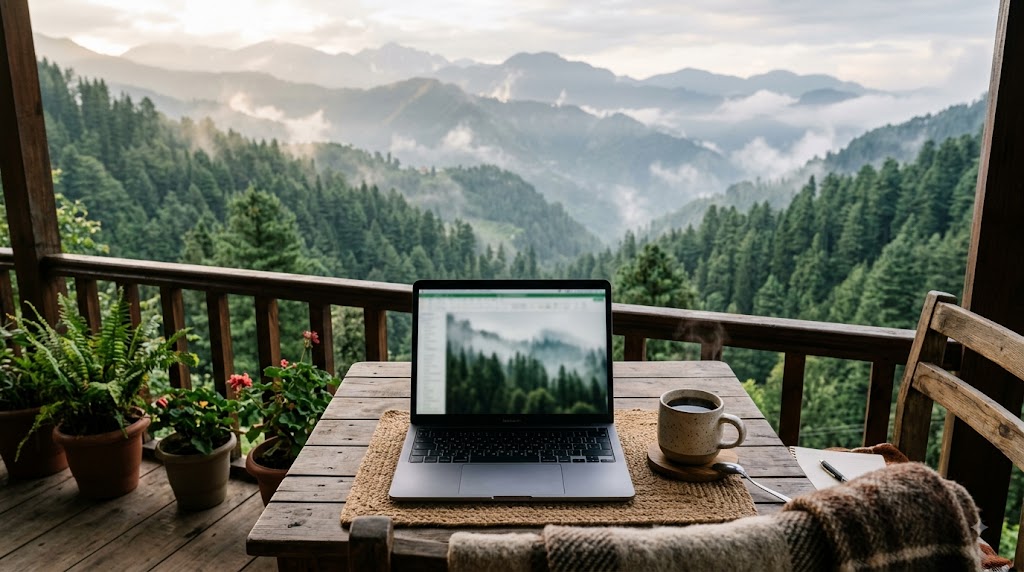
Category: Domestic Tours

  • Workation Destinations from Chandigarh: Work From the Hills Without Losing Your WiFi

    Workation Destinations from Chandigarh: Work From the Hills Without Losing Your WiFi

    In recent years, the way people travel has changed. Instead of asking where to go on holiday, many now ask where they can work while enjoying a holiday. For travellers in Chandigarh, some of India’s best workation destinations are closer than they think.

    We often hear from people who want to spend a week working remotely from the hills. They want a change from working at home and prefer a place with beautiful views. As one of the travel agents in Chandigarh, we help travelers plan trips that suit their needs. This guide explores the best hill stations for a workcation. It focuses on travel time, internet access, and comfort rather than just scenic views.

    Quick context: A workcation only works if the WiFi does. This guide ranks Chandigarh-reachable hill destinations by connectivity reliability and distance first, scenery second, which is the opposite order most travel content uses and the order that actually matters once you are three hours into a client call.

    What Actually Matters for a Workation, in Order

    1. Reliable internet, not just available internet. A property advertising WiFi and a property with fibre-backed WiFi that survives a video call are two very different things.
    2. Distance from Chandigarh, since a workation with a six-hour drive each way eats into the working days you actually have available.
    3. A proper desk and chair, not a bed and a view. This sounds obvious and is the single most common disappointment first-time workation bookers report.
    4. Backup power, since hill towns see more frequent outages than plains cities, and a property without a generator or inverter can lose you an afternoon without warning.
    5. Everything else, the view, the cafes, the hiking trails, matters enormously for the experience, but only after the first four are actually sorted.

    The Hub Comparison

    Destination Distance from Chandigarh Connectivity Best For
    Kasauli ~60 km, under 2 hours Generally reliable, close enough for a same-day backup plan if needed A short workation, or testing the concept before committing to a longer one
    Dharamshala / McLeod Ganj ~250 km, 5-6 hours Strong in the main town, more variable outside it, café WiFi is a reliable fallback Longer stays, solo workers who like a built-in café culture for changes of scene
    Bir Billing ~270 km, 6 hours Improving fast but genuinely check with your specific property first Travellers who want serious outdoor time (paragliding, hiking) alongside work
    Tirthan Valley ~260 km, 6-7 hours Patchier, best treated as a genuine digital-detox-with-some-work option rather than a full remote-work base Short async-friendly work stretches, not client-call-heavy weeks
    Manali ~310 km, 7-8 hours Reliable in the main town, co-living spaces increasingly common Longer, multi-week workations with an established remote-work community

    Kasauli: The Test Run

    If you are new to workations, Kasauli is a great place to start. It is less than two hours from Chandigarh, making it ideal for a short break. If an urgent office task comes up, you can return to the city without a long journey.

    Kasauli offers a peaceful setting for remote work. You can enjoy the hills while staying close to home. It may feel more like a change of scenery than a full workcation. However, it is a good way to test whether working from the hills suits your lifestyle.

    McLeod Ganj: The Established Choice

    Dharamshala and McLeod Ganj have the most developed remote-work culture of any option on this list, which shows up in practical ways: cafes that expect laptop workers rather than tolerate them, more reliable connectivity because more of the local economy depends on it, and enough of a working community that meeting other remote workers happens naturally rather than requiring effort. It is also far enough from Chandigarh that this genuinely needs to be a proper trip, not a long weekend squeezed around a normal work week.
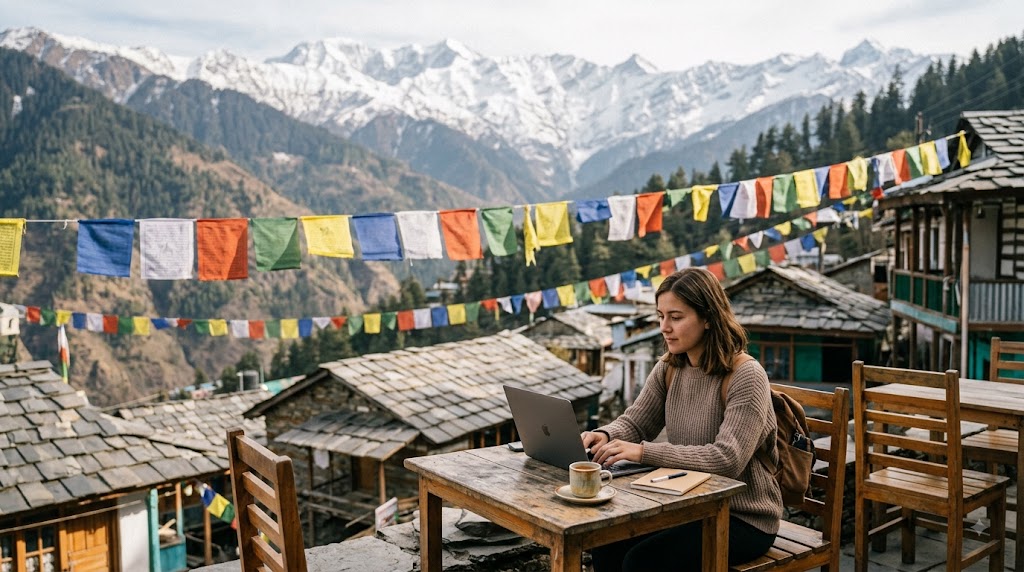
    Person working on a laptop at a hillside cafe in McLeod Ganj with mountain views - McLeod Ganj workation guide
    McLeod Ganj’s cafe culture is built around exactly this: a laptop, a mountain view, and WiFi that does not embarrass itself during a call.

    Bir Billing: Work Hard, Fly Harder

    Bir Billing is famous for paragliding and outdoor adventures. It is also becoming a popular choice for travellers who want to work remotely from the hills. The town has local facilities that can make a workation more comfortable.

    However, internet access may vary between properties. Before booking, ask the hotel or homestay about Wi-Fi speed and reliability. If your work involves video calls, check for backup internet options. This will help you choose a stay that meets your work needs.

    Tirthan Valley: Beautiful, But Be Honest About Why You Are Going

    Tirthan Valley is known for its beautiful scenery and peaceful surroundings. However, it may not be the best choice for a workation that requires constant internet access. Connectivity can be less reliable than in other hill stations.

    The valley is a good option if you want to relax and handle light work during your stay. However, frequent video calls may be difficult due to internet issues. Before booking, consider your work schedule and internet needs. This will help you decide if Tirthan Valley is the right choice for your trip.

    Manali: The Long-Stay Option

    For workations measured in weeks rather than days, Manali has the most developed infrastructure of anywhere on this list, including a genuine co-living scene that did not exist a few years ago. It is also the furthest from Chandigarh, which means the travel time only makes sense once amortised across a longer stay. A three-day Manali workation rarely feels worth the journey. A three-week one often does.

    Beyond the Big Five: Underrated Options Worth Watching

    The hubs above are the reliable, well-tested choices, but a few less obvious names are worth knowing about, particularly if you want somewhere quieter with fewer other remote workers competing for the same cafe tables:

    • Bundi in Rajasthan is further afield but increasingly mentioned in workation circles for its heritage architecture and a slower pace, better suited to a longer trip that starts or ends in Chandigarh via Delhi.
    • Coorg and Kodaikanal, further south, come up often in national workation content but are a genuine flight rather than a drive from Chandigarh, worth considering only if the trip itself, not just the working days, is the point.
    • Chikhaldara in Maharashtra is flagged as an emerging option nationally, though realistically too far for a Chandigarh-based short workation and better suited to travellers already in that region.

    For most Chandigarh-based remote workers, the Himachal hub comparison above covers the genuinely practical options. These further-flung picks are worth knowing about mainly for a longer, dedicated trip rather than a regular workation rotation.

    Workation vs Bleisure: Two Different Trips

    It is worth distinguishing a workation from the bleisure trend covered in our corporate travel guide, since they solve different problems. Bleisure typically means extending an existing business trip by a few personal days at the same destination. A workation is a dedicated trip built entirely around working remotely from somewhere other than home or office, for its own sake, with no business trip attached to it. Both are growing quickly among Indian professionals, but they need slightly different planning, and conflating them tends to produce a trip that does neither job particularly well.

    What to Actually Pack for a Workation

    • A portable WiFi hotspot or a second SIM on a different network, as backup for exactly the property WiFi outage you did not plan for.
    • A laptop stand and an external keyboard, since working from a bed for a week is a fast route to a sore neck and slower typing.
    • A power bank rated for laptop charging, not just phone charging, for the hill towns where outages are more common than in the plains.
    • Layered clothing, since most of these destinations run noticeably cooler than Chandigarh, especially in the evenings.
    • Noise-cancelling headphones, for the call you need to take from a cafe or a shared co-living space.

    Booking the Right Kind of Stay

    Not every hotel or homestay in these towns is workation-ready, even when the listing says it has WiFi. What separates a genuinely workable stay from a disappointing one:

    • A dedicated desk in the room, confirmed before booking rather than assumed from photos.
    • Recent reviews mentioning WiFi speed specifically, not just its presence, since a property can technically have WiFi that cannot handle a video call.
    • Co-living or co-working focused properties in Manali and McLeod Ganj specifically, which are increasingly purpose-built for exactly this traveller rather than repurposed tourist accommodation.
    • A cafe or two within walking distance as a genuine backup plan, not a nice-to-have.

    Best Time of Year for a Himachal Workation

    Season Conditions Verdict
    March – June Pleasant, warming toward summer, roads fully open Reliable and comfortable, popular enough that booking a couple of weeks ahead helps
    July – September Monsoon, landslide risk on some routes, lower crowds and rates Workable if you can be flexible about travel dates around weather, quieter cafes as a bonus
    October – November Clear skies, crisp air, arguably the best month for both work and weekend hikes Our top recommendation for a first workation attempt
    December – February Cold, occasional snow at higher points, some properties reduce services Beautiful but confirm heating and power reliability before booking, cold snaps can affect connectivity infrastructure too

    October and November consistently come up as the sweet spot in conversations with clients who have done this more than once, since the monsoon’s connectivity risk has passed and winter’s cold and reduced services have not yet arrived.

    Weekday vs Weekend: Planning Around the Actual Work

    The travellers who get the most out of a workation treat the travel days deliberately, arriving a day before the work week starts rather than trying to work through arrival-day travel fatigue, and building in at least one genuine day off mid-stay rather than treating every single day as a normal office day in a nicer location. Our weekend getaways guide covers the pure-leisure version of many of these same routes, worth reading if you are trying to decide whether this trip should be a workation at all or simply a proper break.

    Solo Workation vs Team Workation

    The planning conversation changes noticeably depending on whether you are going alone or bringing a small team, and it is worth being clear about which one you are actually organising before booking anything.

    • Solo workations prioritise café culture and a light sense of community over dedicated meeting space, since most solo remote workers are on calls rather than hosting them, and value being somewhere with other people around rather than fully isolated.
    • Small team workations, increasingly requested by startups and small departments wanting a change of scenery together, need a property with an actual meeting room or a large common area with reliable WiFi that can handle several simultaneous video calls, not just one.
    • Team workations also need group logistics, shared transport from Chandigarh, rooms clustered together rather than scattered, and a single point of coordination, similar in spirit to the group travel principles covered in our group travel desk, just for a work trip rather than a wedding or pilgrimage.

    A property that works beautifully for one person quietly working through a laptop on a café balcony can fall apart the moment five colleagues try to run a client call from the same WiFi connection at the same time. This is worth checking with the property directly rather than assuming capacity that was never actually tested.

    Talking to Your Manager About a Workation

    For employees rather than founders or freelancers, the workation conversation often needs to happen with a manager first, and it goes better with specifics rather than a vague request. Naming the exact destination, the connectivity plan including a backup option, and confirming which days involve meetings versus focused work tends to land better than a general ask to “work remotely for a bit.” Several of our corporate clients, covered in more depth in our corporate travel guide, have started formalising exactly this kind of request into their travel policy, which is worth checking if your company already has a managed travel programme in place.

    Common Workation Mistakes We See

    Mistake Why It Backfires
    Booking based on the view in the photos alone The desk setup and WiFi speed matter more day to day than the view does after the first afternoon
    Choosing the furthest, most scenic option for a 3-day trip Travel time eats the working days you actually need, and the trip ends just as you settle in
    Not confirming backup power with the property Hill town outages are common enough that this should be a direct question, not an assumption
    Scheduling the same call-heavy week you would have in the office Defeats much of the purpose, and stretches the property’s WiFi at exactly the wrong moments

    Frequently Asked Questions

    Which is the best workation destination near Chandigarh?

    It depends on trip length. Kasauli suits a short trip or a first attempt, McLeod Ganj suits a week-long stay with an established remote-work culture, and Manali suits multi-week stays where the longer travel time is worth amortising across more working days.

    How reliable is WiFi in Himachal hill towns?

    It varies significantly by town and even by specific property. McLeod Ganj and Manali have the most developed, reliable connectivity on this list. Bir Billing is improving. Tirthan Valley is genuinely patchier and better suited to lighter, asynchronous work.

    How far in advance should I book a workation stay?

    Two to four weeks ahead is usually enough for these destinations outside peak season, though properties with dedicated co-working setups in Manali and McLeod Ganj can book up faster since demand for exactly that setup keeps growing.

    Can Flywings help plan a workation trip, not just a holiday?

    Yes, we increasingly get exactly this request, and the planning conversation is slightly different from a normal leisure trip. Tell us how many days are genuinely work days versus leisure days, and we will match the destination and property accordingly.

    Is a workation worth it for a trip shorter than a week?

    For destinations under two hours away like Kasauli, yes. For anything requiring a five-plus hour drive, the travel time starts to outweigh the benefit on a trip shorter than about five days.

    What is the difference between a workation and a bleisure trip?

    A bleisure trip extends an existing business trip with a few personal days at the same destination. A workation is a standalone trip built entirely around remote work somewhere other than home, with no business trip attached. They solve different problems and are usually planned differently.

    Can a small team do a workation together, not just one person?

    Yes, and this is a growing request from startups and small departments. It needs a different kind of property, one with genuine meeting space and WiFi capacity for several simultaneous calls, plus group transport and room coordination similar to any group trip.

    Bring the Laptop, Skip the Kitchen Table

    A great workation combines good planning with beautiful views. Tell us about your work schedule and how many days you need reliable internet. We will help you choose a suitable destination and stay.

    Looking for a relaxing break instead? Explore our weekend getaways guide for ideas near Chandigarh. You can also contact us to plan a workation that suits your needs.

    Written by Sukhjinder Kaur, Senior Travel Content Writer at Flywings Tour & Packages Pvt Ltd – planning trips from Mohali, Punjab since 2013. Connectivity and infrastructure details reflect conditions as of August 2026 and can change property by property, so confirm specifics before booking.
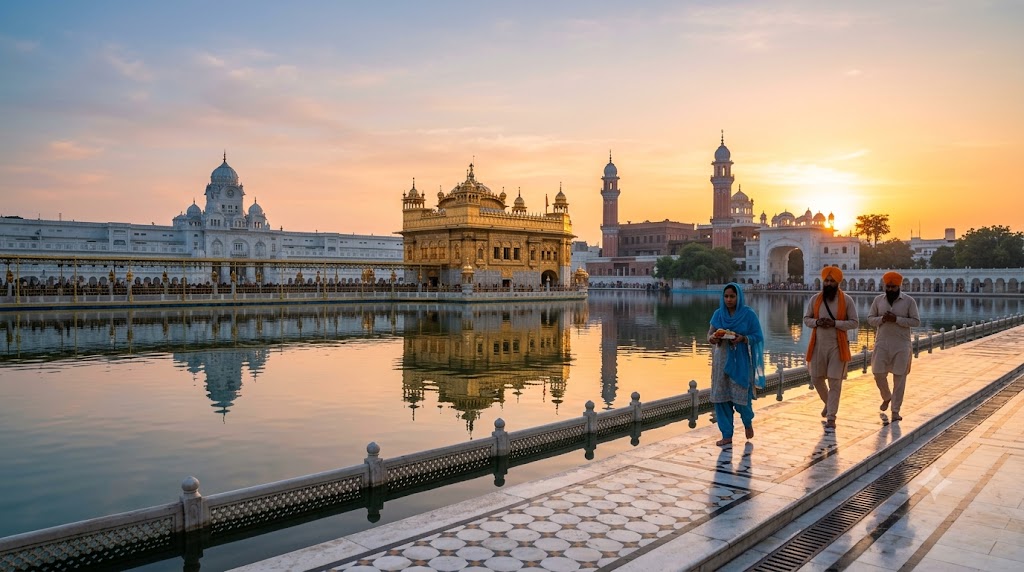
  • Golden Temple Amritsar: The Complete Visitor Guide — Perfect Your Day, Hour by Hour (2026)

    Golden Temple Amritsar: The Complete Visitor Guide — Perfect Your Day, Hour by Hour (2026)

    Amritsar rewards a well-planned single day better than almost any other city in India — the Golden Temple works on any schedule you give it (it never closes), the Wagah Border ceremony runs on a fixed clock 30 km away, and the gap between them is exactly enough time for the food this city is famous for. At Flywings Tour & Packages Pvt Ltd, we’ve sent Chandigarh and Punjab families here for a day trip, a weekend, and everything in between since 2013. Here is the whole visit mapped hour by hour, so you leave with the full experience and not the rushed version.

    6:00 AM — Sunrise at the Golden Temple

    The single best hour to arrive. The Golden Temple (Harmandir Sahib) is open 24 hours a day, every day, with free entry and no religious qualification to enter — but sunrise is when the marble parkarma is calmest, the light on the gilded dome is softest, and the crowds of the day haven’t arrived yet. Enter via the causeway, and before anything else, follow the three rules every visitor observes: remove your shoes at the entrance (free counters hold them), cover your head (scarves are provided if you don’t have one), and wash your feet in the shallow water channel at the entrance. Modest dress — shoulders and knees covered — applies to everyone, regardless of gender.

    Budget a minimum of 2–3 hours for a proper visit: the walk around the parkarma, the causeway queue into the inner sanctum for darshan, and simply sitting by the sarovar (the sacred pool) taking it in. If you want the complete experience including a langar meal and time to reflect, plan for closer to 5–6 hours across the day rather than a single rushed pass.

    9:00 AM — Langar: The World’s Largest Free Kitchen

    Somewhere around mid-morning, once you’ve done a first circuit of the temple, sit for langar — the free community meal that has run continuously at the Golden Temple for centuries. It serves around 100,000 meals a day, free, to anyone regardless of faith, caste or nationality, prepared and served largely by volunteers. Queues move fast even when they look long; join the line, sit on the floor in the communal hall, and eat what’s served. It’s not just a meal — it’s the single clearest expression of the Golden Temple’s core philosophy, and skipping it is the most common regret we hear from first-time visitors.

    11:00 AM — Jallianwala Bagh and the Partition Museum

    Both sit within walking distance of the Golden Temple along Heritage Street, and both add historical weight to the trip:

    • Jallianwala Bagh: the walled garden and site of the 1919 massacre, now a memorial with a small museum — a sober, important stop, best given 30–45 minutes.
    • Partition Museum: the world’s first museum dedicated to the 1947 Partition, telling the story through oral histories, refugee artifacts, letters and photographs. It’s open 10 AM–6 PM, Tuesday to Sunday (closed Monday), with a modest entry fee for tourists. Give it at least an hour if you’re interested in history — photography isn’t permitted inside, so be present rather than filming.

    1:00 PM — Amritsari Food Break

    This is non-negotiable in Amritsar. Hall Bazaar and the lanes around the Golden Temple complex serve some of the best food in North India — kulchas stuffed and griddled to order, lassi thick enough to stand a spoon in, and tandoori everything. Locals have their favourite decades-old spots; ask your driver or hotel, since the best kulcha stall in Amritsar rarely has a sign worth photographing.

    1:45 PM — A Quick Heritage Street Shopping Stop

    If you have twenty minutes before heading to Wagah, Heritage Street between the Golden Temple and Town Hall is worth a walk-through: Punjabi phulkari embroidery, juttis (traditional footwear), and Amritsari papad and wadiyan make honest, packable souvenirs. Save the bigger shopping session for the evening when you’re back from Wagah and not racing a ceremony start time — Hall Bazaar stays lively well into the night.

    2:30 PM — Depart for Wagah Border

    The Wagah Border sits roughly 30 km from central Amritsar, and this is the one fixed appointment of the day — the Beating Retreat ceremony has a set start time and fills up fast, so leave with a real buffer. Most hotels and drivers recommend departing by 2:30–3 PM to account for security queues and seating, especially in peak season or around national holidays.

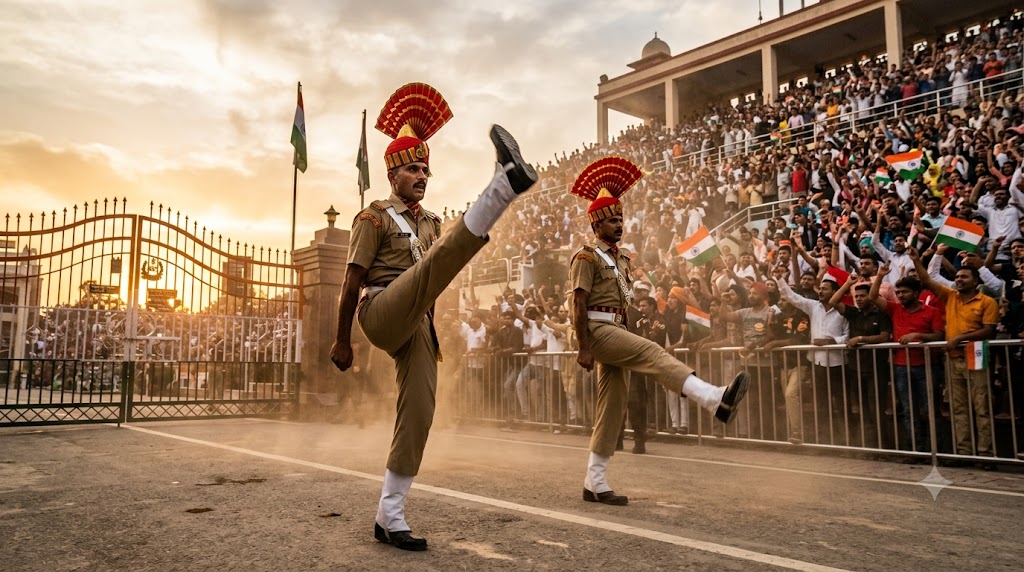
    BSF soldiers performing the high-energy Wagah Border retreat ceremony at sunset — Wagah Border ceremony Amritsar
    The Wagah Border Beating Retreat — 45 minutes of high-kick marching, flag lowering and crowd energy between India’s BSF and Pakistan’s Rangers, completely free to watch.

    4:30–5:30 PM — The Wagah Border Ceremony

    The ceremony’s start time shifts with the season — around 4:30 PM in winter, closer to 5:30 PM in summer — so confirm the current timing for your travel date. What follows is genuinely one of India’s most electric 45 minutes: BSF and Pakistan Rangers soldiers perform a high-energy display of precision marching, high kicks and flag lowering, with packed stands cheering on both sides of the border. It’s free, but arrive early for a decent seat — the stands fill completely around Independence Day (15 August) and other national occasions, when the atmosphere reaches its peak patriotic energy. If you’re travelling around mid-August, this is worth building your whole Amritsar day around.

    7:00 PM — Back to the Golden Temple, Lit Up

    The Golden Temple at night is a different experience entirely from the morning — the dome and surrounding buildings are lit, reflected in the sarovar, and the atmosphere turns quieter and more contemplative as the day-trip crowds thin out. This is also, for many visitors, the most photogenic hour of the whole day.

    9:45 PM — The Palki Sahib Ceremony

    If you can stay this late, this is the single most moving ritual at the Golden Temple: the Guru Granth Sahib (the Sikh holy scripture) is ceremonially carried in a golden palanquin from the main sanctum back to the Akal Takht for the night, accompanied by singing and devotees lining the causeway. It runs around 9:45 PM (closer to 10 PM in summer). Staying for this turns a good day trip into a genuinely memorable one — but it does mean a later drive back if you’re returning to Chandigarh same-day.

    One Day or Two? Planning the Logistics

    One-Day Trip from Chandigarh Overnight in Amritsar
    Best for Time-limited visitors, a focused Golden Temple + Wagah day Families wanting the full hour-by-hour experience above, including Palki Sahib
    Departure from Chandigarh Early morning, ideally by 5–6 AM to maximise the day Flexible — arrive the evening before
    Return Late night after Wagah or an early Palki Sahib viewing Next morning, unhurried
    Getting there ~230 km road (4–4.5 hours) or a short flight to Amritsar (ATQ) Same options, less time pressure

    Our honest recommendation: if you can spare one night, do — the Palki Sahib ceremony and a relaxed, non-rushed morning darshan are worth it. If time is genuinely tight, the one-day version above still delivers the Golden Temple, langar, Wagah Border and Amritsari food in a single, well-paced day.

    Where to Stay, If You’re Staying the Night

    • Walking distance from the Golden Temple: the most convenient tier — you can dip back in for the night view or Palki Sahib without a taxi, though rooms here vary widely in comfort and book up fast around Independence Day and Sikh festival dates.
    • Near the Mall Road / Ranjit Avenue area: more modern hotel options with easier parking, a short cab ride from the temple complex.
    • Highway-adjacent properties: useful if you’re arriving late by road or continuing on toward Jammu the next morning, trading a bit of walkability for convenience on a longer itinerary.

    We book the tier that matches your plan — temple-adjacent for a Palki Sahib-focused evening, or highway-side if Amritsar is a stopover on a longer Vaishno Devi or Kashmir trip.

    Getting to Amritsar from Chandigarh

    Amritsar is one of the most convenient short trips from the Tricity — road, rail and air all work well, and Amritsar’s own international airport (ATQ) means many travellers also combine a Golden Temple visit with an onward or inbound international flight, as we cover in our international flights from Chandigarh and Amritsar guide. It also sits directly on the route north toward Jammu, making it a natural add-on to a Vaishno Devi yatra or a Kashmir trip.

    Practical Tips We Give Every Client

    • Head covering: carry your own scarf or bandana if you’d rather not use the temple’s shared ones, especially for larger groups.
    • Photography: generally allowed around the Golden Temple complex, but strictly prohibited inside the Partition Museum — check signage at each site.
    • Footwear: shoe-check counters at the Golden Temple are free and well-organised, but keep your token safe.
    • Wagah Border seating: gender-segregated stands are standard; arrive early for a clear view, and expect security screening similar to an airport.
    • Mobility considerations: the Golden Temple parkarma is flat marble and wheelchair-manageable; Wagah’s stand seating is less accommodating — let us know in advance if this matters for your group.
    • Weather: October–March offers the most comfortable temperatures for a full day of walking; summer visits should front-load outdoor time to the morning and evening.

    Frequently Asked Questions

    What are the Golden Temple’s timings?

    The Golden Temple is open 24 hours a day, every day of the year, with free entry at any time. There’s no official closing time — the complex, langar and parkarma are accessible round the clock, though the most peaceful hours are early morning and late evening.

    How do I combine the Golden Temple and Wagah Border in one day?

    Start at the Golden Temple at sunrise, cover langar and the Heritage Street sites (Jallianwala Bagh, Partition Museum) by early afternoon, have lunch, then depart for Wagah Border by 2:30–3 PM to reach in time for the ceremony (4:30 PM in winter, 5:30 PM in summer). Return to the Golden Temple in the evening for the lit-up night view and, if time allows, the 9:45 PM Palki Sahib ceremony.

    What time is the Wagah Border ceremony?

    Around 4:30 PM in winter months and closer to 5:30 PM in summer — always confirm the current schedule for your travel date, and plan to arrive at least 1.5–2 hours early, especially around Independence Day (15 August) when stands fill to capacity.

    Is the Golden Temple free to visit?

    Yes, entirely — there’s no entry fee, and langar (the community meal) is also free for every visitor regardless of faith or nationality. The Partition Museum, a separate attraction nearby, does charge a modest entry fee for tourists.

    Can I visit Amritsar as a day trip from Chandigarh?

    Yes — it’s roughly a 4–4.5 hour drive each way (about 230 km), which comfortably supports a well-planned one-day visit if you leave early. For the full hour-by-hour experience including the night-time Palki Sahib ceremony, an overnight stay is more relaxed.

    Can Flywings arrange a private Amritsar day trip from Chandigarh?

    Yes — private cab, a paced itinerary matched to the hour-by-hour plan above, and Wagah Border seating guidance are all part of our Amritsar day-trip and overnight packages. Tell us your dates and group size for a quote.

    Plan Your Perfect Amritsar Day

    Amritsar is one of the easiest, most rewarding trips from the Tricity — but the difference between a rushed visit and a genuinely memorable one comes down to timing it right. Let us plan the day (or the overnight) around you. Explore more of our India tour packages from Chandigarh, or reach us directly:

    Written by Sukhjinder Kaur, Senior Travel Content Writer at Flywings Tour & Packages Pvt Ltd — planning trips from Mohali, Punjab since 2013. Timings verified as of July 2026; ceremony schedules and museum hours can shift seasonally, so confirm current timings when you enquire.

  • Spiti Valley Trip from Chandigarh: The Complete Road-Trip Guide Before the Season Closes (2026)

    Spiti Valley Trip from Chandigarh: The Complete Road-Trip Guide Before the Season Closes (2026)

    Not every trip from Chandigarh needs to be a beach or a shrine — sometimes it needs to be a road disappearing into a landscape that looks like nowhere else in India. That’s Spiti Valley: a high-altitude cold desert in Himachal Pradesh, all bare brown mountains, whitewashed monasteries clinging to cliffs, and villages that feel closer to Tibet than to Chandigarh, even though the drive starts right here. At Flywings Tour & Packages Pvt Ltd, we’ve watched Spiti go from a hardcore-backpacker secret to one of the most-asked-about road trips in the Tricity — and the season window that makes it possible is closing faster than most travellers realise. Here’s everything to know before you go, from route choice to altitude sickness, written for someone who has never done a Himalayan road trip before.

    Is Spiti Valley the Right Trip for You?

    Before the logistics — an honest check, because Spiti isn’t Shimla with better views:

    • Say yes if: you want dramatic, stark landscapes over lush greenery, don’t mind long driving days, are comfortable with basic guesthouse comfort in remote villages, and want a trip that feels like an achievement, not just a holiday.
    • Think twice if: you have very young children, anyone in the group has a heart or lung condition (altitude matters — more on this below), or your idea of a hill trip is a resort with room service.
    • The reward: monasteries over a thousand years old, some of the world’s highest motorable villages, night skies with more stars than most Indians have ever seen, and a road trip story that outlasts every beach photo.

    The Season Window — Why Timing Matters More Here Than Anywhere Else

    Spiti isn’t a year-round destination the way Shimla or Manali are. High mountain passes close with snow, and the full circuit genuinely only works within one window:

    Period Status
    November – May Manali route closed by snow; Shimla-Kinnaur route technically open but needs 4×4/snow chains and real cold-weather experience
    Mid-June – Mid-October The full circuit window — both entry routes open, this is when 95% of travellers should go
    July – August Warmest, but the Kinnaur side can see monsoon landslides — the Manali side stays comparatively drier since Spiti sits in a rain shadow
    September The sweet spot — golden poplar trees, clear skies, thinning crowds, and rates that soften after the August peak

    If you’re reading this in mid-to-late summer, the practical message is simple: the window is open right now, but it closes by mid-October — this is genuinely a “plan this month, not next spring” trip if you want to go this year.

    Two Ways In: Shimla-Kinnaur vs Manali

    Both routes start from the Chandigarh side of Himachal, and each gives a completely different trip:

    Route Character Best For
    Shimla → Kinnaur → Kaza Longer, more gradual altitude gain along the Sutlej river valley, passing Kalpa and Chitkul Better acclimatisation, first-timers, those wanting Kinnaur’s greener scenery en route
    Manali → Kunzum Pass → Kaza Shorter but steeper, crossing high passes quickly Time-limited trips, those who’ve already acclimatised, combining with a Manali stop

    Our recommendation for a first Spiti trip: enter via Shimla-Kinnaur and exit via Manali (or vice versa) if your schedule allows — you see both faces of the region and gain altitude more gradually, which matters far more than most travellers expect.

    Permits: Simpler Than You’ve Heard

    Indian tourists do not need a special permit for most of Spiti Valley — including Kaza, Tabo, Key Monastery, Kibber and Chandratal — which surprises many first-timers who’ve heard permit horror stories from other border regions. Foreign nationals do need an Inner Line Permit for the Spiti and Kinnaur region, arranged at the DC office in Shimla or Kaza, or via the Himachal Pradesh e-permit portal. For Indian travellers, the paperwork is refreshingly light — carry a government photo ID, as with any domestic trip.

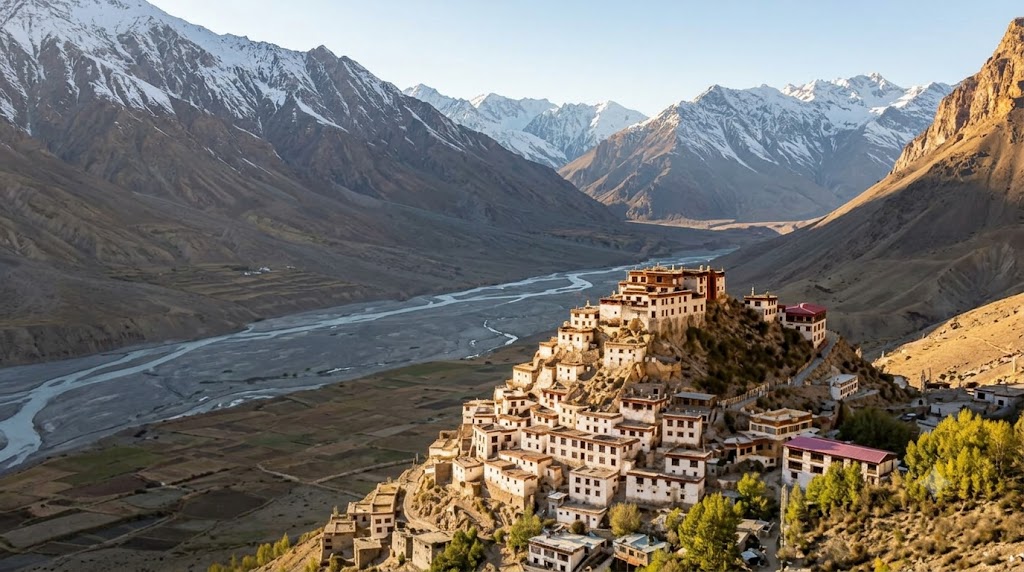
    Key Monastery perched on a hilltop above the Spiti river valley — Kaza Spiti Valley Himachal Pradesh
    Key Monastery, one of Spiti’s oldest and largest, stacked on its hilltop above the valley — the image most people picture when they hear “Spiti”.

    A Realistic 7-Day Itinerary

    1. Day 1 — Chandigarh to Shimla/Narkanda: A relatively easy driving day to start gaining altitude gradually.
    2. Day 2 — Onward to Sarahan or Kalpa (Kinnaur): Following the Sutlej valley, with Kinnaur Kailash views opening up as you climb.
    3. Day 3 — Kalpa to Nako: Crossing into the drier, starker Spiti-side landscape — the transformation is dramatic and sudden.
    4. Day 4 — Nako to Kaza via Tabo: Stop at Tabo Monastery, over a thousand years old, before reaching Kaza, Spiti’s small “capital”.
    5. Day 5 — Kaza local circuit: Key Monastery, Kibber (one of the world’s highest motorable villages), and Chicham bridge.
    6. Day 6 — Kaza to Chandratal (seasonal) or straight toward Manali: The moon-lake Chandratal, when road conditions allow, or a direct push toward Kunzum Pass.
    7. Day 7 — Over Kunzum Pass to Manali: The dramatic exit route, ending in Manali’s relative comfort before the drive home to Chandigarh.

    This can be tightened to 5–6 days for a faster trip, but Spiti punishes rushing more than most destinations — the roads are slow by nature, and altitude needs the buffer days built in.

    Altitude and Safety: The Section Not to Skip

    Spiti’s villages sit between roughly 3,000 and 4,500+ metres — genuinely high altitude, where altitude sickness (AMS) is a real, common risk, not a rare edge case:

    • Gain altitude gradually. This is the single biggest reason we recommend the Shimla-Kinnaur entry for first-timers — it climbs in stages rather than jumping straight to Kaza’s altitude.
    • Hydrate more than feels necessary. Dehydration worsens AMS symptoms; drink water constantly through the trip, not just when thirsty.
    • Know the warning signs: headache, nausea, dizziness and breathlessness beyond normal exertion. Mild symptoms mean rest and hydration; worsening symptoms mean descend — don’t push through.
    • Avoid alcohol and heavy exertion on your first day or two at altitude, however tempting the views are for a trek.
    • Travel with a driver who knows the region. Local drivers recognise AMS symptoms early and know exactly where the nearest lower-altitude town is — this is not a route to self-drive on a first attempt.
    • Carry basic medication as advised by your doctor before the trip, and know where the nearest medical points are along your route.

    Beyond the Main Circuit: Worth the Detour

    • Dhankar Monastery and Lake: a cliffside monastery even more dramatically perched than Key, with a short hike up to a glacial lake — often skipped by rushed itineraries, which is exactly why it’s worth the detour.
    • Pin Valley: a side valley known for its stark beauty and as habitat for the elusive snow leopard in winter — a full-day detour for travellers with an extra day to spare.
    • Langza, Komic and Hikkim: a trio of villages near Kaza famous for fossil-hunting, one of the world’s highest motorable villages, and (in Hikkim’s case) the world’s highest post office — a fun half-day loop from Kaza.
    • Chandratal Lake: the “Moon Lake”, reachable via a seasonal side road — camping here under Spiti’s night sky is, for many travellers, the single best memory of the trip when road conditions allow it.

    Food and Connectivity on the Road

    Kaza has the region’s best range of small cafés and guesthouse kitchens, serving a mix of simple Himachali, Tibetan (think momos and thukpa) and traveller-friendly food — don’t expect variety once you’re beyond Kaza’s handful of villages, and pack some snacks for long driving days. Mobile network is limited to patchy BSNL coverage in places and largely absent between towns, so tell family back home to expect radio silence for a day or two — this is very much part of Spiti’s appeal, not a flaw to work around.

    What to Pack

    • Serious layering: daytime sun is strong, nights drop close to freezing even in summer.
    • Sunscreen and sunglasses: UV exposure at altitude is significantly stronger than at sea level.
    • A power bank and offline maps: mobile network is patchy to non-existent through much of the route.
    • Cash: ATMs are scarce beyond Kaza; carry enough for the whole circuit.
    • A basic medical kit including any AMS medication discussed with your doctor.

    Booking a Package vs Self-Driving

    Spiti is one region where we actively steer first-timers away from self-driving unless someone in the group has real mountain-driving experience — the roads are narrow, altitude affects judgement more than people expect, and breakdown support is thin between towns. A Flywings Spiti package handles the vehicle (with an experienced local driver), homestay/guesthouse bookings matched to each night’s altitude, and a pace that respects acclimatisation — the same logic we apply to Kashmir and Himachal weekend trips, extended to Spiti’s more demanding terrain.

    Frequently Asked Questions

    What is the best time to visit Spiti Valley from Chandigarh?

    Mid-June to mid-October is the full circuit window, with September standing out as the sweet spot — golden autumn colours, clearer skies, and thinner crowds than the July–August peak. Outside this window, mountain passes close and the trip becomes far more difficult or impossible for most travellers.

    How many days are needed for a Spiti Valley trip?

    7 days covers the classic circuit comfortably with acclimatisation built in — Shimla-Kinnaur entry, Kaza-area sightseeing, and a Manali exit over Kunzum Pass. It can be tightened to 5–6 days, but we don’t recommend rushing the altitude gain.

    Is Spiti Valley safe for families with children?

    It depends more on altitude tolerance than age — Spiti’s high elevation genuinely affects some people regardless of fitness. Families with older children who acclimatise well can have a wonderful trip; we’d advise caution with very young children and recommend discussing the itinerary with a doctor beforehand if anyone has a heart or lung condition.

    Do Indian tourists need a permit for Spiti Valley?

    No special permit is required for Indian nationals to visit Kaza, Tabo, Key Monastery, Kibber or Chandratal — just a government photo ID, as with any domestic trip. Only foreign nationals need an Inner Line Permit for the region.

    What is the distance from Chandigarh to Kaza?

    Roughly 450–470 km depending on the route, but Himalayan road distance is measured in hours, not kilometres — expect the drive (spread across multiple days with overnight stops) to take 3–4 driving days each way via either entry route, not a single push.

    Which route is better for a first-time visitor — Shimla-Kinnaur or Manali?

    Shimla-Kinnaur, for most first-timers — it gains altitude more gradually along the Sutlej valley, which meaningfully reduces AMS risk compared to Manali’s steeper, faster climb over high passes. If your schedule allows, entering via one route and exiting via the other gives you the best of both without doubling back.

    Can Flywings arrange a Spiti Valley trip with a driver?

    Yes — we arrange the vehicle with an experienced mountain driver, altitude-appropriate guesthouse stays, and a paced itinerary, as a complete package from Chandigarh. Tell us your dates and group size for an itemised quote.

    The Window Is Open — For Now

    Spiti rewards travellers who plan a little and respect the altitude a lot. With the season closing by mid-October, the right time to start planning is now, not after the passes shut for winter. Explore more of our India tour packages from Chandigarh, or talk to our desk directly:

    Written by Sukhjinder Kaur, Senior Travel Content Writer at Flywings Tour & Packages Pvt Ltd — planning road trips and holidays from Mohali, Punjab since 2013. Route and season information verified as of July 2026; mountain road conditions change with weather, so confirm current status before you travel.

  • Vaishno Devi Package from Chandigarh & Amritsar: The Complete Planning Guide (2026)

    Vaishno Devi Package from Chandigarh & Amritsar: The Complete Planning Guide (2026)

    Of everywhere on this list, Vaishno Devi is the trip most travellers from Chandigarh, Mohali and Punjab actually take at least once — and the one most families still plan last-minute, on a WhatsApp forward and a hope. A Vaishno Devi package from Chandigarh or Amritsar deserves a bit more than that, because the yatra rewards planning: the right registration slot, the right mode of ascent for your group, and the right week on the calendar make the difference between a rushed, exhausting climb and the kind of trip people talk about for years. At Flywings Tour & Packages Pvt Ltd, we’ve been organising this exact pilgrimage for Punjab families since 2013. Here is everything to sort out before you book — in the order you’ll actually need it.

    Quick facts before you plan: Katra is roughly 5–6 hours by road from Chandigarh (via Jammu), or a short flight/train to Jammu followed by an hour’s drive. The climb from Katra to the shrine is about 13 km — walkable, ponyable, or skippable by helicopter to Sanjichhat. Registration (the Yatra Parchi) is free and mandatory. The best months are March–April and September–October, once monsoon landslide risk has passed.

    Step 1: Getting to Katra from Chandigarh or Amritsar

    Katra, the base town for the yatra, is reachable three ways from Punjab — pick based on your group’s time and comfort, not habit:

    Route Approx. Time Best For
    Road via Jammu (Chandigarh/Amritsar → Katra) 5–6 hours from Chandigarh; 4–5 hours from Amritsar Families with a private cab, flexible groups
    Flight to Jammu, then road to Katra ~1 hour flight + ~1.5 hour drive Elderly travellers, short-leave trips, summer heat avoidance
    Train to Jammu Tawi, then road to Katra Varies by train; ~1.5 hour drive from Jammu Budget groups, overnight travel to save a day

    Our honest advice for a first-timer group: road via Jammu is simplest for Punjab travellers, since it’s a known highway and needs no connection timing to get right. For elderly pilgrims or a genuinely tight weekend, flying into Jammu removes the most tiring stretch of the trip.

    Step 2: Register for Your Yatra Parchi — Free, but Mandatory

    Every pilgrim needs a Yatra Parchi (registration slip) to begin the climb — it’s free of cost and the process is simple, but skipping it or leaving it to Katra means longer queues:

    1. Register on the official Shri Mata Vaishno Devi Shrine Board portal as a new devotee, creating a Devotee ID.
    2. Select your preferred date and time slot for the climb.
    3. Download and print (or save digitally) your Yatra Parchi — you’ll need it at the Katra check-post before starting.
    4. The same portal handles room bookings, Aarti/Poojan slots, and battery-car bookings within Katra — worth doing together in one sitting.

    Use only the official portal — third-party sites charging a “registration fee” are not legitimate; the yatra parchi itself is always free. We handle this registration as part of every Vaishno Devi package we book, timed to your travel dates.

    Step 3: Choose Your Mode of Ascent

    This is the decision that shapes your whole trip — and the one where “what worked for your neighbour” isn’t always right for your group:

    Mode Time (One Way) Best For Watch-Out
    Trek (on foot) 5–7 hours Fit adults, groups wanting the full devotional experience 13 km uphill — pace yourself, carry water, start early
    Pony / Palki 4–6 hours Elderly pilgrims, those with mobility limits, families with older kids Book at official counters only; agree the fare before starting
    Helicopter (to Sanjichhat) ~5–8 minutes flight + short walk Short-leave trips, elderly or unwell pilgrims, hot-season visits Book up to 60 days ahead online; seats sell out fast around Navratri
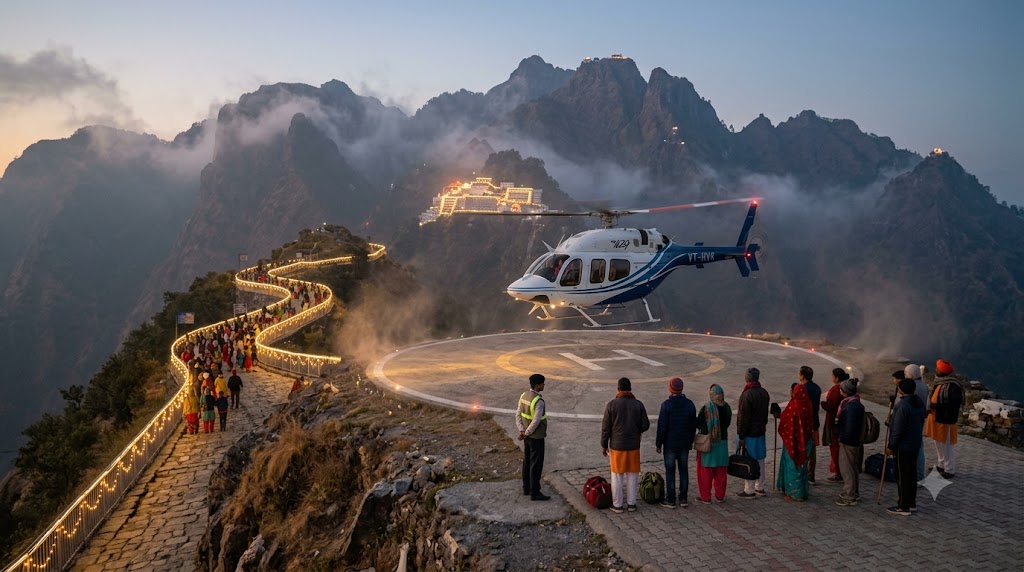
    Helicopter landing at Sanjichhat helipad near Vaishno Devi with mountain views — helicopter booking for Vaishno Devi yatra
    The helicopter to Sanjichhat cuts the climb to minutes — the single most useful option for elderly pilgrims or a genuine one-day yatra.

    Step 4: Pick Your Week — The Best Time to Go

    Vaishno Devi is open year-round, but the calendar genuinely changes the experience:

    Period Conditions Our Take
    March – April Pleasant, clear, moderate crowds One of the two best windows of the year
    May – June Warm to hot, busy with summer holidays Fine if you start the climb pre-dawn to beat the heat
    July – August Monsoon — lush but landslide-prone Avoid if possible; if travelling, check road advisories daily
    September – October Clear post-monsoon skies, Sharad Navratri falls here The golden window — best weather, but Navratri dates themselves are extremely crowded
    November – February Cold, occasional snow at higher points Quiet and scenic, pack serious woollens

    If your dates are flexible, our practical tip: aim for the two-to-three weeks around Sharad Navratri rather than the festival days themselves — you get the same clear autumn weather with a fraction of the queue.

    Step 5: What to Pack and Prepare

    • Comfortable, broken-in walking shoes — this is not the trip for new sandals.
    • A light jacket even in summer — evenings near the shrine are cooler than Katra.
    • A refillable water bottle — stations along the route refill for free.
    • A small daypack — lockers are available in Katra for anything you don’t want to carry up.
    • Any government photo ID for every traveller — required at the check-post alongside your Yatra Parchi.
    • Cash in small denominations — for pony/palki fares and en-route stalls, though UPI works at most fixed counters now.

    Where to Stay in Katra

    Katra’s hotels range from simple guesthouses to comfortable mid-range properties, and location matters more than star rating for this particular trip:

    • Near the Banganga check-post / Yatra starting point: the most convenient tier — you start walking (or catch your pony/helicopter transport) within minutes, which matters most if you’re beginning before sunrise.
    • Katra Main Bazaar: the widest choice of hotels and easiest access to food, shops and the railway/bus station, a short auto ride from the starting point.
    • Quieter outskirts: better rates and more parking space for private vehicles, at the cost of a slightly longer transfer to the check-post.

    We book hotels in the tier that matches your climb plan — right by the check-post for an early helicopter slot, or Main Bazaar for a more relaxed trekking start.

    Vaishno Devi for Kids, Elderly Pilgrims and Large Groups

    • With young children: pony or palki covers the distance without exhausting little legs; battery cars (booked on the same official portal) cover the flatter stretches within Katra itself.
    • With elderly parents: the helicopter to Sanjichhat is the single biggest comfort upgrade available — book it as early as your 60-day window allows, especially around Navratri.
    • Large family or society groups: we coordinate group hotel blocks in Katra and staggered registration slots so the group climbs together rather than getting split across different time windows — tell us your headcount early, since Navratri-season room blocks fill up months ahead.

    Combining Vaishno Devi with Amritsar or Kashmir

    Because Katra sits on the Chandigarh–Jammu–Srinagar road corridor, many of our clients extend a Vaishno Devi trip rather than treating it as a standalone weekend:

    • + Golden Temple, Amritsar: roughly on the way for road travellers from Punjab — an easy add-on for a longer, more complete pilgrimage circuit.
    • + Kashmir: Jammu is the gateway city for both — pilgrims continuing north into the Kashmir Valley can combine the yatra with our Kashmir tour package itinerary on the same trip.

    What to Budget For

    Vaishno Devi is genuinely one of the more affordable pilgrimages to plan, but a few cost categories are worth knowing about before you go, even without fixed figures here — every quote we prepare itemises these individually:

    • Registration (Yatra Parchi): free, always.
    • Transport from Chandigarh/Amritsar: varies by private cab vs shared travel vs flight-to-Jammu.
    • Pony, palki or helicopter: the biggest variable cost — helicopter costs the most but saves the most time and effort.
    • Katra hotel: varies by proximity to the check-post and season, with Navratri commanding the highest rates.
    • Meals and en-route purchases: modest — Katra and the yatra route both have plenty of affordable food options, including free langar at points along the way.

    Share your group size and preferred ascent mode and we’ll send an itemised quote covering all of the above within 24 hours.

    A Realistic Trip Timeline

    For most Chandigarh families, this is how a Vaishno Devi trip actually fits together:

    1. Day 1: Travel from Chandigarh/Amritsar to Katra, check in, complete registration if not done online in advance.
    2. Day 2: Pre-dawn or early-morning start up the hill (trek/pony/helicopter), darshan, descend or return by helicopter, rest in Katra.
    3. Day 3: Optional — visit Katra’s local sights or begin the return journey; some families extend with a short Jammu city stop (Bahu Fort, Raghunath Temple) before heading home.

    Two nights / three days covers this comfortably without rushing the darshan itself, which is the part no one wants to hurry.

    Frequently Asked Questions

    How many days are needed for the Vaishno Devi yatra from Chandigarh?

    Two nights, three days is the comfortable standard — one day to travel and settle in, one for the climb and darshan, and a buffer day for rest or a Jammu city stop before heading home. It can be compressed to a long weekend using a flight to Jammu and the helicopter option.

    Is the Vaishno Devi trek difficult?

    The 13 km climb is steady but manageable for most reasonably fit adults, done at your own pace with rest points throughout. For elderly pilgrims, young children, or anyone with mobility concerns, the pony, palki or helicopter options make the shrine fully accessible without the full trek.

    How do I book the Vaishno Devi helicopter?

    Helicopter bookings open via the official Shrine Board portal up to 60 days in advance and are first-come, first-served — seats around Navratri and other peak weekends sell out quickly. We handle this booking as part of every package, timed to your travel dates.

    Is Yatra Parchi registration really free?

    Yes, completely — registration is free of charge on the official portal. Be cautious of any third-party site charging a “registration fee”; that is not an official cost.

    What is the best time to visit for pleasant weather and fewer crowds?

    March–April and the weeks around (not exactly during) Sharad Navratri in September–October offer the best combination of clear weather and manageable crowds. Avoid peak monsoon (July–August) due to landslide risk, and expect the heaviest crowds during Navratri itself.

    Can I combine Vaishno Devi with a Golden Temple or Kashmir trip?

    Very easily — Katra sits on the Chandigarh–Jammu–Srinagar corridor, so an Amritsar stop works naturally on the way, and Jammu is the same gateway city pilgrims use to continue on to Kashmir. We regularly plan combined itineraries covering two or three of these in one trip.

    Can Flywings arrange the full Vaishno Devi trip, not just transport?

    Yes — registration, Katra hotel booking, private transport from Chandigarh or Amritsar, and helicopter or pony arrangements can all be handled as one itemised package. See more domestic circuits on our India tour packages from Chandigarh page.

    Plan Your Yatra With a Desk That’s Done This Before

    Vaishno Devi is one trip where local logistics knowledge — which Katra hotels are genuinely close to the check-post, which weeks to avoid, how to lock a helicopter slot before it sells out — makes a real difference to how the trip feels. Tell us your dates and group size, and we’ll build the itinerary around them. Explore more of our India tour packages, or reach us directly:

    Written by Sukhjinder Kaur, Senior Travel Content Writer at Flywings Tour & Packages Pvt Ltd — planning pilgrimages and holidays from Mohali, Punjab since 2013. Registration processes and seasonal guidance verified as of July 2026; yatra rules and weather can change, so confirm current details when you enquire.

  • Weekend Getaways from Chandigarh 2026: 10 Best Short Trips by Distance, Season & Long-Weekend Calendar

    Weekend Getaways from Chandigarh 2026: 10 Best Short Trips by Distance, Season & Long-Weekend Calendar

    Living in the Tricity means one thing every Friday evening: the mountains are calling, and they are barely two hours away. If you are searching for weekend getaways from Chandigarh, you are sitting on one of the best launchpads in India — Himachal’s pine towns, Punjab’s heritage cities and Uttarakhand’s river camps all fit inside a two-day window. At our Mohali office, Flywings Tour & Packages Pvt Ltd has been planning short escapes for Tricity families since 2013, and this guide is the exact playbook we use across the counter: the 10 getaways that actually work in a weekend, sorted by driving distance, what each one is best for, which ones shine (and which to avoid) in monsoon, and the remaining 2026 long-weekend calendar so you can block your leaves before everyone else does. (Got more than two days? Our Kashmir tour package guide covers the bigger mountain trip.)

    Key Takeaways

    • Distance is everything on a 2-day trip: pick under 2 hours (Kasauli, Morni, Barog) for pure relaxation, 2–4 hours (Shimla, Chail, Nahan) for a classic hill weekend, and save 5+ hour drives (Manali, McLeodganj, Kasol) for 3-day long weekends.
    • 2026 still has 4 big long weekends — Raksha Bandhan (Aug 28–30), Gandhi Jayanti (Oct 2–4), the Dussehra window (~Oct 17) and Christmas (Dec 25–27). Book these 4+ weeks early; last-minute hill bookings run 20–25% costlier.
    • Monsoon (July–September) has its own winners: Barog, Nahan and Chail turn lush green and misty — but check road conditions for higher-altitude routes before leaving.
    • No permits, no flights, no paperwork: every trip on this list is a drive (or toy-train ride) away — decide Thursday, leave Saturday dawn.
    • Beat the NH5 rush: leaving Chandigarh by 6 AM Saturday versus 9 AM can save you an hour or more on the Shimla highway in season.
    • Every Flywings weekend package includes cab with a hill-experienced driver, handpicked stays and 24/7 support — get a custom quote within 24 hours.

    The 2026 Long-Weekend Calendar (What’s Left)

    Half the art of a great weekend trip is picking the right weekend. These are the remaining official long weekends of 2026 — cross-check against your office holiday list, then lock your stay before the rush:

    Dates (2026) Occasion Our Pick from Chandigarh
    Aug 28 – 30 (Fri–Sun) Raksha Bandhan weekend Monsoon-green Barog or Chail — misty forests at their absolute best
    Oct 2 – 4 (Fri–Sun) Gandhi Jayanti Post-monsoon Shimla–Kufri or a Rishikesh river weekend — clear skies return
    Around Oct 17 (take 1–2 leaves) Dussehra window — up to 5 days The big one: Manali, McLeodganj or even a Kashmir trip fits here
    Dec 25 – 27 (Fri–Sun) Christmas Snow-chasing in Kufri/Narkanda, or Amritsar’s winter food trail

    10 Best Weekend Getaways from Chandigarh, Sorted by Distance

    Every distance below is approximate from Chandigarh city — hill kilometres take longer than they read, so trust the drive time, not the odometer:

    Getaway Approx. Distance / Drive Best For
    Morni Hills ~45 km · 1–1.5 hrs Same-day escape, Tikkar Taal lakes, sunset points
    Kasauli ~60 km · 1.5–2 hrs Colonial calm, Gilbert Trail walks, café evenings
    Barog ~65 km · 2 hrs Monsoon mist, toy-train charm, quiet resorts
    Nahan & Renuka Ji ~90 km · 2.5 hrs Offbeat lakes, lush Sirmaur greenery, zero crowds
    Chail ~110 km · 3 hrs Pine forests, palace lawns, the world’s highest cricket ground
    Shimla & Kufri ~115 km · 3–3.5 hrs The classic — Mall Road, Ridge, winter snow at Kufri
    Rishikesh ~210 km · 4.5–5 hrs River rafting (seasonal), Ganga aarti, camps & yoga
    Amritsar ~230 km · 4–4.5 hrs Golden Temple, Wagah ceremony, the food capital of the North
    McLeodganj & Dharamshala ~250 km · 5.5–6 hrs Tibetan cafés, Triund trek, mountain monasteries (long weekend)
    Manali ~300 km · 6–7 hrs Solang adventures, Old Manali cafés, snow line (long weekend)

    Under 2 Hours: The “Decide on Friday” Trips

    Morni Hills is the Tricity’s backyard — Haryana’s only hill station, with the twin Tikkar Taal lakes, an easy fort visit and sunset viewpoints. Go for a night or even just a long Sunday. Kasauli remains the most-loved quick escape for a reason: cantonment-town discipline keeps it clean and quiet, the Gilbert Trail and Sunset Point walks reset your head, and evenings are all about bakery runs and balcony views. Barog, one stop before Solan on the heritage Kalka–Shimla rail line, is our monsoon favourite — the deodar forests turn impossibly green, mist rolls through the valley, and the town stays blissfully unhurried.

    2–4 Hours: The Classic Hill Weekend

    Chail gives you Shimla’s altitude without Shimla’s traffic — palace lawns, cricket-ground folklore and proper pine silence. Shimla with Kufri is the evergreen family favourite: Mall Road and the Ridge for the evening buzz, Jakhoo temple’s giant Hanuman statue, and Kufri’s meadows (or winter snow) an hour further up. Pro tip from our desk: on peak weekends, stay slightly outside town — Mashobra or Naldehra side — and drive in for the Mall Road evening. Nahan and Renuka Ji is the sleeper hit on this list: Himachal’s largest natural lake ringed by forest, a calm parikrama path, and barely any tourist crowd even on long weekends.

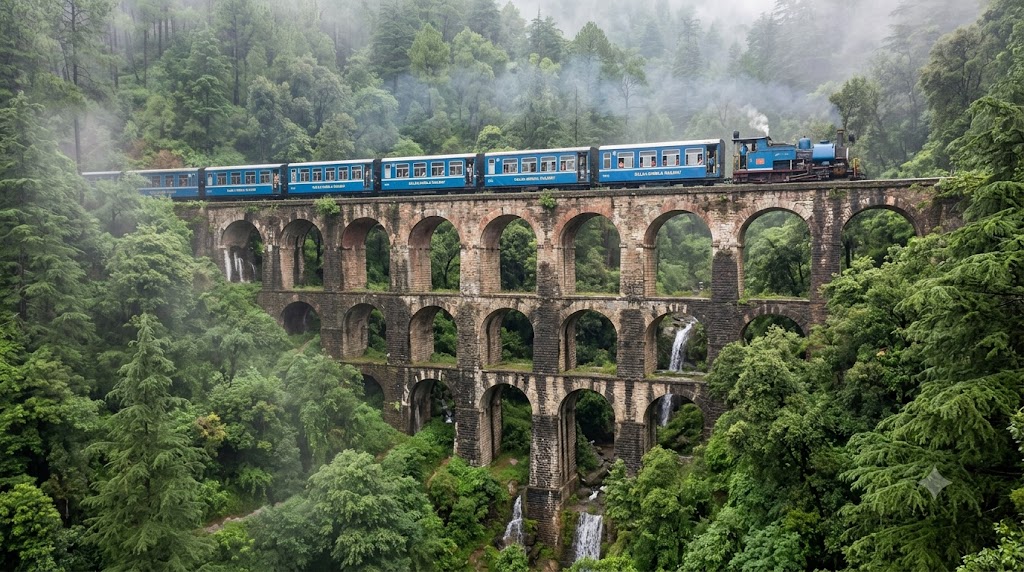
    Kalka–Shimla toy train crossing a stone arch bridge in monsoon greenery — weekend trip from Chandigarh
    The heritage Kalka–Shimla toy train — a UNESCO World Heritage rail line — is the most charming way to turn a Shimla weekend into an experience. We book seats with every Shimla package on request.

    4–7 Hours: Save These for Long Weekends

    Rishikesh flips the script — instead of pine hills, you get the Ganga: white-water rafting (the stretch typically reopens after monsoon, roughly late September to June), riverside camps, the evening Ganga aarti at Triveni Ghat and cafés hanging over the water. Amritsar is the best non-hill weekend in North India: the Golden Temple at dawn, the Wagah border ceremony at dusk, and in between a food trail — kulchas, lassi, tandoori everything — that justifies the drive alone. McLeodganj–Dharamshala needs every hour of a 3-day weekend: monastery mornings, momos in Tibetan cafés, and the Triund ridge trek for the fit. Manali is the big prize — Solang Valley’s adventure sports, Old Manali’s café lanes, Hadimba’s cedar temple — but respect the distance: only attempt it on a genuine 3-day window, ideally with a driver so the family arrives fresh.

    Monsoon Special: Where July–September Actually Shines

    Monsoon gets unfair press in the hills. Yes, you should check conditions for high routes before leaving — but the lower belt is at its yearly best right now:

    • Best in rain: Barog, Nahan–Renuka Ji and Chail — lush, misty, and at their most photogenic; hotel rates also soften mid-monsoon.
    • Fine with care: Kasauli and Shimla — intermittent showers and fog are part of the charm; keep buffer time on the drive back.
    • Better post-monsoon: Manali, McLeodganj and river activities in Rishikesh — save these for the October long weekends when skies clear and rafting reopens.

    Pick by Traveller Type: Who Should Go Where

    The same weekend produces completely different memories depending on who is in the car. This is how we match destinations to groups across the counter:

    • Couples: Kasauli for slow café mornings and quiet trails, Barog in monsoon for the misty-cottage mood, or Chail when you want a romantic weekend that does not involve Mall Road crowds. For anniversaries, we add a private candlelight setup at the resort — just ask.
    • Families with kids: Shimla–Kufri wins — the toy train ride, Jakhoo’s monkeys (hold the caps and glasses), horse rides at Kufri and enough food options for fussy eaters. Morni Hills is the best “first mountain trip” for toddlers: short drive, boating, home by Sunday lunch.
    • Friends’ groups: Rishikesh for the camp-bonfire-rafting combo (post-monsoon), Kasol–Manikaran on a long weekend for riverside cafés and easy treks, or McLeodganj when the group wants the Triund sunrise photo.
    • Parents / elders: Amritsar — flat terrain, deep spiritual anchor at the Golden Temple, wheelchair support available, and food memories they will talk about for months. In the hills, Nahan–Renuka Ji offers scenery without steep walking.
    • Solo resets: Barog or Chail mid-week if you can swing it — the same hotels, half the noise, and the forest entirely to yourself.

    The Flywings Weekend Playbook: 9 Tips from Our Desk

    1. Leave at dawn, not after breakfast. A 6 AM Saturday start beats the NH5 rush and gifts you an extra half-day in the hills.
    2. Book the stay before the cab. On long weekends, good hill hotels sell out weeks before cabs do — lock the room first.
    3. Check the route the night before in monsoon — one call to us or a look at highway updates saves a landslide detour.
    4. Pick one base, not three. Two nights in one hotel beats three towns in two days — hills punish over-planning.
    5. Carry motion-sickness tablets for kids — the last hour into Chail, Kasauli or McLeodganj is all curves.
    6. Ride the toy train one way. Drive up to Shimla, send the car ahead, and do Shimla–Barog or Shimla–Kalka by the heritage rail — kids remember it for years.
    7. Eat where the drivers eat on the highway — the busiest dhaba is always the freshest one.
    8. Keep Sunday evening free. Plan to be back on the plains by 6 PM; night hill-driving after a tiring weekend is the one risk not worth taking.
    9. Book long-weekend dates 4+ weeks out — hill stays for Raksha Bandhan and Dussehra weekends genuinely sell out, and early bookings run meaningfully cheaper.

    Weekend Package vs DIY: The Honest Comparison

    A weekend trip looks too small to need an agency — until the driver cancels on Friday night or the “hill-view” room faces a wall. Here is where a package quietly earns its keep:

    DIY Flywings Weekend Package
    Cab & driver App cabs often refuse hill routes or cancel late Hill-experienced drivers we have used for years, confirmed in writing
    Hotel reality Photos vs reality gamble Properties our team has stayed in or inspected
    Peak-weekend availability “Sold out” everywhere by the time you decide Held inventory with partner hotels for long weekends
    Route problems You improvise One call to Mohali — we reroute or rebook the same day
    Cost clarity Tolls, parking, driver charges appear later One itemised quote, nothing surfacing later

    Frequently Asked Questions

    Which is the best hill station near Chandigarh for a 2-day trip?

    For pure relaxation, Kasauli; for the classic experience, Shimla; for monsoon greenery, Barog. If you want minimum driving, Morni Hills is barely 90 minutes out. Tell us your group type and we will match the destination — free consultation.

    What are the best places to visit near Chandigarh within 100 km?

    Morni Hills (~45 km), Kasauli (~60 km), Barog (~65 km) and Nahan (~90 km) all sit inside the 100 km ring — each works even as a Saturday-morning-to-Sunday-evening plan without a rushed minute.

    Is Shimla worth visiting in monsoon?

    Yes, with eyes open: the town is misty and beautiful, rates are softer, and crowds thinner. Keep buffer time for the drive, avoid the highest side-routes after heavy rain, and treat fog as part of the experience rather than a problem.

    Which long weekends are left in 2026?

    The big remaining windows are Raksha Bandhan (Aug 28–30), Gandhi Jayanti (Oct 2–4), the Dussehra stretch around Oct 17 (up to 5 days with a leave or two), and Christmas (Dec 25–27). Confirm against your office calendar, then book early — these dates sell out first.

    Can Manali be done in a weekend from Chandigarh?

    In two days, honestly, no — you would spend 12–14 hours of it on the road. On a 3-day long weekend with a driver, absolutely: leave Friday dawn, get two full mountain days, return Sunday. That is exactly how we package it.

    Which weekend getaway near Chandigarh is best for couples?

    Kasauli and Barog top our honeymoon-and-anniversary bookings — close enough that you are at the resort by lunch, quiet enough that the weekend actually feels like an escape. For something more private, ask us about the cottage-style stays around Chail and Mashobra; the good ones rarely appear on booking apps.

    When does it snow near Chandigarh, and where can we see it in a weekend?

    Snowfall in the nearby hills typically arrives between late December and February. Kufri and Narkanda (beyond Shimla) are the most reliable weekend snow points from Chandigarh; Kasauli gets occasional light snow that melts fast. For guaranteed deep snow in a short trip, the Christmas–New Year window towards Kufri is the classic plan — book that one earliest of all.

    Does Flywings arrange weekend trips with cab and hotel together?

    Yes — that is our most popular domestic product from Chandigarh: cab with a hill-experienced driver, handpicked stay, and a day-wise plan, quoted as one itemised price. Call +91 99143 10333 and your weekend is planned in one conversation.

    Your Next Weekend Is Already Waiting

    The best thing about living in Chandigarh is that a great trip never needs a month of planning — just the right shortlist and an early start. Browse our tour packages, or let us plan your weekend end to end:

    Written by Sukhjinder Kaur, Senior Travel Content Writer at Flywings Tour & Packages Pvt Ltd — planning flights and holidays from Mohali, Punjab since 2013. Distances, drive times and 2026 holiday dates verified as of July 2026; road conditions and holiday calendars can shift, so confirm current details when you enquire.

  • Kashmir Tour Package from Chandigarh 2026: Flights, Road Route, 5-Day Itinerary & Best Time

    Kashmir Tour Package from Chandigarh 2026: Flights, Road Route, 5-Day Itinerary & Best Time

    Looking for a Kashmir tour package from Chandigarh? You are closer to Paradise on Earth than almost anyone else in India. From the Tricity, Srinagar is a short flight or one scenic road trip away — no passport, no visa, no currency exchange, just the Himalayas. At our Mohali office, Kashmir is the most-requested domestic holiday every single year, from summer family trips to December honeymoons in the snow. In this guide, our team at Flywings Tour & Packages Pvt Ltd (planning Kashmir holidays from the Chandigarh Tricity since 2013) covers everything travellers ask us across the counter: how to reach Srinagar from Chandigarh, the proven 5-day Srinagar–Gulmarg–Pahalgam itinerary, the best months season by season, honest safety guidance, and the practical tips that make a Kashmir trip smooth.

    Key Takeaways

    • No documents drama: Kashmir is a domestic destination — no visa, no passport; any government photo ID works for hotels and flights.
    • Getting there: Chandigarh to Srinagar is roughly 1.5 hours by air, or a ~600 km road journey via Jammu — and there is now also a rail option to Srinagar via Katra on the new Himalayan line.
    • Ideal duration: 4 Nights / 5 Days comfortably covers Srinagar, Gulmarg and Pahalgam — add a night for Sonmarg or Doodhpathri.
    • Best time: Kashmir works all four seasons — spring tulips (April), summer meadows (May–August), autumn chinar gold (September–October), and snow season (December–February).
    • Signature stays: at least one night on a Dal Lake houseboat is non-negotiable — it is the experience guests remember most.
    • Book early for peak windows: April tulip weeks, summer school holidays and Christmas–New Year sell out first; booking 4+ weeks ahead is typically 20–25% cheaper than last-minute.

    Why Kashmir Is the Tricity’s Favourite Mountain Escape

    Ask around Chandigarh, Mohali or Panchkula about the one Indian holiday everyone either has taken or wants to take, and Kashmir wins comfortably. Here is why it works so well from this side of the country:

    • It is genuinely close: Srinagar is one of the shortest mountain flights from Chandigarh, and the road route via Jammu is a classic North Indian road trip.
    • Nothing else looks like it: Dal Lake houseboats, floating vegetable markets, Mughal gardens, saffron fields and alpine meadows — no other Indian destination packs this variety into a 5-day trip.
    • Every season is a different destination: the same Gulmarg is a flower meadow in July and a ski slope in January. Repeat trips never feel repeated.
    • Perfect for every group: honeymooners get shikara sunsets, families get pony rides and gondolas, elders get gardens and houseboat calm — all in one itinerary.
    • No visa paperwork: unlike our Dubai packages, there is zero documentation lead time — Kashmir can be planned in a week.

    Chandigarh to Kashmir: Flight, Road or the New Train

    The first decision in any Kashmir plan is how you reach Srinagar. All three options below are ones we book every week — each suits a different kind of traveller:

    Option Time & Route Best For
    Flight (IXC/DEL → SXR) Approx. 1.5 hours in the air; non-stop Chandigarh–Srinagar flights operate seasonally, with year-round connections via Delhi Families with kids or elders, short trips, winter travel
    Road via Jammu (NH44) ~600 km; most travellers split it with a halt at Jammu or Patnitop, crossing the Banihal tunnel into the Valley Road-trip lovers, groups with their own vehicle, flexible schedules
    Train via Katra Reach Katra from Chandigarh, then the new Himalayan rail line — over the world’s highest railway arch bridge on the Chenab — runs to Srinagar Scenery seekers; seats on the new line sell out fast, so book well ahead

    Our honest advice from more than a decade of bookings: fly at least one way. The mountain highway is beautiful but weather-dependent — in winter and during heavy rain it can close for hours. Flying into Srinagar and driving out via Jammu (or vice versa) gives you the scenery without betting the whole trip on one road. Flight fares on this route swing sharply with season — as with all our routes, booking around 4 weeks or more in advance is typically 20–25% cheaper than last-week fares. Ask our desk for today’s lowest fare.

    Kashmir Tour Packages from Chandigarh: How It Works (2026)

    Every Flywings Kashmir package includes transport (flights or private cab as chosen), hotels and a houseboat night, all transfers within the Valley, sightseeing with a local driver who knows the roads, and 24/7 support from our Mohali office. Every trip is quoted individually for your dates and group size, so you always get the current best price:

    Package Duration Covers Best For
    Kashmir Family 4 Nights / 5 Days Srinagar + houseboat, Gulmarg, Pahalgam Families, first-timers
    Kashmir Honeymoon (custom) 5 Nights / 6 Days Above + Sonmarg day trip, candlelight houseboat dinner Couples, anniversaries
    Kashmir Winter (custom) 4–6 Nights Srinagar + extended Gulmarg stay for snow & skiing Snow lovers, ski learners

    What decides your Kashmir package cost?

    Two quotes for “the same” Kashmir trip can differ a lot. These are the five things that actually move the number — check them before comparing:

    Cost Head What Moves It
    Transport (flight vs road) Flight fares by season and booking window; cab category (sedan vs Innova vs Tempo) for road trips
    Houseboat category Standard vs Deluxe vs Super Deluxe — carving, lake position and dining differ hugely
    Hotel nights in Gulmarg/Pahalgam Staying overnight in Gulmarg costs more than day-tripping from Srinagar — but sunrise on the meadow is worth it
    Season April tulip weeks, May–June holidays and Christmas–New Year run highest; March and November are value months
    Local experiences Gondola tickets (Phase 1 vs Phase 2), shikara hours, pony rides, Sonmarg add-on — check what is genuinely included

    If a quote looks suspiciously cheap, something above has been quietly dropped — usually the houseboat becomes a budget hotel, or “Gulmarg” means a drive-past without the gondola. Our quotes are itemised line by line. Get your itemised Kashmir quote within 24 hours.

    Best Time to Visit Kashmir from Chandigarh

    There is no wrong season in Kashmir — only different Kashmirs. Match the month to what you want to see:

    Months What You Get Verdict for Chandigarh Travellers
    March – April Spring blossoms; Asia’s largest tulip garden opens for a few weeks near Dal Lake Most photogenic window. Tulip weeks are short and busy — lock dates early.
    May – August 20–30°C valley weather while Chandigarh crosses 40°C; green meadows, gushing rivers The classic escape. Peak family season; book gondola slots in advance.
    September – October Autumn — chinar trees turn gold and crimson, saffron harvest at Pampore begins Underrated and quieter; photographers’ favourite; pleasant days, crisp evenings.
    December – February Snow everywhere; Gulmarg becomes India’s premier ski resort Magical but cold (often below 0°C at night). Fly rather than drive; pack serious woollens.
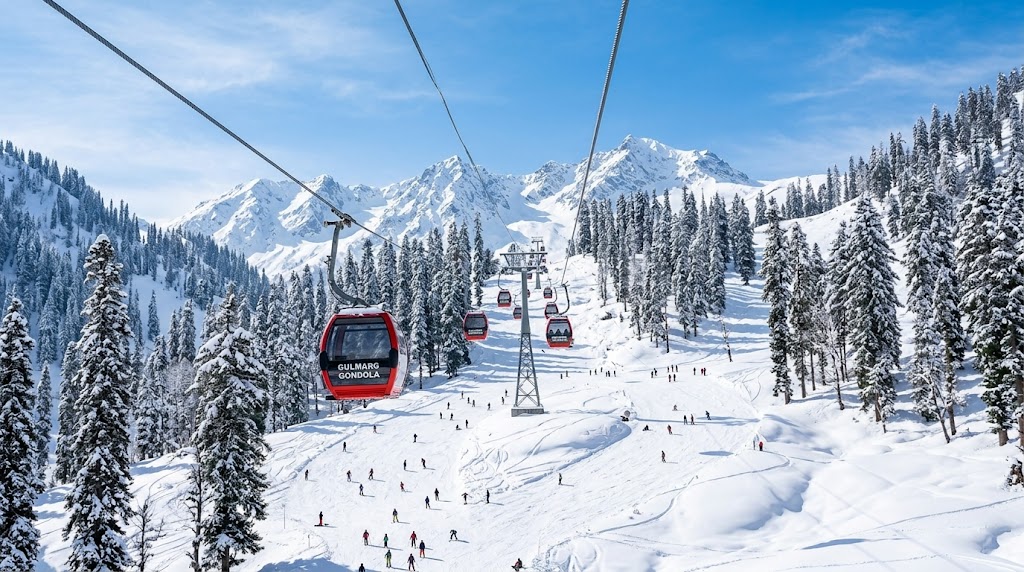
    Gulmarg Gondola cable car over snow meadows — included in Kashmir package from Chandigarh
    The Gulmarg Gondola — one of the world’s highest cable cars — climbs towards Apharwat’s slopes at nearly 4,000 metres. Tickets are included in every Flywings Kashmir package.

    Our Proven 5-Day Kashmir Itinerary from Chandigarh

    This is the day-wise plan from our best-selling Kashmir Family 4N/5D package, refined over hundreds of departures:

    1. Day 1 — Arrival & Houseboat Evening: Land in Srinagar (or arrive by road), check in to a traditional carved houseboat on Dal Lake. Sunset shikara ride past floating gardens and the old lake neighbourhoods, kahwa on the deck, dinner on board — the perfect first evening.
    2. Day 2 — Srinagar & the Mughal Gardens: Morning at Nishat and Shalimar gardens with the Zabarwan hills behind them, Chashme Shahi’s spring water, and Hazratbal’s lakefront views. Afternoon in the old city for pashmina, papier-mâché and walnut-wood shopping (your driver knows the fair-price stores). Move to a Srinagar hotel or keep the houseboat.
    3. Day 3 — Gulmarg: Drive about 1.5–2 hours to the “Meadow of Flowers”. Ride the famous Gulmarg Gondola — Phase 1 to Kongdoori, and weather permitting Phase 2 towards Apharwat at nearly 4,000 m. Summer brings flower meadows and pony trails; winter brings snow play and ski lessons. Evening back in Srinagar or overnight in Gulmarg.
    4. Day 4 — Pahalgam: Drive to the Lidder Valley (about 2.5–3 hours) past the saffron fields of Pampore. In Pahalgam, take the pony or local cab circuit to Betaab Valley and Aru Valley — pine forests, river bends and meadows that have starred in half of Bollywood. Overnight in Pahalgam or return to Srinagar.
    5. Day 5 — Departure (or extend): Fly out of Srinagar, or add a night for Sonmarg’s glacier valley (summer) or offbeat Doodhpathri’s silent meadows before heading home to Chandigarh.

    Is Kashmir Safe for Tourists Right Now?

    This is the question families ask us most, and it deserves a straight answer rather than a slogan. Millions of Indian tourists visit Kashmir every year, and the main tourist circuit — Srinagar, Gulmarg, Pahalgam, Sonmarg — is heavily secured, with tourism the Valley’s economic lifeline and locals famously hospitable to visitors. At the same time, conditions in any Himalayan border region can change, which is why we never run Kashmir bookings on autopilot: our team tracks ground reports and advisories daily, works with local drivers and hoteliers we have known for years, stays reachable 24/7 during your trip, and reroutes or reschedules immediately on the rare occasion something needs adjusting. Our practical advice: book with an agency that has real, current local contacts, keep your itinerary on the established circuit, and follow your driver’s guidance on timings — that formula has kept our guests’ trips smooth for more than a decade.

    9 Practical Tips from Our Kashmir Desk

    1. Fly one way minimum. Keep the road for the scenery, but do not bet both legs of the trip on one highway’s weather.
    2. Insist on the houseboat night. Guests who “save” by skipping it regret it every single time — it is Kashmir’s signature.
    3. Book the gondola in your package. Phase 2 tickets are limited and sell out in season; on-the-spot queues waste half a Gulmarg day.
    4. Carry cash for small purchases. Cards and UPI work in Srinagar city, but connectivity in Gulmarg/Pahalgam markets can be patchy.
    5. Layer, whatever the month. Even August evenings on Dal Lake need a light jacket; winter needs proper thermals, not just a heavy coat.
    6. Buy saffron and dry fruits at Pampore or government-verified stores — your driver will steer you past the tourist-trap shops.
    7. Keep buffer time on travel days. Mountain weather delays flights and closes passes; never plan a same-day onward connection that cannot flex.
    8. Travel with any photo ID for every member — hotels and houseboats register all guests, including children.
    9. Book peak windows 60+ days out. Tulip season and Christmas–New Year houseboats and Gulmarg hotels genuinely sell out.

    Booking a Package vs Planning Kashmir Yourself

    Kashmir looks simple to DIY until you are negotiating shikara rates at 6 PM or discover your “lake-view” hotel is a 40-minute drive from Dal Lake. The honest comparison:

    DIY (apps + portals) Flywings Package from Chandigarh
    Transport You juggle flight fares, or hire an unknown cab at Jammu Fares tracked daily; known drivers on Valley roads for years
    Houseboat quality Photos online rarely match the boat Boats we have personally inspected and re-book every season
    Local logistics Union cab rules in Gulmarg/Pahalgam surprise outsiders Handled — local circuits pre-arranged at fixed rates
    Weather disruptions You rebook everything yourself One call to Mohali; we re-route the same day
    When something goes wrong App chatbots A human who knows your itinerary, in Punjabi/Hindi/English, 24/7

    Frequently Asked Questions

    How much does a Kashmir trip from Chandigarh cost?

    It depends on your month, transport choice (flight vs road), houseboat category and hotel nights in Gulmarg or Pahalgam — a January ski trip and a July family trip price very differently. We prepare an itemised quote for your exact dates and group within 24 hours. Call +91 99143 10333 or send an enquiry — free, no obligation.

    Is there a direct flight from Chandigarh to Srinagar?

    Non-stop Chandigarh–Srinagar flights operate on a seasonal schedule, and one-stop connections via Delhi run year-round with multiple daily options. Our ticketing desk checks live schedules for your dates and books the fastest routing at the lowest current fare.

    What is the road distance from Chandigarh to Kashmir?

    Roughly 600 km to Srinagar via Jammu on NH44, crossing the Banihal tunnel into the Valley. Most travellers split the drive with an overnight halt at Jammu, Katra or Patnitop and reach Srinagar fresh the next afternoon.

    How many days are enough for Kashmir?

    4 nights / 5 days covers the classic trio — Srinagar with a houseboat night, Gulmarg and Pahalgam. Add a fifth night for Sonmarg (summer) or a slower two-night Pahalgam stay. Less than 4 nights means cutting one of the three, which we do not recommend on a first trip.

    When does it snow in Gulmarg?

    Reliable snow typically arrives by late December and holds through February, which is also when Gulmarg’s ski season peaks. For guaranteed deep-winter snow with functioning gondola access, January is the safest bet — and book flights, since the highway is least reliable then.

    Do I need a permit or passport for Kashmir?

    No. Jammu & Kashmir is a domestic destination — any government photo ID (Aadhaar, driving licence, voter card) is all you need for flights, hotels and houseboats, for every member of the family.

    Ready to See Paradise on Earth?

    Every season we send families, couples and groups from Chandigarh, Mohali, Panchkula and across Punjab to the Valley — flights or cabs, houseboat and hotels, gondola tickets and local circuits wrapped into one transparent quote and one point of contact. Browse the Kashmir Family 4N/5D package, explore the Kashmir destination guide, see all India tour packages from Chandigarh, or get a customised quote within 24 hours:

    Written by Sukhjinder Kaur, Senior Travel Content Writer at Flywings Tour & Packages Pvt Ltd — planning flights and holidays from Mohali, Punjab since 2013. Routes, schedules and seasonal details verified as of July 2026; mountain schedules change with weather and season, so confirm current options when you enquire.